


The best home gym isn't some all-in-one machine you see on an infomercial. It's a smart collection of tools you've hand-picked to match your specific fitness goals, your available space, and your budget. For most of us, that starts with a foundation of versatile gear—think resistance bands for strength, a heavy jump rope for cardio, and a battle rope for intense conditioning. This way, you're buying equipment you’ll actually look forward to using.
Building Your Perfect Home Gym Starts Here
Let's be honest, staring at the endless scroll of home workout equipment online can be overwhelming. It's tempting to hunt for that one magic bullet machine that promises a complete transformation. But the best home gyms aren't built on impulse; they're built with a clear purpose.
You don't need a garage packed with chrome and steel to see incredible results. The secret is knowing that just a few, well-chosen pieces of gear can open the door to hundreds of different exercises. This guide will help you sidestep the confusion and lay out a clear path to building a gym that works for you. We’ll focus on how versatile, space-saving tools can deliver a full-body burn that’s just as good—if not better—than what you’d get at a commercial gym.
Rethinking the Modern Home Gym
The way we think about fitness is changing. More people than ever are discovering the freedom and consistency that come with working out at home. This isn't just a passing fad; it's a real shift in how we prioritize our health.
The global home gym equipment market is booming. It was valued at around USD 12.4 billion in 2025 and is expected to climb to an incredible USD 19.6 billion by 2035. What's driving this? A massive change in behavior, with 70% of fitness adopters now saying they prefer working out at home because of the flexibility it offers.
This explosion in popularity means we have more innovative and higher-quality options than ever before. Companies are now designing effective equipment that fits into real-world living spaces. You can now create a serious training zone in the corner of your apartment. To see what these modern solutions look like, check out the versatile equipment from MONFIT.
Your Path to a Smarter Setup
Think of building your home gym as a journey. It starts by getting a handle on a few key ideas that will help you make smart decisions every step of the way. In this guide, we're going to walk through:
- Goal-Oriented Selection: How to pick gear that directly supports what you want to achieve, whether that’s building muscle, shredding fat with HIIT, or just moving and feeling better.
- Space and Budget Planning: We’ll map out realistic setups for small apartments, spare rooms, and full-on garage gyms, with smart buys for any budget.
- Progressive Investment: You don't have to buy everything at once. We’ll show you how to start with the essentials and thoughtfully expand your gym as you get stronger and more committed.
With this approach, you'll build a home gym that feels like your own personal fitness sanctuary—a space you'll be excited to use day in and day out.
Matching Your Equipment to Your Fitness Goals
Trying to choose home gym equipment without a clear goal in mind is a lot like grocery shopping without a recipe—you'll end up with a cart full of random stuff, a cluttered kitchen, and no real plan for dinner. The best home gyms are built with a clear purpose. Every piece of gear should have a job, one that's tied directly to what you want to achieve. This approach makes sure you invest in tools you'll actually use, turning your space into a real engine for results.
So, before you buy a single thing, you need to get crystal clear on your main fitness ambition. Most goals fall into one of three big buckets, and each one demands a different set of tools and a different style of training. Once you understand the "why" behind your workouts, you can pick the gear that makes the most sense for your journey.
This visual guide breaks down how your goals, space, and budget all work together as the three pillars of a solid home gym plan.
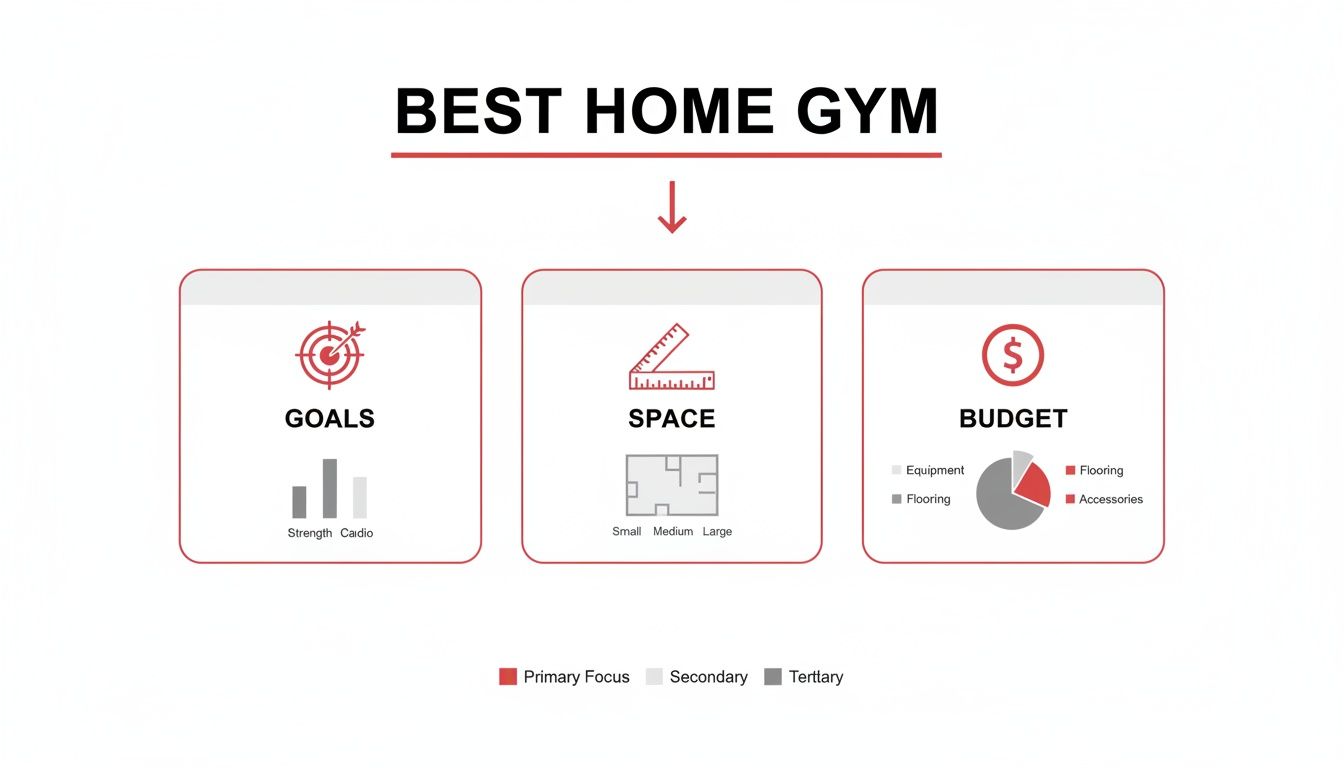
As you can see, your fitness goals are the starting point. They dictate everything else, from the equipment you need to how it fits within the space and budget you have to work with.
To make this even clearer, let's break down which equipment works best for each primary goal. This table gives you a quick snapshot of how to align your purchases with your ambitions.
Home Gym Equipment by Primary Fitness Goal
| Fitness Goal | Core Principle | Essential Equipment | MONFIT Solution |
|---|---|---|---|
| Strength & Muscle | Progressive Overload: Constantly increasing the challenge on your muscles. | Resistance Bands, Dumbbells/Kettlebells, Pull-up Bar | Resistance Band Kit: Perfect for adding tension to bodyweight moves and achieving progressive overload at home. |
| Cardio & HIIT | Metabolic Conditioning: Pushing your heart rate up for sustained periods. | Jump Ropes, Battle Ropes, Kettlebells | Battle Ropes & Heavy Jump Ropes: Unbeatable for high-intensity, full-body conditioning that builds power. |
| Mobility & Recovery | Flexibility & Tissue Health: Preparing the body for work and aiding recovery. | Foam Roller, Light Resistance Bands, Lacrosse Ball | Light Loop Bands: Ideal for pre-workout activation exercises and post-workout stretching routines. |
Each piece of equipment in that table is chosen for a reason. It's not just about filling a room; it's about getting the right tools for the job you want to do. Let's dig a little deeper into each category.
For Building Strength and Muscle
The non-negotiable rule for building muscle is progressive overload. It’s a simple concept: you have to consistently make your muscles work harder than they’re used to. That’s what forces them to adapt, repair, and grow back stronger. At a commercial gym, that usually means slapping another plate on the barbell.
You can absolutely create that same muscle-building stimulus at home. While a competitive powerlifter might need a full squat rack, most of us can get incredibly strong with more versatile gear. This is where a high-quality set of resistance bands becomes a non-negotiable part of your toolkit.
"To build muscle with home workouts, focus on increasing your repetitions, going close to failure... performing more difficult variations... and increasing your time under tension (by going slower)."
MONFIT resistance band kits are built for exactly this. They come with a variety of tensions, so you can gradually increase the difficulty on foundational exercises like squats, presses, and rows. Unlike dumbbells, bands provide what’s called variable resistance—the tension actually increases as you move through the exercise, which fires up more stabilizer muscles and gives you a unique stimulus for growth.
For Cardio and Conditioning
If your main goal is to get your heart in top shape, burn a ton of calories, or just be a more explosive athlete, your focus shifts. You’re moving away from slow, heavy lifts and into the world of high-intensity work. You need equipment that will get your heart rate jacked and test your will to keep going. Thankfully, bulky treadmills are no longer your only option.
Functional conditioning tools deliver a far more engaging—and effective—full-body workout. They teach your body to work as one cohesive unit, building practical fitness that actually shows up in your daily life.
Here are a couple of my favorites:
- Battle Ropes: A MONFIT battle rope is one of the most brutal and effective conditioning tools out there. It’s a low-impact, high-output workout that slams your core, upper body, and legs all at once. You'll build serious explosive power and metabolic endurance.
- Heavy Jump Ropes: Forget the flimsy speed ropes from gym class. MONFIT's heavy jump ropes are a different animal entirely—they’re a hybrid strength and cardio tool. The extra weight forces your shoulders, back, and grip to work overtime, turning a simple cardio drill into a legit full-body burner. Find out how a weighted jump rope can transform your workouts and see why it's a staple for so many home gym builders.
These tools are perfect for High-Intensity Interval Training (HIIT), a proven method for getting more done in less time.
For Mobility and Recovery
True fitness isn’t just about how hard you can push. It’s also about preparing your body to perform and helping it bounce back afterward. This is where mobility and recovery work comes in. It’s the "un-sexy" stuff that keeps you injury-free, improves your range of motion, and makes sure you can keep training consistently for the long haul.
This part of fitness gets overlooked all the time, but it’s the secret glue that holds everything else together. The right tools help you release tight muscles, improve your flexibility, and get blood flowing to sore areas to speed up the healing process.
Your mobility toolkit should include:
- Foam Rollers: A must-have for deep-tissue self-massage.
- Lacrosse Balls: Perfect for digging into smaller, stubborn knots and trigger points.
- Light Resistance Bands: MONFIT's loop bands are fantastic for pre-workout activation drills and targeted stretching routines. They’re great for waking up sleepy muscles like your glutes and rotator cuffs, which helps prevent injury and improves how you move.
When you thoughtfully match your equipment to your primary goal—strength, conditioning, or recovery—you create a system where everything works together. Each piece has a purpose, ensuring your investment of time, money, and energy pays off with the best possible results.
Choosing Gear for Your Space and Budget
Let’s be honest. The two things that stop most people from building a home gym are feeling like they don't have enough space or a big enough budget. It’s so easy to scroll through Instagram, see those massive garage setups, and think it’s an all-or-nothing game.
But that’s just not true. The best home gym equipment is scalable. It should fit into the life, the space, and the budget you have right now.
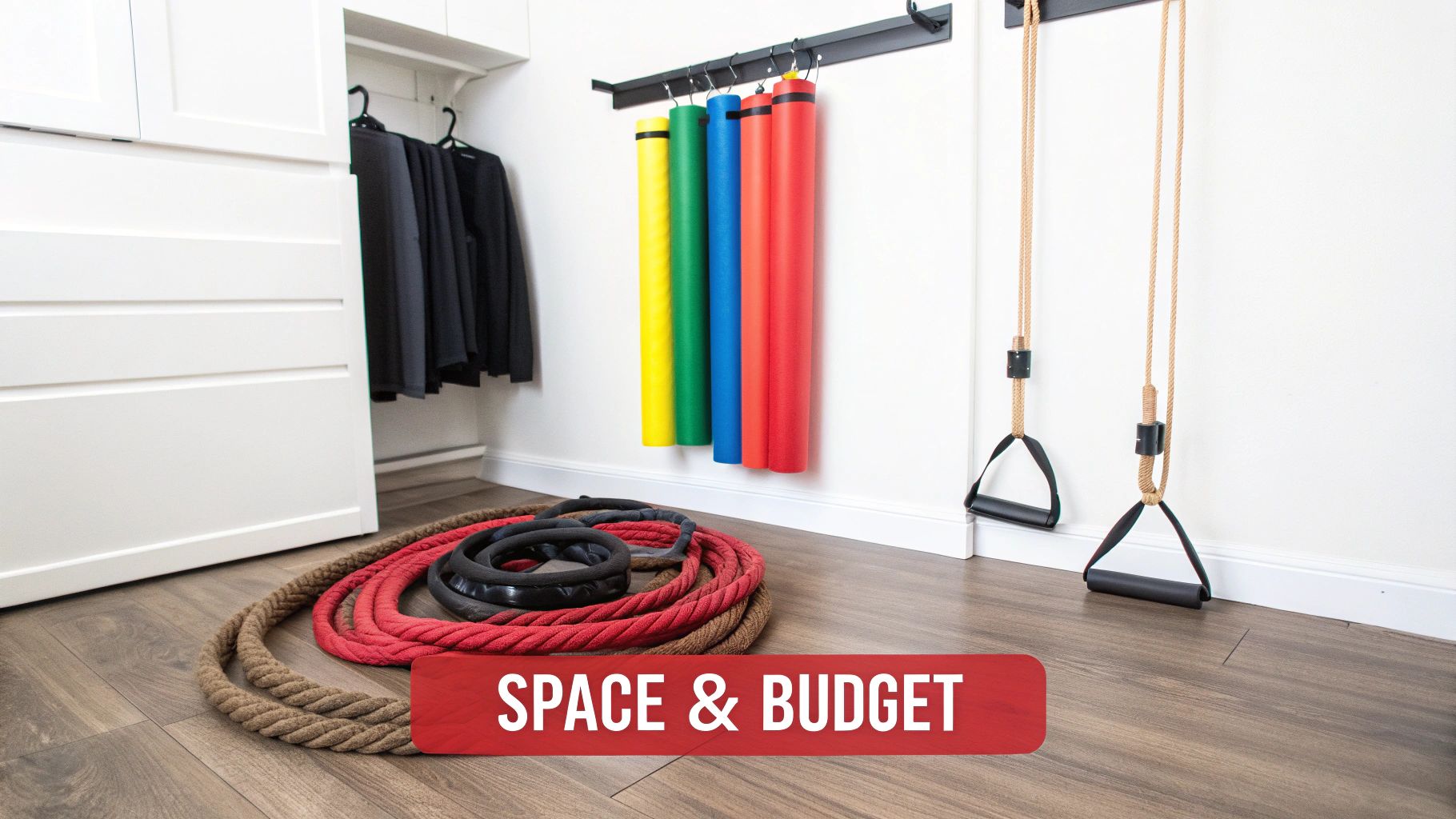
Forget needing a dedicated room. Your fitness journey can absolutely start in a corner of your living room. From there, maybe it grows into a spare bedroom, and one day, it might just take over the whole garage. The trick is to make smart, strategic choices that get the most out of every square foot and every dollar.
This idea of starting small and smart lines up perfectly with the huge shift toward working out at home. The demand for home fitness gear is climbing fast—the market was valued at USD 19.98 billion in 2025 and is expected to hit USD 31.01 billion by 2029. This boom is all about convenience and the rise of workouts like HIIT, which has seen a 40% jump in popularity for home users since 2020. You can get more details on these home fitness market trends at Research and Markets.
The Compact Corner Setup
Living in an apartment or a small house doesn't mean you can't have an awesome workout space. It just means you need to be clever about it, prioritizing equipment that does a lot and stores away easily. Think of this as your "under the bed" or "in the closet" gym. The goal here is maximum impact, minimal footprint.
In this scenario, bulky machines are out. Versatile, portable tools are your best friends.
-
Minimalist Budget (Under $100): This is where you get the absolute most bang for your buck. A high-quality set of MONFIT Resistance Loop Bands should be your first buy. They open the door to hundreds of exercises, adding resistance to everything from squats and lunges to overhead presses and rows. Pair them with a single heavy kettlebell, and you've got a fantastic foundation for strength and endurance. You can check out a great selection of resistance loop bands right here.
-
Balanced Budget ($100 - $300): With a bit more to spend, you can really round out your routine. Add a MONFIT Heavy Jump Rope into the mix. This is a serious cardio and conditioning tool that takes up virtually no space. We’re not talking about your old playground rope; the extra weight fires up your shoulders, core, and grip, turning a simple exercise into a full-body blast.
The Dedicated Room Setup
If you’ve got a spare bedroom or a corner of the basement you can claim, your options really start to open up. You now have the luxury of leaving some equipment out, which is a surprisingly powerful motivator for staying consistent. You can finally create a permanent, inviting space to train.
Here, the focus shifts from pure portability to building a more complete training system. You have room for one or two larger pieces that can anchor your workouts, while still relying on versatile tools for most of your programming.
Your home gym should be a place you want to be. By choosing equipment that aligns with the workouts you enjoy, you're not just buying gear; you're building a habit. The best setup is the one that removes friction and makes it easy to show up every day.
This means you can start to dial in your equipment choices based on your specific goals.
-
Minimalist Budget (Under $200): Take the foundation from the compact setup (bands and a jump rope) and add a doorway pull-up bar. This is a game-changer for building back and bicep strength—one of the toughest things to train effectively at home without the right equipment.
-
Balanced Budget ($200 - $500): This is the sweet spot for creating a truly powerful conditioning space. It's time to bring in the MONFIT Battle Rope. Nothing quite matches the metabolic workout a battle rope delivers. It’s low-impact but incredibly high-intensity, building explosive power and serious endurance. With a battle rope, a jump rope, and bands, you have a complete system for both strength and HIIT.
-
All-In Budget ($500+): With a bigger budget, you can add a set of adjustable dumbbells. This gives you the best of both worlds: the raw, athletic power of battle ropes for conditioning and the precise, progressive overload of dumbbells for classic strength training.
The Garage Gym Powerhouse
For many fitness lovers, the garage gym is the ultimate dream. It gives you high ceilings, a durable floor, and enough room for heavy lifting and dynamic movement. This is where you can truly replicate—and in many ways, surpass—the commercial gym experience.
You have the freedom to build a setup that’s geared for serious strength, Olympic lifting, or intense functional fitness circuits.
-
Minimalist Budget (Under $500): Every great garage gym starts with the essentials. That means a quality barbell, a starter set of bumper plates, and a pair of sturdy squat stands. This is your foundation for the big three: squats, deadlifts, and presses.
-
Balanced Budget ($500 - $1500): Now, build on that foundation. Add a flat utility bench and a full set of MONFIT Pull-Up Resistance Bands. The bench unlocks dozens of new pressing and pulling exercises, while the bands are crucial for everything from assisted pull-ups to mobility work and adding variable resistance to your barbell lifts.
-
All-In Budget ($1500+): At this level, you can finish your powerhouse. Upgrade those squat stands to a full power rack for better safety and more exercise options. Add a set of kettlebells for dynamic work and bring in a MONFIT Battle Rope to anchor against the rack for some brutal workout finishers. This is a gym with no limitations.
Building Your Gym With a Phased Approach
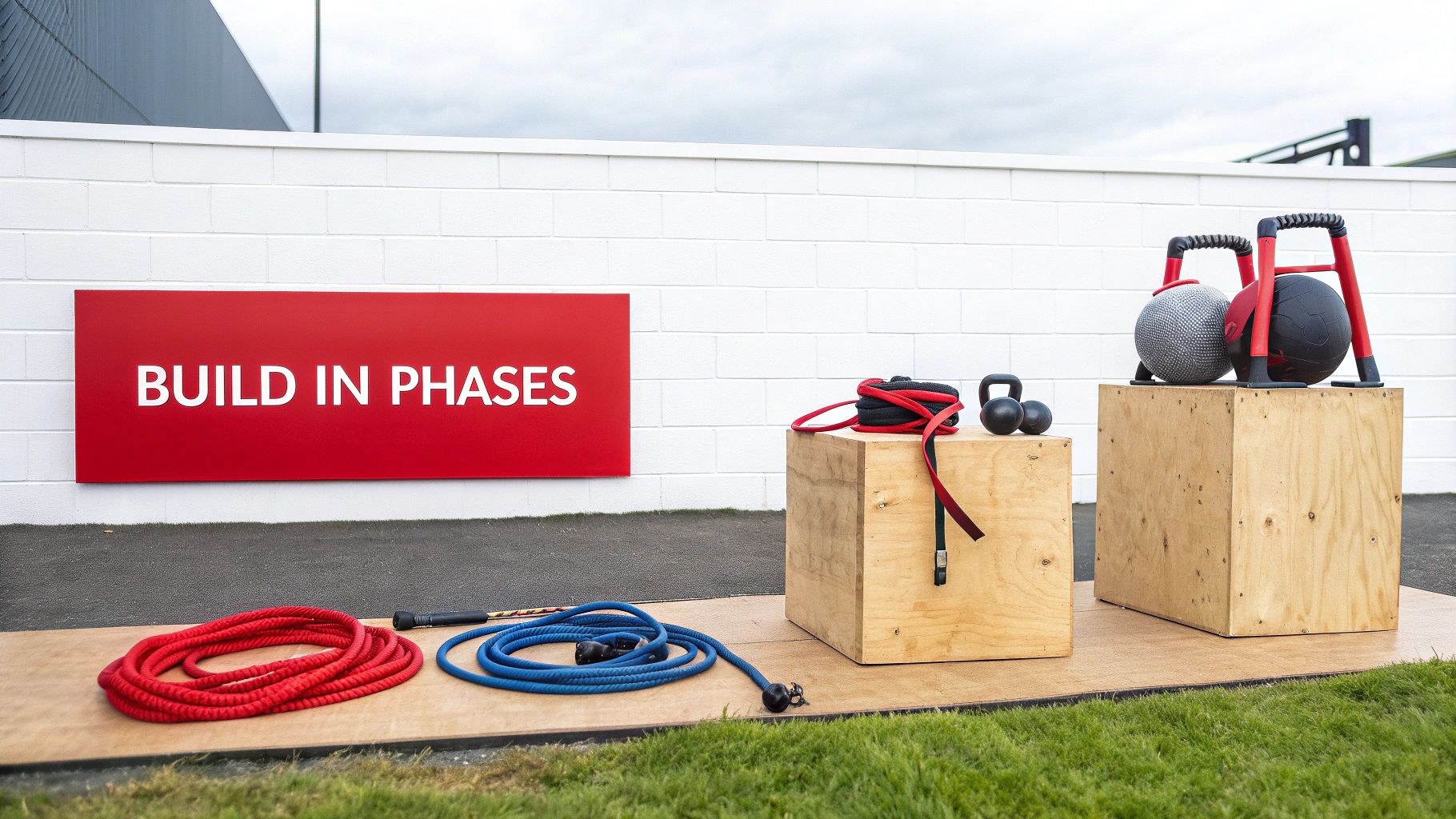
The biggest mistake I see people make when starting a home gym is thinking they need everything right away. This "all-or-nothing" mindset is the fastest way to get overwhelmed, blow your budget, and end up with a room full of expensive gear that just gathers dust. The best home gyms are built with a smart plan, not a single, massive shopping spree.
A much better way to go about it is to build your gym progressively. Think of it like leveling up in a game. You don't start by fighting the final boss; you begin with the basics, master them, and gradually unlock more advanced tools as you get stronger and more committed.
This phased approach keeps the whole process feeling manageable and financially sane. It also guarantees every piece of equipment you buy has a clear purpose and earns its spot in your workout space. Let's walk through this journey in three simple, achievable phases.
Phase 1: The Foundation
This is ground zero. Your goal here is simple: build a consistent workout habit with a few versatile, low-cost essentials. You’re not dropping thousands of dollars; you’re investing in consistency with tools that deliver the most bang for your buck.
Your foundational gear should cover the basics—strength, cardio, and mobility—without hogging a ton of space. This is where MONFIT’s equipment really shines, creating the perfect starting block for any fitness journey.
- Core Strength Tool: A complete set of MONFIT Resistance Bands is a must-have. They are the ultimate foundational tool for strength training, letting you add resistance to everything from squats and lunges to presses and rows. You can learn more about how to use pull-up resistance bands to scale your workouts from day one.
- Cardio Engine: Grab a MONFIT Heavy Jump Rope. This is your go-to for conditioning. It torches calories and builds coordination, grip strength, and shoulder stability way more effectively than a standard speed rope ever could.
With just these two pieces, you have a full, effective gym that you can literally store in a drawer. This is your proving ground.
Phase 2: The Specialization
So, you've made working out a regular thing. You've been training consistently for a few months and the habit has stuck. Awesome. Now it’s time for Phase 2. You can reward yourself by adding equipment that dials in on the type of training you actually enjoy. This phase is all about specializing.
You're no longer just "working out"—you're chasing a specific goal or passion. Maybe you've discovered a love for high-intensity metabolic conditioning, or perhaps you're more drawn to building pure, raw strength.
This is where you double down on what you love. If you genuinely enjoy your workouts, you're 90% more likely to stick with them long-term. Your gear should reflect the activity that actually gets you excited to train.
For instance, if HIIT is your thing, now is the perfect time to bring in a MONFIT Battle Rope. It delivers a unique, low-impact but high-intensity workout that builds explosive power and endurance like nothing else. It’s a specialized piece that takes your conditioning to a completely different level.
Phase 3: The Upgrade
You've reached Phase 3 when fitness is no longer just a habit—it's a core part of your lifestyle. You’ve been at it consistently for six months, a year, maybe more. By now, you know exactly what you need because you’ve bumped up against the limitations of your current setup. Now, you can confidently make those bigger investments.
This is the time to look at the big-ticket items that will complete your dream gym.
- For the Strength Athlete: This is when you upgrade to a squat rack, barbell, and a solid set of bumper plates.
- For the Conditioning Fanatic: You might add an air bike or a rower to complement your battle ropes and heavy jump rope.
By waiting until this phase, you take all the guesswork out of it. You’re not buying a power rack because you think you should; you’re buying it because you’ve maxed out what your bands can do and you need that next step to keep progressing. This intentional, phased approach is the real secret to building the best home gym—one that grows right alongside you.
Look After Your Gear, and It'll Look After You
You’ve made a smart choice by investing in your health with a home gym. Just like a car or any other valuable tool, your fitness equipment needs a little TLC to keep it performing at its best for the long haul. A simple maintenance routine is the easiest way to protect that investment.
Think of it as a quick pre-workout ritual. Spending just a few minutes each week giving your gear a once-over will not only extend its life but also keep your workouts safe and effective. It's the small habit that stops tiny issues from turning into big, expensive problems.
From your resistance bands to your battle rope, a consistent check-up keeps your tools in prime condition.
A Quick and Easy Inspection Checklist
You don't need a toolbox or a mechanic's license for this. A simple visual and physical check is usually all it takes to catch wear and tear before it becomes a real issue.
Here’s what to look for:
- Resistance Bands: Before you start a workout, give your MONFIT bands a gentle stretch. Look them over for any tiny nicks, tears, or weird discolorations. Pay extra attention to where the band connects to handles or anchors, as that's a high-stress spot.
- Battle Ropes: After a killer session, your MONFIT battle rope might have picked up some dust or debris. Just wipe it down with a damp cloth. This prevents grime from getting deep into the fibers and breaking them down over time.
- Heavy Jump Ropes: Make sure the handles are still tightly attached to the rope. Glance down the length of the rope itself to check for any deep cuts or frays that could cause it to snap during a fast-paced workout.
Why a Good Warranty Is Your Best Friend
Regular maintenance is your first line of defense, but a solid warranty is your ultimate safety net. In a crowded fitness market, what really separates good gear from great gear is durability and a brand you can trust. There's a reason conventional, non-subscription equipment holds a massive 68.18% of the market—it’s built to be dependable.
For the 80% of people who say consistency is their biggest hurdle, knowing their equipment won't let them down is a huge deal. You can discover more insights about home fitness market trends to see why this is so important.
This is where you see a brand’s true colors. A straightforward, fair warranty proves a company believes in its own products.
A great warranty isn't just about getting a replacement if something breaks. It's a statement of quality. It’s the company saying, "We built this to last," giving you the peace of mind to go all-out in your training without worrying about your gear failing.
We get it. MONFIT offers clear, no-nonsense policies to protect your purchase because we want to be a reliable partner in your fitness journey. We encourage you to read more about the MONFIT warranty program and see how we stand behind our equipment, giving you the confidence to invest in yourself.
Your Blueprint for a Powerful Home Workout Space
We've covered a lot of ground, and hopefully, you're feeling ready to take the next step. Building a great home gym isn't about buying the most expensive gear or trying to replicate a commercial gym in your spare room. It's about being strategic and choosing tools that fit you—your goals, your space, and your budget.
The best home gym is, quite simply, the one you'll actually use.
The whole idea is to start with a solid foundation and build from there, piece by piece. This way, everything you buy has a purpose, whether it's for building strength, cranking up your cardio, or improving your mobility. This approach keeps you from getting overwhelmed and helps turn your fitness goals into a sustainable, everyday habit.
From Plan to Action
You now have a clear framework to work from. It all boils down to starting with a versatile base and then expanding as you get stronger and more committed.
- Start Smart: Don't try to buy everything at once. Begin with multi-functional gear like a MONFIT resistance band kit for strength and a heavy jump rope for an incredible cardio workout.
- Build Consistency: The real magic happens when you show up consistently. Your first few pieces of equipment are more than enough to get amazing results while you build that routine.
- Expand with Purpose: Once you've got the habit locked in, you can add more specialized equipment that excites you, like a battle rope for some high-intensity finishers.
Your home gym isn't a finished product; it's a project that evolves right along with you. It grows as you get stronger, adapting to your new goals and reflecting your hard work. It’s your space, built for your journey.
You’ve got the knowledge and the plan. All that's left is to take that first step. Your ideal workout space isn't some far-off dream—it's right here, waiting for you to bring it to life.
Ready to build a gym you'll love? Check out the MONFIT catalog and start putting together your perfect fitness toolkit.
Answering Your Home Gym Questions
Even the best-laid plans come with questions. When you're putting together your own gym, it’s natural for a few things to pop up. Let's tackle some of the most common questions we hear so you can move forward with confidence.
What’s the Bare Minimum I Need to Get Started?
If you want to cover all your bases—strength, cardio, the whole nine yards—you can get a surprisingly effective start with just two pieces of gear. Seriously, that's it.
First, a solid set of MONFIT resistance bands is a must-have. They’re your ticket to applying progressive overload to pretty much every muscle you have. Then, grab a MONFIT heavy jump rope. It’s a cardio powerhouse that takes up almost zero space. For under $100, you’ve got a complete system for building muscle and torching fat.
How Can I Get a Great Cardio Session Without a Giant Machine?
You don’t need a treadmill the size of a small car to get your heart pounding. In fact, some of the most effective conditioning tools are also the most compact. They're often better at delivering a full-body workout that actually builds functional fitness.
A MONFIT Battle Rope, for example, is just brutal in the best way possible. It’s an all-out conditioning workout that hits everything from your grip to your core to your lungs. Looking for something different? A MONFIT Heavy Jump Rope fries calories while simultaneously building coordination and shoulder stability. Both are perfect for those short, intense HIIT sessions that get you maximum results in minimum time.
You don't need expensive, oversized machines for world-class conditioning. The best cardio tools are often the simplest. They challenge your body to work as an integrated system, building athletic fitness that translates directly to real-world strength and stamina.
Are Resistance Bands Really as Good as Dumbbells?
When it comes to building muscle, the answer is a resounding yes—as long as you use them right. Muscle growth is all about one thing: progressive overload. Resistance bands are a fantastic way to make that happen.
The magic is in what’s called "variable resistance"—the further you stretch the band, the harder it gets. This forces your muscles to work through the entire movement, firing up all those little stabilizer muscles that free weights sometimes miss. Don't just take our word for it; studies show that resistance band training delivers strength gains right on par with conventional weights.
What’s the Best Gear for a Tiny Apartment?
Living in a small apartment means every inch of floor space is prime real estate. The game plan is simple: pick gear that does multiple jobs and disappears when you're done.
Here’s what I’d call the perfect apartment-friendly setup:
- A Full Set of MONFIT Resistance Bands: Get a mix of pull-up, loop, and tube bands. This covers all your bases for strength work.
- A MONFIT Heavy Jump Rope: Your go-to for killer cardio that you can do with just a little bit of overhead clearance.
- A MONFIT Battle Rope: This is an incredible addition if you've got a small balcony, a patio, or can take it to a nearby park for a workout finisher.
That combination gives you a total workout system that can be stashed away in a closet or even a single drawer.
Ready to stop dreaming and start building? MONFIT has the durable, versatile gear you need to create a home gym that works for you. Check out the collection and find the tools to finally own your workout.
Shop the MONFIT Home Gym Collection Now
Article created using Outrank
