


If you're just starting out, the best home gym equipment isn't some complicated, expensive machine. It’s actually a simple, effective trio: a set of loop resistance bands for building strength, a heavy jump rope for cardio, and a foam roller for mobility. This trio covers every foundational aspect of fitness without needing a dedicated room or a huge budget.
Why a Home Gym Is Your Secret Weapon for Fitness Success
Let's be honest, starting a fitness journey can be intimidating. Between the crowded weight rooms, confusing machines, and that nagging feeling of being watched, it’s enough to make anyone want to quit before they even start. A home gym completely dismantles those barriers, giving you a private, judgment-free space where the only thing that matters is your progress.
Think of it as building your personal sanctuary for success. There's no waiting for equipment, no commute, and absolutely no comparing yourself to the person on the next machine. You can blast your favorite music, work out at dawn or midnight, and focus 100% on getting your form right.
The Power of Simplicity and Consistency
It’s a common mistake to think you need dozens of fancy machines for a good workout. The reality? Consistency with a few basic, functional tools will get you far better results. This is exactly where MONFIT’s gear comes in—it’s durable, space-saving, and designed to grow with you as you get stronger.
This approach is all about making fitness fit into your life, not the other way around. When your gym is just a few steps away, the biggest hurdle to consistency—just getting there—is gone. A quick 20-minute workout is suddenly easy to squeeze in when you don’t have to account for 30 minutes of travel and prep time.
The most effective home gym isn't the one with the most expensive gear; it's the one you use consistently. Versatile, high-quality tools remove excuses and make daily movement a natural part of your routine.
This shift toward accessible home fitness is more than just a passing trend. The global home gym equipment market is exploding, projected to grow from USD 12.4 billion in 2025 to USD 19.6 billion by 2035. That surge is fueled by people just like you, who are realizing that compact, effective gear like resistance bands is far more practical than bulky, single-use machines.
This is why MONFIT’s pull-up bands and loop bands are perfect for how people train today. You can learn more about the home fitness market surge on futuremarketinsights.com.
The 4 Pillars of a Beginner's Home Gym
Before you even think about adding equipment to your cart, let's talk strategy. One of the biggest mistakes beginners make is just buying a random collection of gear they've seen online. You end up with a cluttered space and no real plan.
A much better way to think about it is to build your gym around four essential fitness pillars. This ensures you create a balanced, effective routine that covers all your bases.
Imagine you're building a high-performance car. You wouldn't obsess over the engine and completely forget about the brakes, suspension, or electrical system, right? The same goes for your body. Each pillar supports the others, helping you build a physique that’s not just strong, but also resilient, mobile, and full of energy.
Pillar 1: Resistance Training
This is your foundation. Resistance training is all about building strength and muscle by making your muscles work against an opposing force. Think of this as the engine of your fitness car—it’s what generates power, fires up your metabolism, and sculpts your body.
For anyone just starting, you don't need a massive, intimidating squat rack. In fact, more versatile tools like resistance bands are often a much smarter choice. They provide what's known as progressive resistance, which simply means the tension increases the more you stretch the band. This is fantastic for your joints and helps you nail down proper form right from day one.
MONFIT’s Loop Resistance Bands are the perfect example. You can use them for everything from squats and glute bridges to upper-body rows, giving you a killer full-body workout with a single, easy-to-store tool. As you get stronger, you just grab a thicker band. You can even use them to help you master bigger movements—learn more about using pull-up resistance bands to work your way up to your first full pull-up.
Pillar 2: Cardiovascular Health
If resistance is the engine, cardio is the electrical system that powers the whole machine. It strengthens your heart and lungs, boosts circulation, and is a powerhouse for burning calories. Good, consistent cardio is the key to all-day energy, endurance, and long-term health.
The good news? Cardio doesn't have to mean slogging away on a treadmill for an hour. It can be dynamic, fun, and incredibly efficient. A tool like a heavy jump rope, for instance, is a game-changer. It blends intense cardio with a surprising amount of resistance, challenging your shoulders, core, and legs all at once.
A heavy jump rope workout is like doing a sprint and a light weightlifting session at the same time. It’s one of the most efficient pieces of home gym equipment out there, delivering huge results in very little time and space.
Pillar 3: Mobility and Recovery
This is your car's suspension system. Mobility work ensures everything moves smoothly, absorbs shock, and prevents breakdowns. It’s all about improving your joints' range of motion and keeping your muscles feeling good. Skipping mobility is a fast track to stiffness, bad posture, and nagging injuries.
I get it—this is the pillar most people skip when they're excited to lift heavy or break a sweat. But trust me, making time for it is absolutely non-negotiable if you want to make sustainable progress.
A couple of simple tools can make a world of difference:
- Floss Bands: These specialized MONFIT bands use targeted compression to improve joint mobility and ease soreness. Wrapping a joint like a knee or elbow for just a couple of minutes can dramatically improve how it feels and functions.
- Stretching: Simply dedicating 5-10 minutes after your workout to some basic stretches helps lengthen tight muscles and kicks the recovery process into high gear.
Pillar 4: Metabolic Conditioning
Alright, now for the turbocharger. Metabolic conditioning (or "metcon") is all about short, intense bursts of all-out effort. The goal is to send your heart rate through the roof and push your metabolic limits. This kind of training is unbelievably effective for shredding fat and improving your overall capacity to do work.
This is where equipment like Battle Ropes really shines. A single 30-second blast of rope slams can be more demanding than several minutes of jogging. It creates a powerful afterburn effect that keeps your body torching calories long after you've collapsed on the floor. It's an incredible way to cap off a workout and truly elevate your fitness.
To make this crystal clear, here’s a simple blueprint that ties these four pillars together, showing you why each is essential and what gear you need to get started.
Your Beginner Home Gym Equipment Blueprint
| Equipment Pillar | Primary Fitness Goal | Why It's a Must-Have | Recommended MONFIT Gear |
|---|---|---|---|
| Resistance | Build Muscle & Strength | This is the core of changing your body composition, boosting metabolism, and getting stronger. | Loop Resistance Bands |
| Cardio | Improve Heart Health & Endurance | Essential for burning calories, increasing energy levels, and supporting overall health. | Heavy Jump Rope |
| Mobility | Prevent Injury & Improve Movement | Keeps your joints healthy and muscles pliable, ensuring you can train safely and effectively for years. | Floss Bands |
| Conditioning | Burn Fat & Increase Work Capacity | Short, intense bursts of work skyrocket your fitness and create a powerful fat-burning aftereffect. | Battle Ropes |
The real power of this four-pillar approach is how accessible and effective it is. You don't need a second mortgage to get started. The data backs this up—beginners naturally lean toward affordable, versatile gear like bands and ropes. In fact, this type of conventional equipment commands a huge 65.10% market share in North America, largely because of its low cost and high functionality. You can read more about the North America home fitness equipment market on mordorintelligence.com.
Even better, this stuff works because you'll actually use it. Studies show that 80% of people using bands stick with their routines, compared to just 60% for those who buy expensive, bulky machines. Consistency is everything, and this simple, four-pillar setup is built for it.
How to Choose Your Gear Based on Goals, Space, and Budget
Understanding the four pillars of a home gym is a great start, but turning that knowledge into a smart purchase is where the real work begins. Let's be honest, the "best" home gym equipment isn't a one-size-fits-all product; it's the gear that actually fits into your life.
To make sure you don't end up with expensive equipment that just gathers dust, we need to get clear on three critical questions first.
Think of it like planning a road trip. You wouldn't just hop in the car and start driving without a destination in mind (your goal), a rough idea of how much you can spend on gas (your budget), and knowing what kind of vehicle you’re working with (your space). Answering these questions up front ensures you actually end up where you want to be.
Defining Your Fitness Goal
Everything starts with your "why." Your primary goal dictates the kind of training you'll be doing, and certain tools are simply better for specific jobs. Let’s break down the most common goals people have when they start out.
-
For Weight Loss: If shedding pounds is your main objective, you need tools that crank up your heart rate and build a little muscle to boost your metabolism. Your best friends here are going to be a MONFIT Heavy Jump Rope and a good set of Loop Resistance Bands. The jump rope is an incredible calorie-torcher, while the bands help you build lean muscle, which in turn helps you burn more calories even when you're not working out.
-
For Building Muscle: To build muscle, you have to challenge your body with progressive resistance. This is where you need equipment that can grow with you as you get stronger. MONFIT Pull-Up Bands are fantastic for this. They can help you master tough bodyweight exercises like pull-ups or add some serious resistance to squats and presses. Throw in a Battle Rope, and you've got a killer tool for building functional strength and power in your upper body and core.
-
For Overall Health and Wellness: Maybe you just want to feel better, move without pain, and build a fitness habit that actually sticks. If that's the case, your focus should be on balance and consistency. A well-rounded setup that hits cardio, strength, and mobility is perfect. A simple combination of Loop Resistance Bands, a jump rope, and some Floss Bands covers all your bases without being complicated or overwhelming.
This diagram helps visualize how these different training styles come together to form a complete home gym.
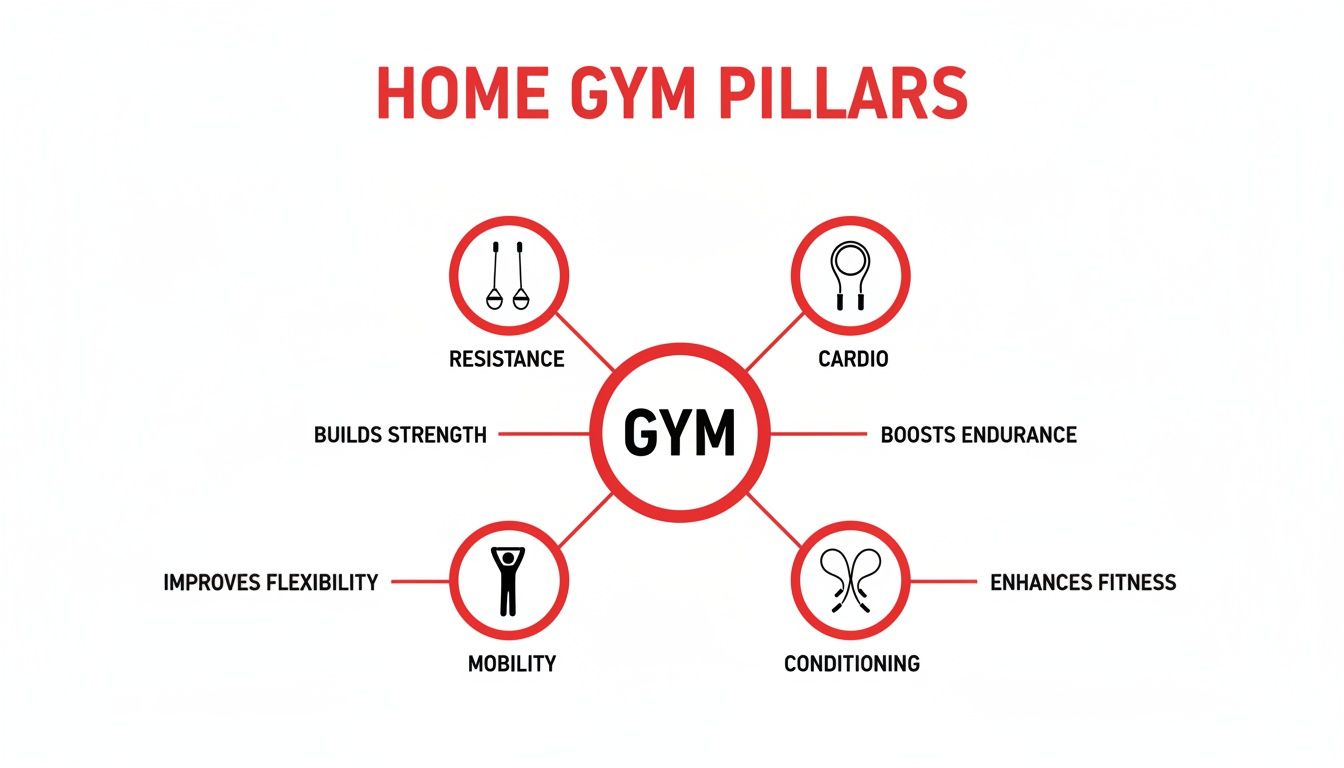
As you can see, a truly effective setup blends elements from all four pillars to create a balanced fitness solution.
Assessing Your Available Space
Alright, let's talk about the real world. You absolutely do not need a dedicated room to build an awesome home gym. I've seen people get incredible results with a setup that fits neatly in the corner of their living room.
The key is choosing space-efficient gear.
Take a tape measure and figure out what you're really working with. Do you have a clear 6x6 foot area? That’s more than enough room for a fantastic workout with a jump rope, resistance bands, and bodyweight exercises. Got a bit more room in a garage or basement? Now you can comfortably add something like a Battle Rope, which needs a bit more length to be used properly. MONFIT gear was designed for this exact reality—it's compact, portable, and easy to stash away, making it perfect for apartments and smaller homes.
Working with Your Budget
Finally, let’s talk money. While investing in your health is always a smart move, you don't need to drop thousands of dollars right out of the gate. In fact, it’s much smarter to start with a modest budget, build the habit, and then add to your arsenal over time.
Here's a simple way to think about it:
-
Tier 1 (Under $100): Focus on the absolute essentials. A set of MONFIT Loop Resistance Bands and a Heavy Jump Rope give you a complete workout solution that covers both strength and cardio for a tiny investment. This is the perfect starting point.
-
Tier 2 ($100 - $250): At this level, you can really expand your training options. Build on that foundation by adding a set of Pull-Up Bands for more advanced strength work and a Battle Rope for some high-intensity conditioning. Now you have a seriously versatile setup.
-
Tier 3 ($250+): With a larger budget, you can go for a complete, all-in-one gym. This would include everything from the previous tiers plus a full set of Tube Bands with attachments, which let you replicate almost any cable machine exercise you'd find in a commercial gym.
By putting some real thought into your goals, space, and budget, you can pick the right gear for you, ensuring you make a smart investment that will pay off for years to come. For more detailed layouts and ideas, check out our guide on how to build a home gym.
Three Perfect Starter Gym Kits You Can Build Today
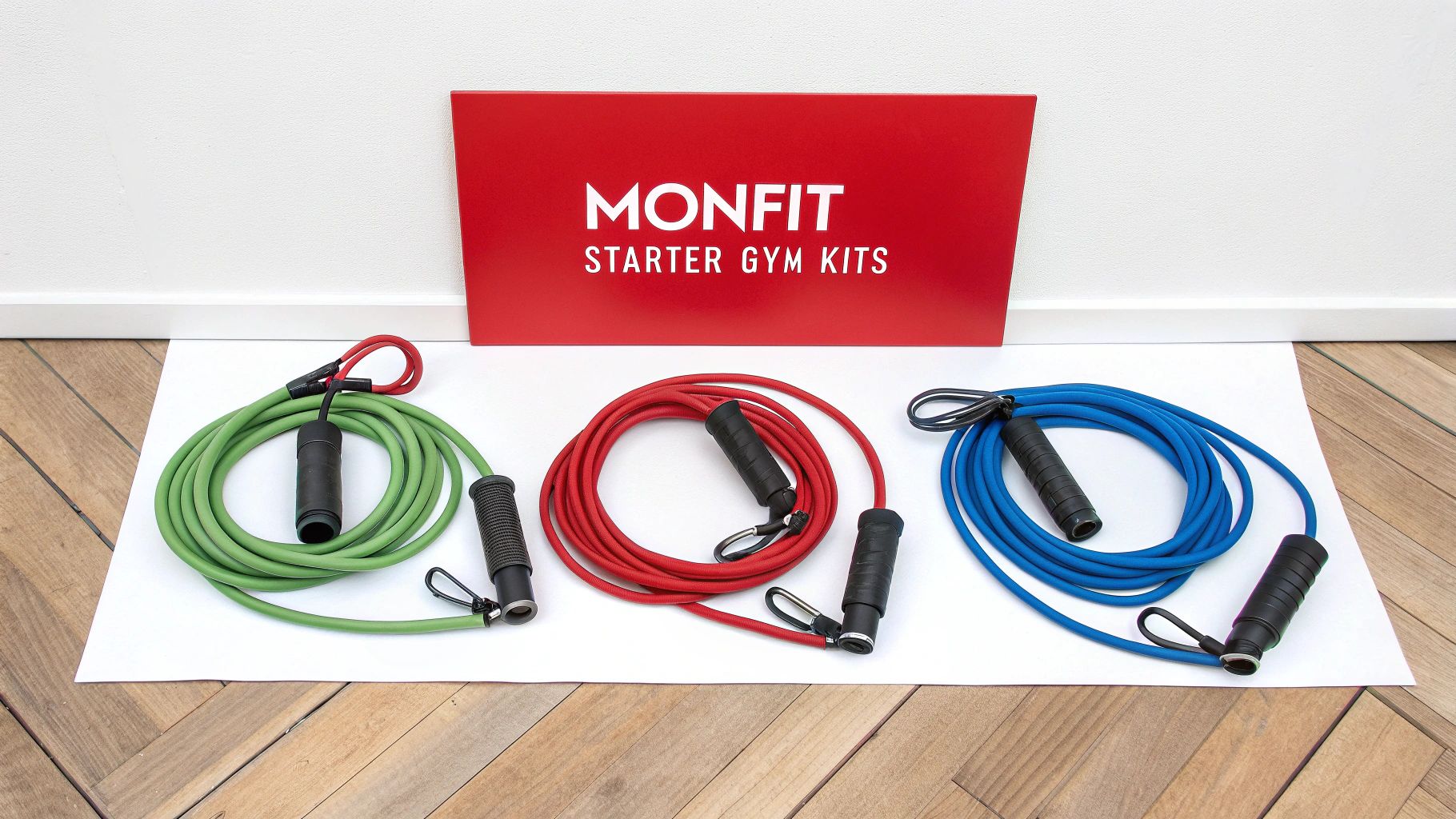
Alright, you've got the core principles down. Now it's time for the fun part: turning that knowledge into a real-world home gym. I know, looking at all the options can feel like drinking from a firehose. That’s why we’ve put together three battle-tested MONFIT kits.
Each one is a complete workout solution, thoughtfully designed for different spaces, budgets, and fitness goals. Think of these as your roadmap to getting started the right way, with gear that actually gets the job done.
Compare Your MONFIT Starter Gym Options
To make it even easier to see which path is right for you, here's a quick side-by-side look at our three curated starter packages.
| Starter Kit | Total Budget | Core Equipment | Best For |
|---|---|---|---|
| Apartment Warrior | Under $150 | Jump Rope, Loop Bands, Floss Bands | Small-space dwellers, budget-conscious beginners, and frequent travelers. |
| Garage Gladiator | $150 - $300 | Everything in Apartment Warrior + Battle Rope & Pull-Up Bands | Those with a bit more room who want to add high-intensity cardio and serious strength. |
| Total Performance | $300+ | Everything in Garage Gladiator + Tube Band System | The serious beginner who wants a complete, long-term solution that mimics a full gym. |
No matter which you choose, you're investing in a foundation that can grow with you.
The Apartment Warrior Kit (Under $150)
Think you don't have enough space for a home gym? Think again. This ultra-minimalist kit is designed for maximum results in minimal square footage. You can get a killer workout in the corner of your living room and then store everything in a single drawer.
This setup proves you don't need a huge budget or a dedicated room to get fit. It’s built on three versatile tools that cover strength, cardio, and mobility.
Core Equipment:
- Heavy Jump Rope: Forget the flimsy playground ropes you remember. A good weighted jump rope is a cardio machine and a full-body conditioner rolled into one. It lights up your core, shoulders, and back while absolutely torching calories.
- Loop Resistance Bands: These are your portable, go-anywhere weight rack. A quality set of loop bands provides a huge range of resistance for squats, rows, presses, and glute work, helping you build strength from head to toe.
- Floss Bands: This is your secret weapon for feeling better, faster. Wrapping these around sore joints like knees and elbows helps boost blood flow, ease stiffness, and speed up recovery between workouts.
The Garage Gladiator Setup ($150 to $300)
Ready to kick things up a notch? The Garage Gladiator package takes the solid foundation of the Apartment Warrior and adds two powerful tools for more advanced strength work and serious conditioning.
This is the perfect kit if you have a bit more room to play with—think a garage, basement, or a spare room. You're not just working out anymore; you're training.
Core Equipment:
- Everything from the Apartment Warrior Kit: Heavy Jump Rope, Loop Resistance Bands, and Floss Bands.
- Battle Rope: There's nothing quite like it for metabolic conditioning. A few minutes of battle rope work will send your heart rate through the roof, build explosive power, and create an awesome afterburn effect that keeps you burning calories long after you're done.
- Pull-Up Bands: These aren't just for pull-ups! These heavy-duty bands are your key to unlocking progressive overload. Use them to assist your first pull-up, add serious resistance to squats and push-ups, or perform powerhouse movements like banded good mornings.
The Total Performance Package ($300+)
For the beginner who's all-in and wants a comprehensive, long-term fitness solution, this is it. The Total Performance Package includes everything from the previous tiers and adds one final, game-changing piece of equipment for truly limitless variety.
With this setup, you can effectively replicate most of what you'd find in a commercial gym, all from the comfort of your home.
This complete kit empowers you to perform hundreds of exercises, ensuring your workouts stay fresh, challenging, and effective for years to come. It’s not just a starter kit; it's a foundation for a lifelong fitness journey.
Core Equipment:
- Everything from the Garage Gladiator Setup: Heavy Jump Rope, Loop Bands, Floss Bands, Battle Rope, and Pull-Up Bands.
- Tube Bands with Attachments: This system is the centerpiece of true versatility. With door anchors, handles, and ankle straps, our MONFIT Tube Bands let you mimic almost any cable machine exercise you can think of—chest presses, lat pulldowns, tricep extensions, leg curls, and so much more.
Getting a Handle on Your Gear: Proper Form and Technique
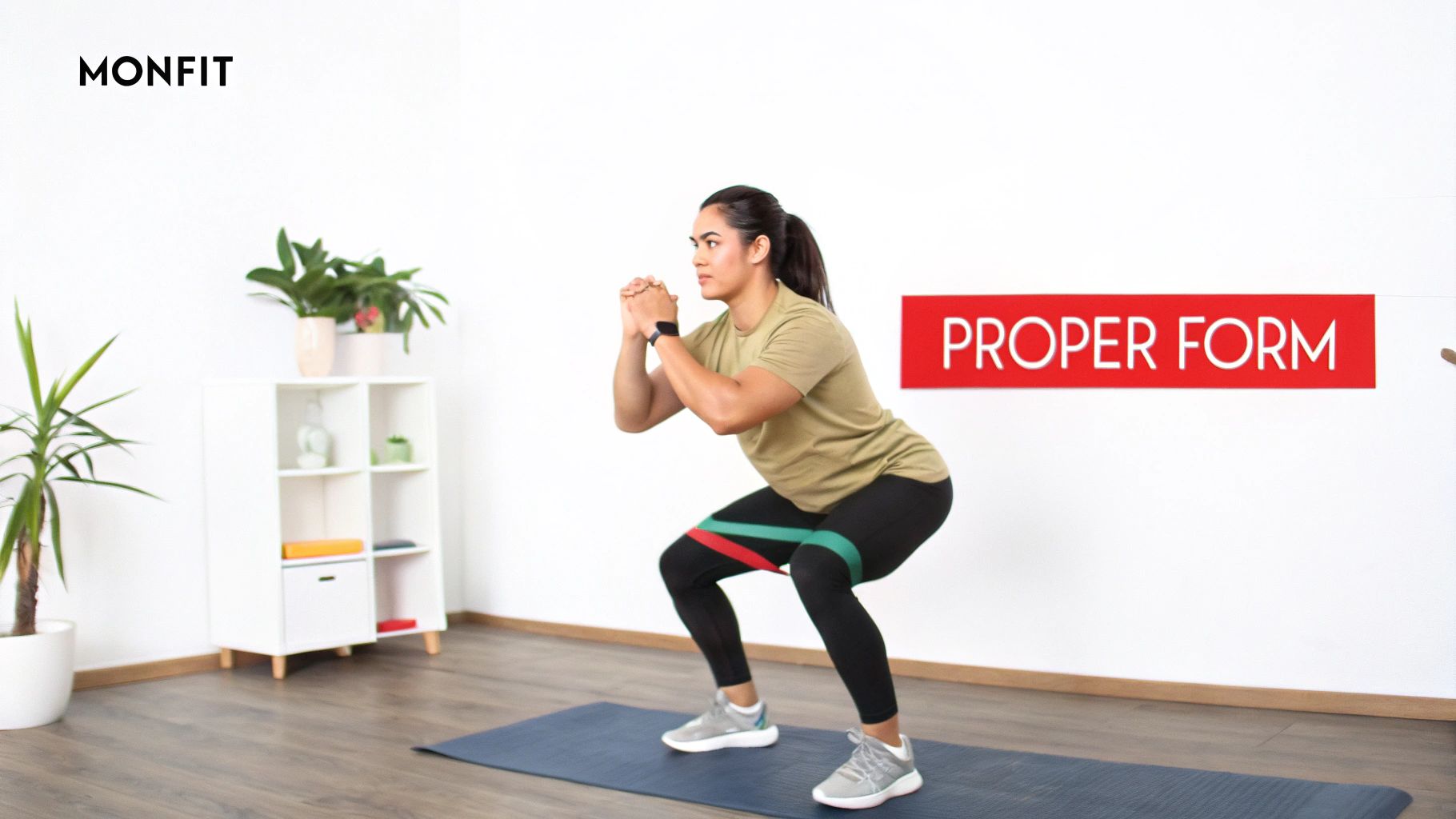
Having the right equipment is a huge first step, but it’s only part of the equation. The real results start showing up when you learn to use those tools with confidence and solid technique. Think of it like this: you've just been handed the keys to a high-performance car. Now, you need to learn how to drive it to truly appreciate what it can do.
This is where we build that confidence from the ground up. We’re going to focus on mastering the basics with your new MONFIT gear. Getting your form right isn't just about avoiding injury—it’s about making sure the right muscles are firing. That’s the secret to getting stronger, faster.
Nailing the Resistance Band Squat
The squat is a true powerhouse exercise. Adding a resistance band takes it to another level, turning it into a focused workout for your glutes and hips. A couple of common slip-ups can derail your progress, though. Let's make sure you get it right from day one.
Step-by-Step Guide:
- Position the Band: Step inside a MONFIT Loop Band and pull it up your legs so it rests just above your knees. It should feel snug, but not like it's cutting off circulation.
- Get Your Stance: Place your feet a little wider than your shoulders, toes pointed forward or just slightly out. Press your knees outward to create some tension in the band before you even start.
- The Descent: Start the squat by pushing your hips back, like you’re aiming for a chair behind you. Keep your chest lifted and your core tight. Go down until your thighs are parallel to the floor, or as low as you can without your back rounding.
- The Ascent: Push through your heels to stand back up, squeezing your glutes at the very top. The key here is to keep pushing your knees out against the band the entire time—on the way down and on the way up.
The number one mistake beginners make is letting their knees cave inward. Think of the band as your personal coach; it gives you immediate feedback, reminding you to keep those hip muscles firing to maintain great alignment. This one cue makes all the difference.
Choosing the Right Band for the Job
Not all bands are the same, and picking the right resistance level is crucial. If it’s too light, you won’t challenge your muscles enough to see change. If it’s too heavy, your form will suffer, which defeats the whole purpose.
- For Lower Body Moves (Squats, Glute Bridges): You’re working big, strong muscles here. A medium to heavy band is usually a good bet.
- For Upper Body Moves (Rows, Bicep Curls): These are smaller muscle groups, so a light to medium band is often the perfect starting point.
MONFIT bands are color-coded for a reason. Always start with a lighter resistance to really nail the movement. Once you can finish all your reps with perfect form, you’ve earned the right to move up to the next level. For a deeper dive into the different options, check out our guide to resistance tube bands to see which style is the best fit for you.
Finding Your Heavy Jump Rope Rhythm
A heavy jump rope is a phenomenal conditioning tool, but it feels different from the speed ropes you used as a kid. The trick is to let the weight of the rope create the momentum for you.
Tips for a Perfect Rhythm:
- It’s All in the Wrists: Don't swing your whole arms around. The movement should be small, controlled circles coming from your wrists.
- Stay Light on Your Feet: Keep your jumps small and low to the ground—just high enough for the rope to pass underneath. You should be on the balls of your feet.
- Brace Your Core: A tight core keeps you stable and upright, helping you transfer energy efficiently with each rotation.
If you find yourself tripping up a lot, just slow it all down. Practice swinging the rope by your side without even jumping to get a feel for the timing. It’s all about finding that smooth, repeatable cadence. A little bit of practice is all it takes to unlock a seriously powerful cardio workout.
Building Your Fitness Future: How to Progress and Grow
Think of your new home gym equipment as more than just a purchase. It's the starting line for a long-term investment in yourself. To make real, lasting progress, you only need to understand one core principle: progressive overload.
It’s a bit like learning an instrument. You don’t sit down at a piano for the first time and try to play a concerto. You start with scales, practice simple songs, and slowly build your skill. Your muscles learn and adapt in the exact same way.
Progressive overload simply means gradually asking a little more of your body over time. This consistent, gentle push is the signal that tells your muscles, "Hey, we need to get stronger to handle this!" Without that signal, you'll eventually hit a plateau where your progress grinds to a halt because your body has already mastered the current challenge.
Putting Progressive Overload into Action
This might sound complicated, but it's actually pretty straightforward. And it doesn't always mean you have to lift heavier weights. With versatile gear like your MONFIT equipment, you have a bunch of different ways to keep things challenging and keep the results coming.
Here are a few simple ways to progress:
-
Increase Resistance: This is the most obvious one. Once you can comfortably nail all your reps with your current MONFIT Loop Band, it's time to move up to the next color. That small increase in tension is progressive overload in its purest form.
-
Add More Reps or Sets: Not quite ready for a tougher band? No problem. Just do a little more work with the one you have. Try adding one extra rep to each set, or tack on a whole new set at the end of your exercise.
-
Decrease Rest Time: Want to kick up the intensity? Shorten your rest periods between sets. If you normally rest for 60 seconds, try cutting that down to 45. This forces your muscles and cardiovascular system to work more efficiently.
The goal isn’t to destroy yourself in every workout. It's about making small, smart, and sustainable increases in difficulty over time. Consistent effort is what builds a strong, resilient body that lasts.
Caring for Your Equipment
Just like your body, your gear needs a little care to stay in top shape. Looking after your MONFIT equipment is simple, but it makes a huge difference in how long it lasts.
After a tough workout, just wipe down your bands and ropes with a damp cloth. Let them air dry completely before you put them away. It's also a good idea to store them out of direct sunlight, as UV rays can weaken the materials over time. Treat your gear well, and it will be ready for your next session, year after year.
Your Top Home Gym Questions, Answered
Jumping into the world of home fitness always brings up a few questions. That's a good thing! Getting these practical details sorted out is the first step toward building a routine you'll actually stick with. Let's clear up some of the most common things beginners ask.
How Much Space Do I Really Need?
You'd be surprised how little you need to get started. Forget needing a whole spare room; for most of the core equipment we've talked about, a clear floor space of about 6x6 feet is perfect.
That’s enough room to get a good jump rope session in, stretch out for some resistance band work, or do any kind of floor exercise without knocking over a lamp. MONFIT gear was practically made for this. You can stash our resistance bands, heavy rope, and floss bands in a single drawer. No excuses, even in a studio apartment.
Can I Actually Build Muscle with Just Bands?
Yes, one hundred percent. The secret to muscle growth isn't about lifting the heaviest thing you can find; it's about a principle called progressive overload. All that means is you have to consistently make your muscles work harder than they're used to.
Resistance bands are brilliant for this. They provide smooth, increasing tension through the entire range of motion, which is something free weights can't do.
As you get stronger, you just have to up the challenge by:
- Grabbing the next band up in resistance.
- Adding a few more reps or another set to your workout.
- Slowing down your movements to keep the muscle under tension longer.
Your muscles don't know if you're lifting iron or stretching a band. All they know is the challenge, and that's what forces them to adapt and grow stronger.
Never mistake simplicity for a lack of results. The unique tension from resistance bands is an incredible tool for building a strong, functional body, especially when you're focused on nailing down good form.
How Many Times a Week Should I Be Working Out?
When you're new to this, consistency beats intensity every single time. A great goal is to aim for 2-3 strength workouts a week, making sure to take a day off in between. Your muscles don't get stronger during the workout; they rebuild and grow during that 48-hour recovery window.
A simple, effective starting schedule could be:
- Monday: Full-body workout
- Wednesday: Full-body workout
- Friday: Full-body workout
- In-between Days: Focus on active recovery—go for a walk, do some light stretching.
Listen to your body. Rest is part of the program. If you have more questions, the MONFIT FAQs page is packed with more detailed answers to just about everything.
Ready to build a smart, effective home gym that can keep up with you? MONFIT makes tough, space-saving gear designed for real progress. Check out our whole collection of resistance bands, heavy jump ropes, and other conditioning tools at https://monfitness.com and get your fitness journey started right.