


So, you're ready to build a home gym. The good news? It's easier and more affordable than you think. Forget the image of a sprawling, machine-filled room. A truly effective home gym is all about being smart, strategic, and personal.
This isn't about collecting equipment; it's about building a space you’ll genuinely want to use. We're going to walk through how to create a functional, motivating gym built around your specific needs, one that grows with you.
Your Blueprint for the Perfect Home Gym
The best home gyms I've ever seen started with a clear plan, not an impulse buy. Before you even browse for a single dumbbell, you have to get clear on your "why." What kind of training actually gets you excited to move? Answering that question honestly is the difference between a sound investment and an expensive coat rack.
To help you get started, I've put together a simple framework. Think of these as the foundational pillars of your home gym. Answering these questions now will save you a ton of time, money, and frustration down the road.
Home Gym Planning Framework At a Glance
| Planning Pillar | Key Questions to Ask | Example Goal |
|---|---|---|
| Fitness Vision | What do I enjoy? What results do I want (strength, cardio, flexibility)? | I want to build functional strength for daily life and feel more energetic. |
| Space Reality | How much floor space do I have? What's the ceiling height? Any obstacles? | I have an 8' x 10' corner in my garage with a 9' ceiling. |
| Budget | What can I realistically invest upfront? What can I add later? | I have a $500 starting budget, with plans to add a bigger piece in 6 months. |
| Equipment | What tools give me the most bang for my buck for my specific goals? | I'll start with adjustable dumbbells, a bench, and a set of resistance bands. |
This simple exercise grounds your entire project. It forces you to think through the entire process from start to finish, ensuring every decision you make is intentional.
Define Your Fitness Vision
First things first, what’s your primary training style? Are you looking to build serious muscle, get your heart rate soaring with intense conditioning, or simply move better and feel healthier? Your answer will dictate everything that comes next.
-
For Strength Training: The name of the game is progressive overload. You need tools that let you gradually increase the challenge over time. Think adjustable dumbbells, kettlebells, or eventually, a good squat rack.
-
For HIIT and Conditioning: You're looking for gear that gets you breathless, fast. Battle ropes, heavy jump ropes, and plyo boxes are perfect for this. They don't take up much space but deliver a massive metabolic punch.
-
For Mobility and General Fitness: Versatility is your best friend. A high-quality set of resistance bands, a good mat, and a couple of foam rollers can create an incredibly powerful and compact setup.
This initial self-assessment is the most important step. It guarantees that every single piece of equipment you bring into your home has a specific job to do.
A well-planned home gym is built in phases. Start with a versatile, high-impact foundation and expand as your skills and commitment grow. This approach is both budget-friendly and highly effective.
Measure Twice, Buy Once
Alright, time to get practical. Grab a tape measure and get the exact dimensions of your space—whether it's a garage, a spare bedroom, or just a small corner of your apartment. This is non-negotiable.
Jot down the length, width, and, crucially, the ceiling height. Don't forget to think about clearance. You need room to move safely around the equipment. A battle rope, for instance, needs a good amount of linear space to be effective, while a set of resistance bands needs almost none.
This step grounds your dream gym in reality. The global home gym equipment market is absolutely exploding—it's projected to hit USD 19.6 billion by 2035—because people are figuring out how to get amazing workouts in smaller spaces.
Brands like MONFIT are designed for exactly this. Tools like pull-up bands and heavy jump ropes can deliver a knockout workout without requiring a dedicated room. To get a better idea of how these pieces can anchor a space-efficient setup, check out our guide to the best home gym equipment. You can also learn more about this trend from this in-depth home gym equipment market report.
Building Your Foundation for Under $200
You don’t need to spend a fortune to build a home gym that gets real results. Honestly, for less than what you'd pay for a couple of months at a commercial gym, you can pull together a smart, versatile kit that lays the groundwork for some serious progress. We're starting lean and mean, focusing on functional gear that builds practical strength and conditioning without taking over your living space.
The idea here is to get the most bang for your buck. We’re skipping the single-purpose machines and bulky weights for now. Instead, we'll build a curated toolkit that unlocks hundreds of exercise variations. The goal is simple: prove that a small investment can make a massive impact.
This decision tree really nails it—your goals, space, and budget are the three pillars that should guide every single equipment choice you make from day one.
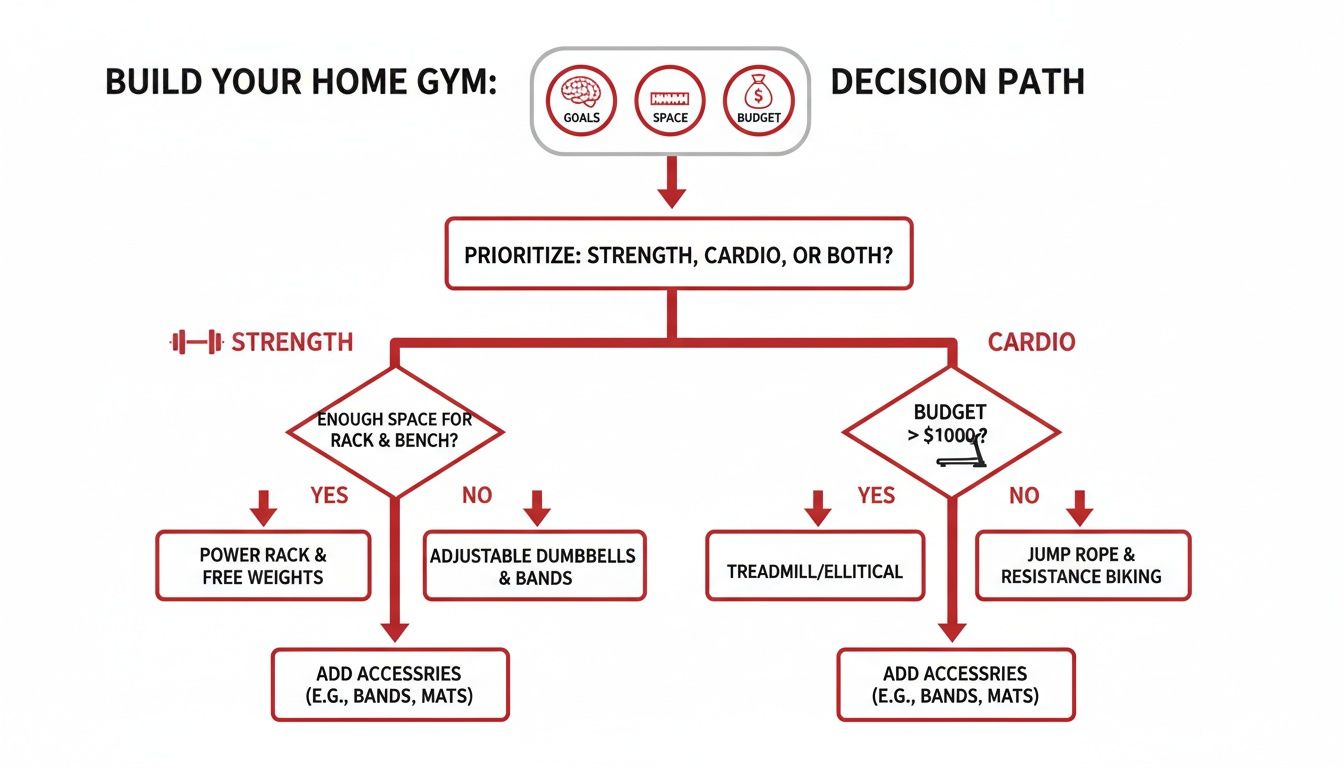
As you can see, everything flows from those core considerations. Follow this path, and you'll build a gym that feels like it was made just for you.
The Cardio Cornerstone: MONFIT Heavy Jump Ropes
Forget about that clunky treadmill for a minute. When it comes to high-intensity cardio that torches calories and builds athletic coordination, nothing beats a heavy jump rope. Unlike the speed ropes you might remember from the playground, a weighted rope brings your shoulders, back, and core into the fight, turning a simple cardio session into a full-body workout.
The MONFIT Heavy Jump Ropes are a perfect place to start. That extra resistance forces you to control your movements and generate more power, which spikes your heart rate faster and builds serious endurance. In fact, just 10 minutes of jumping rope can feel like a 30-minute run, making it one of the most efficient workouts you can do at home.
The Ultimate Strength Multiplier: MONFIT Pull-Up Assistance Bands
Next up is what I consider the most versatile piece of equipment you can possibly own. MONFIT's Pull-Up Assistance Bands aren't just for helping you finally nail that first pull-up; they're a complete strength-training system packed into a few loops of rubber. These thick, durable bands come in various resistance levels, letting you make exercises easier or harder on the fly.
Here’s how they become your all-in-one trainer:
- Assisted Bodyweight: Loop a band around a pull-up bar to get the boost you need to perform pull-ups and dips with perfect form.
- Added Resistance: Drape a band across your back for push-ups or over your shoulders for squats to add a whole new challenge to classic moves.
- Mobility and Stretching: Use them before a workout to wake up your muscles and after to cool down, improving flexibility and helping you recover.
Because they can both assist and resist movement, they're an indispensable tool for anyone building a home gym on a budget. They completely eliminate the need for multiple machines by providing dynamic, variable resistance.
Rounding Out Your Kit with Targeted Bands
To complete your foundational setup, a couple of other types of bands offer specialized benefits that are tough to replicate otherwise. They're fantastic for isolating smaller muscle groups and mimicking exercises you’d normally need a big cable machine for.
MONFIT Loop Resistance Bands
These smaller "mini-bands" are your secret weapon for firing up your glutes and building hip stability. Worn around your thighs or ankles, they add resistance to moves like glute bridges, lateral walks, and clamshells. Building strong glutes and hips is critical for preventing lower back pain and improving your power in major lifts like squats and deadlifts. If you want to add these to your arsenal, you can check out the benefits of resistance loop bands for targeted training.
MONFIT Tube Bands with Handles
Think of these as your portable cable machine. The handles and included door anchor let you perform a huge variety of exercises right in your living room:
- Chest presses and flys
- Lat pulldowns and rows
- Bicep curls and triceps pushdowns
- Shoulder raises and face pulls
They provide constant tension throughout each rep, which is an incredible stimulus for muscle growth and endurance.
With just these four items—a heavy jump rope and three types of bands—you have a complete fitness program in your hands. You can build strength, crush cardio, and improve your mobility, all from the comfort of home.
Putting It All Together: A Sample Budget Workout
So, what does a workout with this gear actually look like? It’s straightforward but brutally effective.
Full-Body Strength and Conditioning Circuit (3-5 Rounds)
- Warm-Up: 5 minutes with the MONFIT Heavy Jump Rope (mix in some high knees).
-
The Circuit:
- Banded Push-Ups: 10-15 reps (pull-up band across your back)
- Banded Squats: 15-20 reps (pull-up band over your shoulders)
- Tube Band Rows: 12-15 reps (anchored to a door)
- Glute Bridges: 20 reps (loop band around your thighs)
- The Finisher: 3 minutes of High-Intensity Interval Training (HIIT) with the Heavy Jump Rope (30 seconds all-out, 30 seconds rest).
This entire setup costs well under $200, fits in a small bag, and can deliver a workout that rivals anything you’d get at a commercial gym. It's the perfect, no-excuses foundation for your fitness journey.
Expanding Your Arsenal for Strength and Conditioning
So, you've got the basics down and you're building consistent habits. Fantastic. Now it's time to kick things up a notch and start layering in some new challenges to accelerate your progress. This next step is all about making smart additions to your gym that open up a whole new world of training possibilities, hitting both raw strength and high-intensity conditioning.
We're moving beyond the essentials to create a more complete training space. The idea is to add pieces that work with what you already have, creating a setup where every item makes the others more effective. This is how you keep pushing past plateaus and keep your workouts from getting stale.
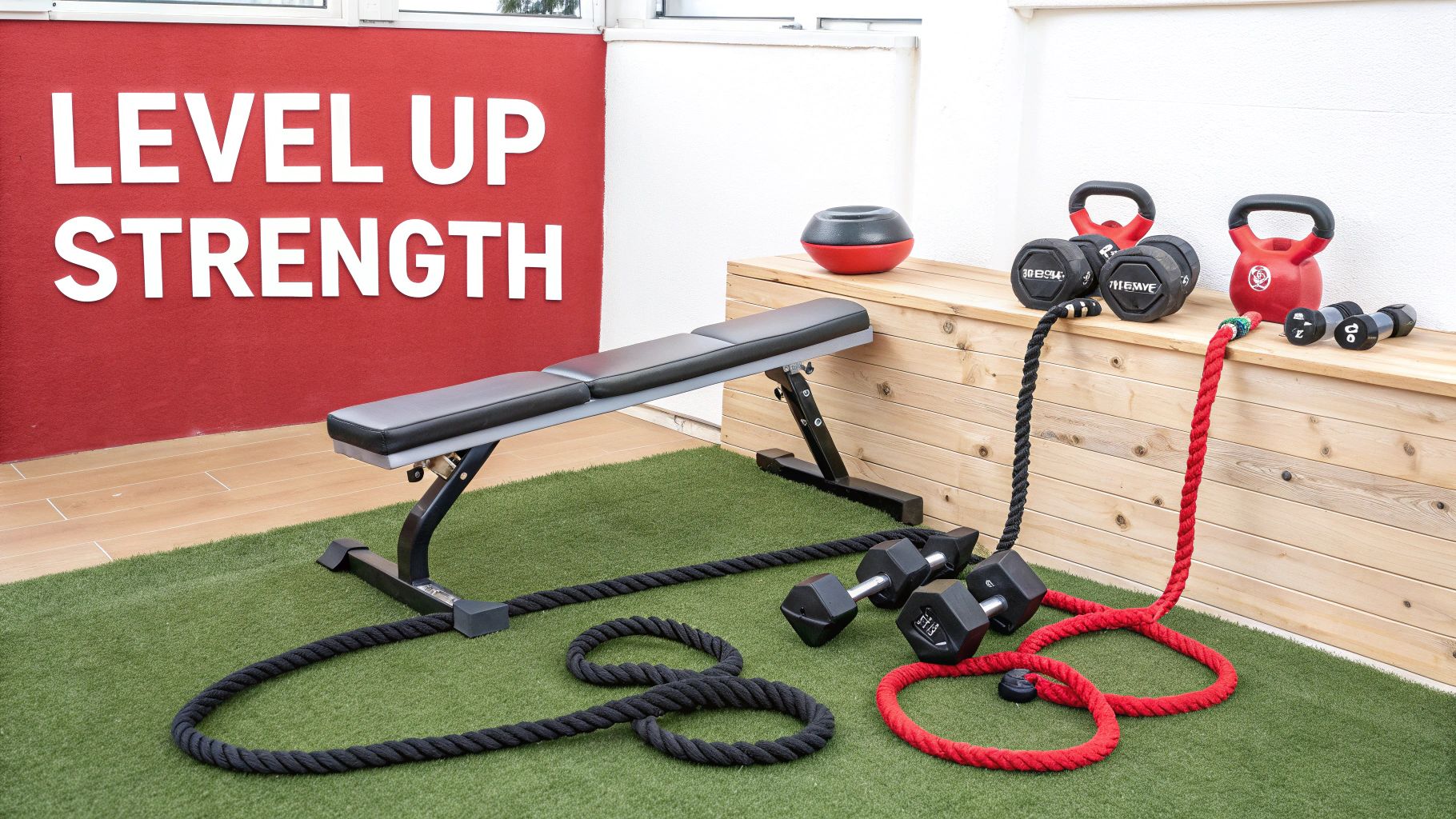
Unleash Full-Body Power with Battle Ropes
If you want to seriously ramp up your metabolic conditioning, few tools can touch the raw intensity of battle ropes. They are an absolute game-changer for HIIT, forcing your entire body—from your grip and core to your legs and back—to work together in one explosive, coordinated effort.
Unlike just hopping on a treadmill, battle ropes build power and muscular endurance at the same time. The constant, flowing waves create a unique kind of resistance that taxes your cardiovascular system without the high impact of running or jumping. A few minutes with MONFIT's Battle Ropes will leave you breathless, torching calories while building real-world, athletic strength.
Making Battle Ropes Work in Smaller Spaces
And no, you don't need a massive garage to use them. Here’s how to make it work:
- Find an Anchor: A solid anchor point is non-negotiable. You can get a dedicated wall mount, or just loop the rope around something heavy and stable like a support post, a heavy kettlebell, or the base of a squat rack.
- Gauge Your Space: You generally need about half the length of the rope in clear floor space. So for a 30-foot rope, you'll want around 15-20 feet of room in front of your anchor point.
- Pick the Right Size: If you're just starting out, stick with a 1.5-inch diameter rope. As you get stronger, you can graduate to a thicker 2-inch rope for a much tougher grip and conditioning challenge.
The True Foundation of Strength: An Adjustable Bench
Next up is a cornerstone piece for any serious strength work: an adjustable bench. Sure, floor presses are fine, but a bench unlocks a massive range of new exercises and lets you hit muscles from different angles for much more complete development. It’s arguably one of the best investments you can make for a home gym.
With an adjustable bench, you can do flat, incline, and sometimes even decline movements. That versatility is huge for targeting different parts of your chest, shoulders, and back. It also just gives you a stable base for countless other exercises, from seated dumbbell curls to single-arm rows.
A quality adjustable bench is the central hub of a strength-focused home gym. It transforms a simple pair of dumbbells into a full-fledged chest, shoulder, and back-building machine.
Choosing Your Weights: Adjustable Dumbbells vs. Kettlebells
With a bench secured, you need some free weights. Your two most space-efficient options are adjustable dumbbells and a set of kettlebells. Both are fantastic choices, but they really shine in different areas.
| Equipment Type | Pros | Cons |
|---|---|---|
| Adjustable Dumbbells | Ultimate space-saver: Replaces an entire rack of dumbbells. Perfect for progressive overload on classic lifts like presses and rows. | Can be a bit clunky to adjust in the middle of a fast-paced workout. Some people find they feel less balanced than a solid, fixed dumbbell. |
| Kettlebells | Incredible for dynamic movements: Built for swings, snatches, and cleans that develop explosive power. The offset weight challenges your stabilizer muscles. | Not as great for traditional isolation lifts. You'll need to buy several different weights as you get stronger, which takes up more space. |
For most people focused on building muscle, adjustable dumbbells probably offer the most bang for your buck. They make it easy to add small amounts of weight over time, which is the secret sauce for consistent muscle growth.
Layering Equipment for Better Results
The real magic happens when you start combining your new toys with the gear you already own. This is where you can create complex, super-effective movements that build a truly functional body.
For example, try this: The next time you do a dumbbell bench press, loop a MONFIT Loop Band around your thighs. As you press the weights, actively push your knees out against the band. This forces your glutes to fire up, creating full-body tension that makes your lift more stable and powerful. You can explore more ways to integrate these tools with our detailed guide on using pull-up resistance bands for more than just pull-ups.
The boom in home fitness is real—the market is projected to hit USD 19.79 billion by 2032. A big driver of this is the popularity of HIIT and functional training, which is exactly where versatile tools like bands and ropes excel. They give you a killer, high-calorie-burning workout while encouraging natural movement patterns, which studies show can help reduce the risk of injury. You can dive deeper into these home fitness market trends to see where things are headed. By thoughtfully expanding your home gym, you're not just buying more stuff—you're investing in a more capable and motivating training space.
Designing Your Workout Space for Maximum Motivation
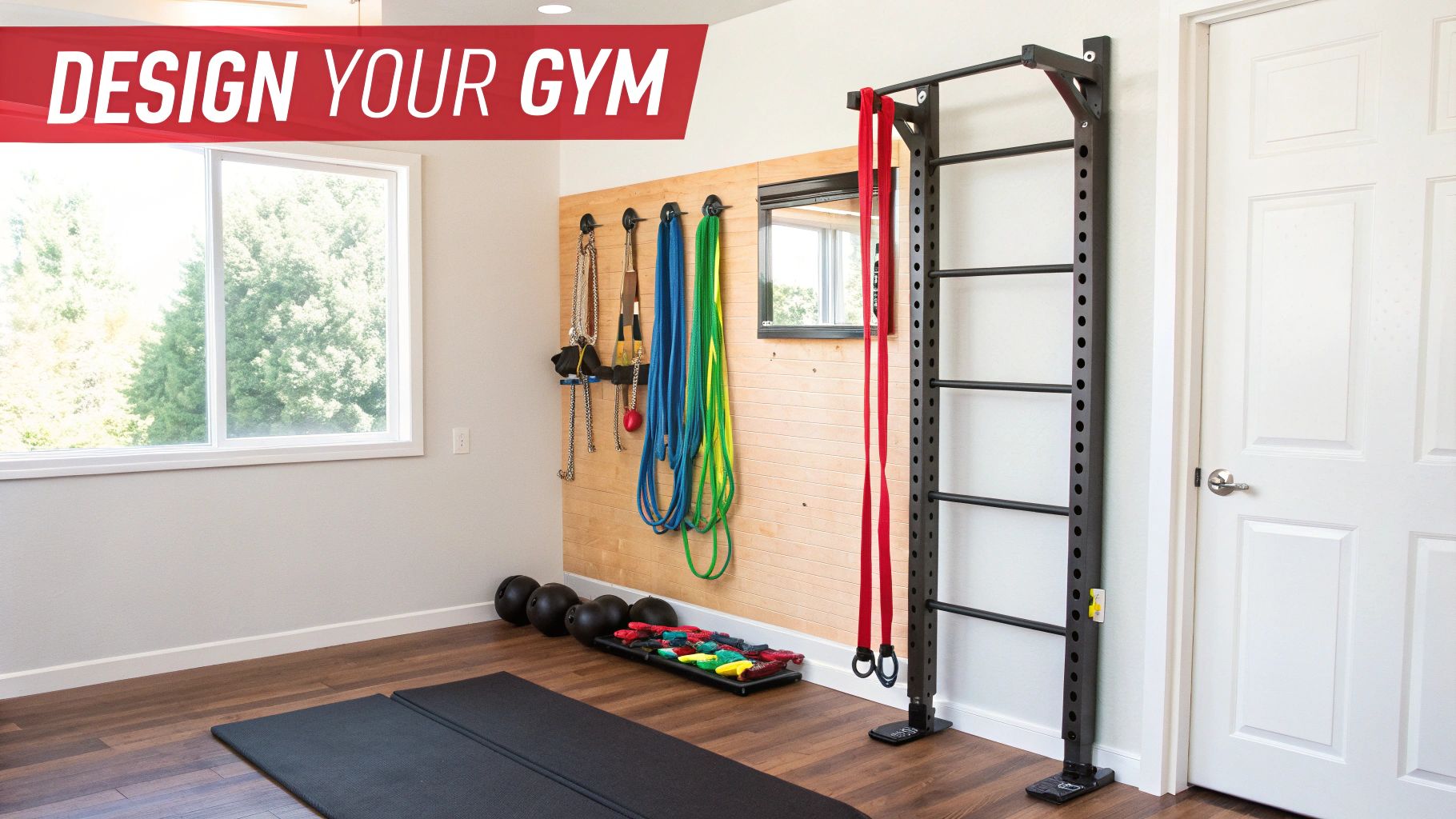
You’ve got the gear, but how you arrange it can be the difference between a fitness sanctuary that pulls you in and a cluttered corner you actively avoid. Designing your home gym isn't just about finding a spot for everything; it's about creating an environment that flips a mental switch, getting you in the zone to perform. This is where you turn your investment into consistent action.
Whether you're working with an entire garage or just a small slice of your living room, the core principles don't change. The mission is to build a dedicated, organized, and inspiring area that makes you actually want to work out.
Laying the Groundwork—Literally
The floor is the foundation of your gym, and getting this part right is non-negotiable for protecting both your body and your home. Trust me, dropping a dumbbell on tile or hardwood is a costly mistake, and exercising directly on concrete is just brutal on your joints.
Interlocking rubber or high-density foam tiles are a fantastic, wallet-friendly solution. They offer excellent shock absorption, are a breeze to install, and immediately define your workout zone. For a standard 10x10 foot space, you can typically get quality flooring for under $100. It’s a small investment that pays huge dividends in safety and comfort.
Your workout space should feel like a destination. Even in a multi-purpose room, using dedicated flooring and smart storage creates a psychological boundary that helps you switch from "home mode" to "gym mode."
Lighting also plays a surprisingly huge role. If your space is dark and dingy, you're not going to feel energized. Swap out those dim bulbs for bright, cool-toned LEDs to mimic natural daylight. A well-lit space doesn't just boost your mood; it helps you see what you’re doing, which is absolutely essential for maintaining proper form.
Mirrors and Motivation
Adding a large, inexpensive mirror is one of the most effective upgrades you can make. This isn't about vanity; it's all about immediate feedback. A mirror lets you watch your form in real-time, helping you catch and correct mistakes before they can lead to injury.
It also has the welcome side effect of making a small space feel significantly bigger and brighter. You don't need a custom professional installation—a few tall, framed mirrors from a home goods store placed side-by-side work perfectly.
Smart Storage for a Clutter-Free Zone
A messy gym is a demotivating and unsafe gym. When space is tight, vertical storage is your best friend. Getting your equipment up off the floor is the key to maximizing your usable workout area and preventing nasty tripping hazards.
To help you get organized, I've put together a quick comparison of some of my favorite storage solutions that I've seen work well in all kinds of spaces.
| Storage Solution | Best For | Space Impact | Average Cost |
|---|---|---|---|
| Wall-Mounted Pegboard | Resistance bands, jump ropes, foam rollers, accessories | Low (uses wall space) | $30 - $70 |
| Vertical Weight Racks | Dumbbells (A-frame) or weight plates (plate tree) | Low (small footprint) | $50 - $150 |
| Wall-Mounted Hooks | Battle ropes, heavy bands, suspension trainers | Very Low (minimal hardware) | $20 - $40 |
| Freestanding Shelving | Kettlebells, medicine balls, shoes, towels | Medium to High | $60 - $200+ |
Choosing the right storage really depends on your gear, but the goal is always the same: keep the floor clear for movement. Think vertically to reclaim your space.
- Wall-Mounted Pegboard: This is a DIY-friendly champion. For under $50, you can create a custom storage wall for hanging your MONFIT resistance bands, jump ropes, and other accessories.
- Vertical Weight Racks: A simple A-frame rack for dumbbells or a vertical plate tree for bumper plates has a tiny footprint but holds a serious amount of weight.
- Wall Hooks: Don't overlook the power of simple, heavy-duty hooks for gear like your MONFIT battle ropes. A properly anchored set of hooks keeps them coiled and completely out of the way. Once they're stored neatly, you can focus on how to perfect your battle rope technique.
While the smart home gym industry continues to grow, pairing a few tech items with analog workhorses like battle ropes offers incredible value. Consider this: the average gym membership can cost over $600 per year, but a one-time investment in foundational MONFIT gear is often under $150 for a lifetime of use. It's no surprise that 65% of Cross-trainers prefer functional tools for their HIIT workouts. A smart budget often allocates about 40% to cardio and conditioning tools like ropes and bands.
By designing a clean, organized, and motivating space, you're building a foundation for long-term success on your fitness journey.
Time to Add Tools for Recovery and Specialization
Once you've settled into a solid routine, you’ll quickly learn that pushing your limits is only half the battle. The real, sustainable progress happens in the time between those tough workouts. This final phase of building out your home gym is all about adding tools that support serious recovery and let you chase more specific fitness goals.
Think of it as graduating from a generalist to a specialist. Your core equipment built your foundation of strength and fitness. This next layer of gear is what will make you more resilient, mobile, and powerful in the ways that truly matter to your personal goals. It's less about cramming in more volume and more about adding precision to your training.
Don't Skip Active Recovery
Hard workouts create tiny tears in your muscles—it’s a necessary part of getting stronger. But without dedicated recovery work, that stress can easily lead to persistent soreness, stiffness, and eventually, a frustrating plateau or an injury. Active recovery tools are designed to speed up that repair process by improving blood flow and restoring your range of motion, so you can come back to your next session feeling ready to go.
One of the most powerful—and most overlooked—tools for this is the floss band. This simple-looking elastic band is a game-changer for joint mobility and soft tissue work.
Tissue flossing works by compressing a joint or muscle group while you move it through a range of motion. This can help break up fascial adhesions, flush out swelling, and restore the natural slide and glide between tissues.
This technique, sometimes called Voodoo Flossing, is incredibly effective for stubborn spots like elbows, knees, and shoulders that often get tight from the repetitive movements in strength training and HIIT.
How to Use MONFIT Floss Bands
Using a floss band is surprisingly simple. Let’s say you have a tight or achy knee from squats. You’d wrap the MONFIT Floss Band snugly around the joint, starting just below it and wrapping upward with about a 50% overlap on each layer.
Once it's wrapped, spend just 1-2 minutes moving through some basic, unloaded exercises:
- Bodyweight squats
- Simple leg extensions and curls
- Walking around or doing a few light lunges
When you take the band off, a fresh wave of blood rushes into the area, helping to flush out metabolic byproducts and ease inflammation. It’s a simple trick that can make a huge difference in how your joints feel and function. For a full tutorial, see our guide on how to use MONFIT Floss Bands for enhanced recovery.
Beyond flossing, a high-density foam roller is great for big muscle groups like your back and quads, while a lacrosse or massage ball can dig into smaller trigger points in your pecs, glutes, or the arches of your feet. With these, your recovery toolkit is pretty much complete.
Leveling Up with Specialized Gear
With a solid recovery strategy in place, you can finally think about adding highly specialized equipment that matches your long-term fitness ambitions. This is the most personal stage of building your gym, where every purchase should solve a specific problem or unlock a new level of training. Don't just buy something because it looks cool on Instagram.
The big question to ask yourself is: what is my current setup preventing me from doing?
Here are a few common paths people take:
- For the Serious Strength Lifter: If your goal is to max out your squat, bench, and deadlift, a squat rack or power rack is the single best investment you can make. The safety it offers with spotter arms is unmatched, letting you push for new PRs without needing a spotter.
- For the CrossFit or HIIT Fanatic: To build explosive power and crank up your metabolic conditioning, a plyo box is a must. It's not just for box jumps; it’s perfect for step-ups, elevated push-ups, and all kinds of movements that add a vertical challenge to your workouts.
- For the Bodybuilding Enthusiast: If sculpting your physique is the priority, a cable machine or functional trainer opens up a world of isolation exercises that free weights just can't match. The constant tension from cables is fantastic for targeting specific muscles and driving hypertrophy.
This final stage is never really "done." As your goals shift, your gym will evolve right alongside you. That’s the real beauty of a home gym—it grows with you, adapting to your journey one piece at a time.
Got Questions About Building a Home Gym?
When you start thinking about building a home gym, a few key questions almost always pop up. Do I actually have the room for this? Can I get a real workout at home? It's completely normal to have these thoughts. Let's walk through some of the most common concerns to clear the air so you can move forward and build something you'll love using.
Getting these things figured out upfront helps you make smarter choices, sidestep the usual mistakes, and build a space that actually pulls you in for a workout, day after day.
How Much Space Do I Really Need?
Honestly, probably a lot less than you think. You can create an incredibly effective workout zone in a space as small as 6x6 feet. It’s not about having a massive room; it’s about choosing smart, versatile gear that delivers big results in a small footprint.
Think about it: a set of MONFIT resistance bands, a heavy jump rope, and a good mat can fit in a small box and be used right in your living room. Now, if you're planning on more dynamic exercises with things like battle ropes, you'll want a bit more clearance—something closer to 10x10 feet would be ideal. The main thing is to make sure you have enough ceiling height for overhead movements and a clear floor so you can move safely without tripping over the coffee table.
Is Working Out at Home as Effective?
Without a doubt. A great workout comes down to consistency, solid form, and the right intensity—not the location. In many ways, a home gym can actually lead to better consistency because it removes all the typical excuses like traffic, gym hours, and waiting for a squat rack to open up.
When you have powerhouse tools like MONFIT's battle ropes for a killer HIIT session or their pull-up bands for building real strength, you can easily match the intensity of any commercial gym. The real secret to getting results is having a plan and sticking to it, and a convenient home setup makes that a whole lot easier.
A workout's value is measured in effort and consistency, not location. A home gym is your secret weapon against excuses, making it easier than ever to just show up.
What’s the Single Most Important Piece of Equipment?
That’s a tough one, as it really depends on your goals. But if I had to recommend one starting point for maximum versatility, it would be a high-quality set of resistance bands. A combo pack like MONFIT's pull-up and loop bands is one of the smartest first buys you can make.
Why? They’re budget-friendly, take up virtually no space, and can be used for just about any fitness goal you can think of:
- Strength Training: They can effectively mimic free weights and cable machines for a full-body workout.
- Bodyweight Assistance: They're perfect for helping you nail challenging exercises like pull-ups.
- Mobility and Rehab: Use them to improve your flexibility and help with recovery.
Because the resistance scales, they work just as well for someone just starting out as they do for a seasoned lifter. It’s a complete workout solution in one small package.
How Do I Stay Motivated Working Out Alone?
Motivation is a real challenge when you're going it alone, but it's totally manageable. The key is to build a routine and an environment that you actually enjoy. First off, create a dedicated workout spot. Even if it's just a corner of a room, it helps your brain flip the switch to "gym time."
Next, take the guesswork out of your training by following a structured program or using a fitness app. Set clear, realistic goals and track your progress—nothing is more motivating than seeing how far you’ve come. And never underestimate the power of a killer playlist to boost your energy.
Finally, consider finding a virtual community. Sharing your progress and struggles with others online can provide that dose of accountability and encouragement you need to keep pushing forward.
Ready to build a foundation of strength and conditioning that fits your life and your space? The MONFIT collection of heavy jump ropes, battle ropes, and resistance bands is designed to deliver maximum results with a minimal footprint. Start building your perfect home gym today at https://monfitness.com and get free shipping on orders over $100!
