

Picking the best home gym equipment brands really boils down to what you want to achieve, how much space you have, and your budget. If you’re looking for a tech-heavy, guided experience, Tonal is a frontrunner. For old-school strength training, it’s hard to beat the reputation of Rogue Fitness. And for anyone who needs functional, space-saving gear, brands like MONFIT deliver some seriously effective solutions.
How to Choose the Best Home Gym Equipment Brands
The home fitness movement is officially mainstream, but walking into the market unprepared can feel like a chore in itself. This guide is designed to help you sift through the options and land on a brand that actually matches your needs. We'll focus on what truly separates the good from the great: things like durability, thoughtful design, and solid customer support.
This massive pivot to working out at home isn't just a feeling; the numbers back it up. The global home gym equipment market is on track to hit USD 19.6 billion by 2035, a significant leap from its USD 12.4 billion valuation in 2025. While treadmills still claim a huge 29.12% of the market in North America, we're seeing a massive surge in the popularity of free weights and resistance bands, especially among busy professionals and HIIT enthusiasts. You can dig into more of this data over at futuremarketinsights.com.
Understanding Your Options
To make this whole process a lot simpler, I like to break the top brands down into three main groups. Each one caters to a different kind of person, so you can quickly figure out which direction to go.
-
All-in-One Smart Gyms (e.g., Tonal): This is the lane for anyone who wants guided, tech-integrated workouts that take up minimal floor space. Think digital resistance, AI-powered coaching, and a library of on-demand classes, usually with a subscription.
-
Traditional Strength Specialists (e.g., Rogue): This is for the serious lifters. These brands are all about heavy-duty power racks, premium barbells, and plates that can take a beating. They’re built for raw performance, not flashy digital features.
-
Versatile Functional Gear Providers (e.g., MONFIT): This category is perfect for high-intensity training in smaller spaces. Brands like MONFIT focus on portable, effective tools—resistance bands, battle ropes, and heavy jump ropes—that give you a full-body workout without needing a dedicated room.
This table gives you a quick side-by-side look at how these categories stack up.
| Category | Best For | Key Features | Price Point |
|---|---|---|---|
| Smart Gyms | Guided Workouts & Tech Lovers | Digital resistance, AI coaching, subscription classes | High initial cost + monthly fee |
| Traditional Strength | Serious Lifters & Powerlifters | Heavy-duty steel, free weights, high durability | Moderate to high one-time cost |
| Functional Gear | Compact Spaces & HIIT | Portability, versatility, progressive resistance | Low to moderate one-time cost |
With this framework in mind, you can more easily pinpoint which type of brand aligns with your goals as we get into the details. For more tips, check out our guide on the best home gym equipment for different workout styles.
The 7 Hallmarks of a Home Gym Brand Worth Your Money
Before you pull out your wallet, let's talk about what actually separates a great piece of home gym gear from the stuff that ends up as a clothes rack. It's not just about flashy marketing. The best brands build their reputation on a handful of core principles that you can actually measure.
Think of these seven points as your personal checklist. This framework will help you look past the hype and really dig into whether a brand is building equipment for the long haul. We're talking about everything from the gauge of steel in a power rack to the snap-back of a resistance band.
1. Build Quality and Durability
This is the big one. How is the equipment actually made? The best brands aren't cutting corners. They're using high-quality materials like heavy-gauge steel for racks, tear-resistant nylon for straps, and multi-layered latex for bands. Durability isn’t about surviving one workout; it's about standing up to thousands of reps over many years.
For example, a cheap squat rack might use flimsy 14-gauge steel. A premium one from a brand like Rogue Fitness will almost always use robust 11-gauge steel. That small difference in numbers means a huge jump in stability and safety when you're under a heavy barbell.
2. Product Focus and Specialization
You can tell a lot about a brand by what they don't sell. Great brands know their lane and stick to it. They don’t try to be everything to everyone, and that focus leads to better products.
- Strength Specialists: Brands like Rep Fitness live and breathe free-weight equipment. They obsess over perfecting their racks, benches, and barbells.
- Functional Fitness Leaders: We designed MONFIT around versatile, space-saving tools like battle ropes and resistance bands. The goal is high-intensity, full-body conditioning without the clutter.
- Smart Gym Innovators: Companies like Tonal are all-in on tech-integrated, all-in-one solutions that use digital resistance and guided workouts.
A clear focus means a brand is pouring all its R&D into making its core products better, not spreading itself thin trying to chase every trend.
3. Space Efficiency and Design
Let's be real: in a home gym, every square foot is prime real estate. The best brands get this. They design equipment that is as functional as it is compact. It's not about making everything tiny; it's about smart design that gives you maximum utility without taking over your living room.
Bowflex practically built its empire on the space-saving design of its adjustable dumbbells, which replace an entire rack of weights. We took a similar approach with MONFIT—our entire catalog is built to deliver a tough workout with gear you can easily stash in a closet.
The real test for any home gym product is whether it improves your living space or just clutters it. Brands that get this right create solutions that are both effective for training and easy to live with every day.
4. Warranty and Customer Support
A solid warranty is more than just a piece of paper; it’s a direct signal of how much a brand believes in its own craftsmanship. A lifetime warranty on a power rack frame or a multi-year promise on resistance bands tells you the company is willing to stand behind its gear.
But that's only half the story. A warranty is useless if the customer support is a nightmare. You need a team that's responsive, helpful, and actually empowered to solve your problem. Checking out customer stories is a great way to vet this; you can usually find dedicated pages with MONFIT reviews and similar feedback for other brands.
5. Price and Long-Term Value
Price is what you pay today, but value is what you get over the next five or ten years. The cheapest option is almost never the best deal in the long run. A slightly more expensive piece of equipment that lasts a decade is a much smarter investment than a bargain-bin item you have to replace next year.
Think about the total cost of ownership. For smart gyms, this often includes a monthly subscription. For traditional equipment, it's usually a one-time purchase. Real value comes from brands that offer durable, effective equipment at a fair price, ensuring your investment pays you back in fitness for years to come.
6. User Experience and Ease of Use
Great equipment just feels right. It should be intuitive and satisfying to use, not a source of frustration. This covers everything from how smoothly a machine adjusts to the grip of a barbell's knurling in your hands.
If a product is clunky, a pain to set up, or just awkward to use, you'll find excuses not to train. Brands that nail the small details—thoughtful ergonomics, clear instructions, and user-friendly features—show they truly understand what their customers need.
7. Innovation and Progression
Finally, the best brands never get complacent. They’re constantly innovating to meet the new challenges and demands of people working out at home.
This might mean integrating smart technology, developing more durable materials, or inventing entirely new types of equipment to solve common problems. A brand that’s committed to pushing forward is a brand that will be able to support your fitness journey as you get stronger and your goals evolve.
Comparing Smart Gyms and Traditional Strength Equipment
When you're building a home gym, you’ll eventually hit a major fork in the road: do you go with a sleek, all-in-one smart gym or stick with tried-and-true traditional strength equipment? This isn't just about what you buy—it's about how you train. You're choosing between the guided, data-rich experience of a high-tech system and the raw, tactile feedback of steel.
Smart gyms from brands like Tonal and Tempo are basically a personal trainer packed into a wall unit or a freestanding screen. They use digital resistance, offer AI-powered feedback on your form, and come loaded with a massive library of on-demand classes. This makes them a fantastic fit for beginners who crave structure or for anyone who just wants an efficient, guided workout without having to think about it.
Then you have the traditional strength giants—brands like Rogue Fitness and Rep Fitness. These guys are the foundation of the home gym world, known for building bombproof power racks, barbells, and plates. Their equipment is all about durability, performance, and giving you absolute control over your training. It’s why serious lifters and powerlifters almost always go this route.
The Real-World User Scenarios
So, which path is yours? Let’s walk through a couple of common situations.
Picture a total beginner, someone who finds a commercial gym intimidating and has no clue where to start with programming. For them, a system like Tempo is a game-changer. It delivers daily classes, logs their progress automatically, and gives real-time corrections on technique. It completely removes the guesswork and helps build confidence right from the start.
Now, think about an experienced lifter who’s deep into a specific powerlifting program. Their entire focus is on progressive overload with the big three: squats, bench, and deadlifts. The digital resistance from a smart gym will likely feel off and might not offer the heavy loads they need. They need the feel of a loaded barbell, making a solid power rack from a traditional brand the only real option. Their training is about pure strength, not a digital class schedule.
No matter which brand you lean toward, this infographic lays out the core things to look for.
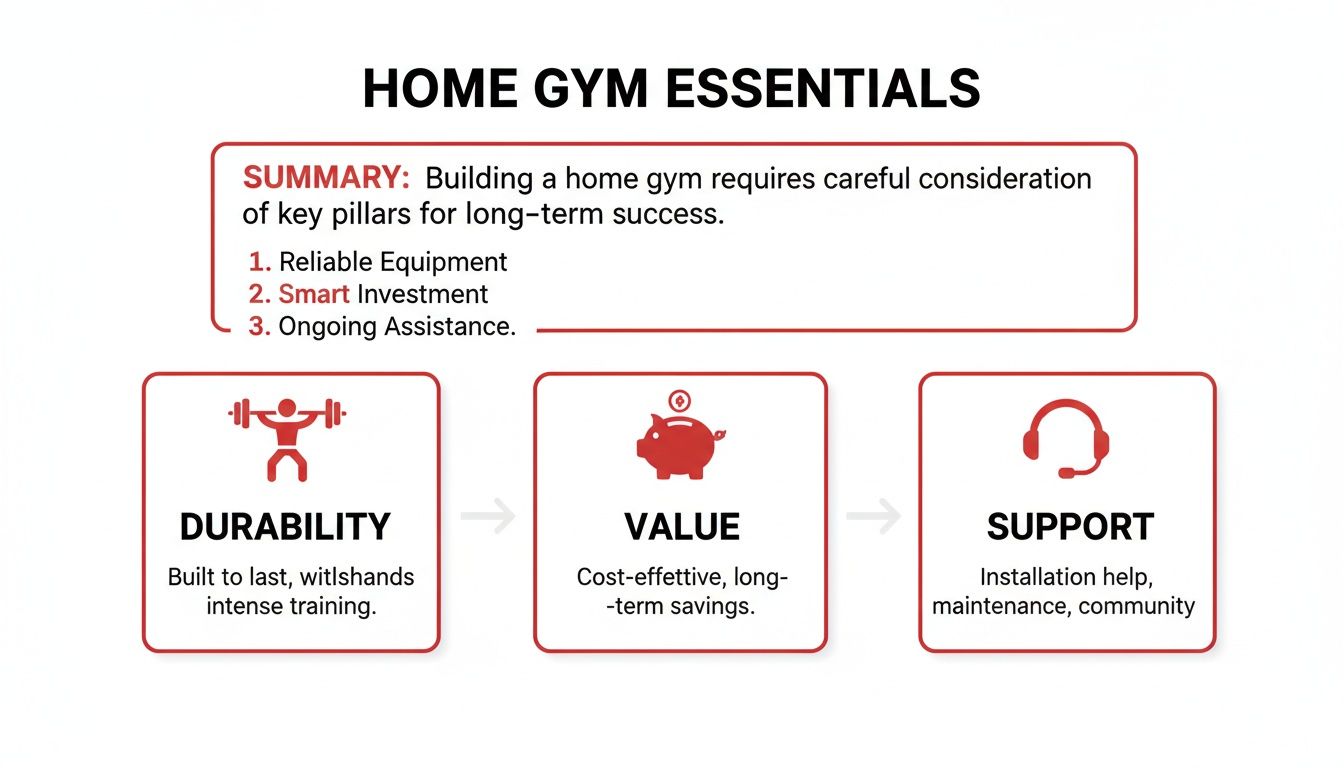
It really boils down to this: durability, long-term value, and solid customer support are the non-negotiables for any quality home gym.
Differentiating by Cost and Footprint
The lifetime cost is one of the biggest differences. Smart gyms come with a hefty upfront price tag, plus a mandatory monthly subscription—usually around $40-$60—to access all the features. While a full power rack setup isn't cheap initially, it’s a one-and-done purchase. No monthly fees.
The core financial question is simple: are you buying a product or a service? Traditional equipment is a product you own forever. A smart gym is an ongoing service that blends hardware with software.
Space is another huge factor. A wall-mounted smart gym like Tonal is incredibly compact, taking up almost no floor space. That's perfect for apartments or multi-use rooms. A power rack, even a small one, needs a dedicated footprint, which can be a non-starter if you're tight on space.
Smart Gyms vs Traditional Racks Feature Comparison
The choice often comes down to the kind of training experience you're looking for. This table breaks down what you get with each option.
| Feature | All-In-One Smart Gyms (e.g., Tonal) | Traditional Strength Brands (e.g., Rogue) |
|---|---|---|
| Workout Guidance | Fully guided; AI coaching, on-demand classes, and live form feedback. | Self-guided; requires your own programming or a third-party app. |
| Resistance Type | Digital or electromagnetic; smooth but can feel different from weights. | Physical free weights (barbells, plates, dumbbells); classic tactile feel. |
| Progressive Overload | Automatic weight adjustments and progress tracking. | Manual; you add more plates to the bar as you get stronger. |
| Exercise Variety | Broad range of guided exercises, from strength to yoga and cardio. | Virtually limitless, but you must know or learn the movements yourself. |
| Footprint | Very space-efficient, especially wall-mounted units. | Requires a dedicated floor space for a rack, bar, and plates. |
| Ongoing Cost | Requires a monthly subscription to access full functionality. | None. A one-time purchase. |
| Target User | Beginners, busy professionals, and tech-savvy fitness enthusiasts. | Serious lifters, powerlifters, and anyone wanting total training autonomy. |
Ultimately, a smart gym offers convenience and a "done-for-you" solution, while a traditional setup gives you unparalleled freedom and a connection to old-school lifting.
Versatility and Training Philosophy
This is where the lines get a little blurry. Smart gyms offer an amazing variety of workouts—strength, HIIT, yoga, mobility—all in one place. The catch is that you’re limited to the training style and exercises the platform offers.
Free weights, however, give you limitless versatility, but you have to be the one in charge. You can follow any program you find, create your own exercises, and train however you want, whether it’s for bodybuilding or CrossFit. For a seasoned athlete, that freedom is everything. For a newcomer, it can feel like being told to build a house without a blueprint.
The North American home fitness market shows this split clearly. Traditional equipment still commands a massive 65.10% market share, winning over budget-conscious buyers and experienced lifters. At the same time, smart gear is catching up fast, with the connected category projected to grow at a 5.95% CAGR through 2031. This growth is driven by the very AI coaching and app integration that makes these platforms so appealing. You can dive deeper into these market trends and their drivers if you're curious.
Why Functional and Portable Gear Is Taking Over
Beyond the classic debate between smart gyms and traditional power racks, a third category of equipment has quietly carved out a huge piece of the market. Brands focused on functional, portable, and space-saving gear are hitting a nerve with a new generation of fitness enthusiasts. This whole approach is about ditching bulky machines and heavy steel for versatile tools that can deliver a brutal, full-body workout without needing its own zip code.
This isn't just about saving space, though. It's a complete shift in training philosophy. Functional fitness is all about mastering movements you actually use in real life—pushing, pulling, lifting, and twisting. The goal is to build practical, usable strength, sharpen your coordination, and just become a more capable human being. It's a perfect fit for today's dynamic workout styles, especially High-Intensity Interval Training (HIIT).
The Rise of the Minimalist Home Gym
Let's be real: for millions of people living in apartments, condos, or homes without a spare garage, a power rack is a complete fantasy. This is where functional gear really proves its worth. Brands in this space design their equipment to be used, abused, and then tucked away out of sight.
This new wave of home gym equipment brands offers powerful solutions that can live in a closet or slide under a bed.
- Battle Ropes: A phenomenal tool for metabolic conditioning and building upper-body endurance. You can anchor them almost anywhere and coil them up when you're done.
- Heavy Jump Ropes: A simple but punishing tool for full-body cardio and power development that takes up next to no floor space.
- Resistance Bands: Probably the single most versatile piece of equipment you can own, offering scalable resistance for strength, mobility work, and physical therapy exercises.
These aren't just compromises; they're smart, purpose-built tools for getting the job done effectively and efficiently. They encourage compound movements that fire up multiple muscle groups at once, which means you get better results in less time.
MONFIT: A Case Study in Functional Design
MONFIT is a perfect example of this modern approach to home fitness. Their entire product line is built on a single principle: delivering the biggest training impact with the smallest possible footprint. By zeroing in on durable battle ropes, a complete range of resistance bands, and heavy jump ropes, MONFIT speaks directly to the needs of anyone working with limited space.
The idea isn't to replicate a commercial gym in your living room. It’s about giving you the essential tools for progressive, high-intensity training that builds real-world strength and conditioning. For instance, a full set of MONFIT resistance loop bands can stand in for dozens of exercises you'd normally do with dumbbells or cable machines, but at a tiny fraction of the cost and space.
The real magic of functional equipment is its adaptability. It meets you wherever you are—a small living room, a hotel room, or a corner of your office—and gives you a challenging workout with zero excuses.
This philosophy lines up perfectly with the biggest drivers in the home fitness market. While forecasts vary, they all paint a picture of massive growth. Some analysts project a USD 4.96 billion surge by 2029, largely driven by the popularity of HIIT and the integration of digital fitness. The key takeaway? All signs point to a colossal demand for durable, effective setups under $1,000, which puts functional tools in the sweet spot for a huge segment of the market. You can dig deeper into these home gym equipment market insights to see where things are headed.
Who Benefits Most from Functional Equipment?
While just about anyone can get a great workout with this gear, it’s a game-changer for a few specific types of people. The apartment dweller who wants to blast through a workout before work without waking up the neighbors is a prime candidate. So is the hybrid athlete who hits a commercial gym a few times a week but wants functional tools at home to supplement their training on other days.
Busy professionals who travel for work find that a set of resistance bands and a jump rope are all they need to stay on track while on the road. This incredible flexibility is what defines functional equipment. It systematically dismantles the most common barriers to exercise—no time, no space, no gym—making it one of the most practical and sustainable ways to build a fitness habit that actually sticks.
Matching Your Fitness Goals to the Right Brand
Theory is great, but the rubber meets the road when you apply it to your own life. The "best" home gym brand isn't a one-size-fits-all trophy; it's the one that solves your specific fitness problems. To make this crystal clear, let's walk through three common scenarios and see which brands and gear make the most sense.
By looking at how different goals and limitations shape these decisions, you'll get a much better feel for which path is right for your own fitness journey.
Scenario 1: The Apartment Dweller Focused on HIIT
You live in a small apartment with zero dedicated gym space. Your goal is high-intensity interval training (HIIT) to get your heart rate up and build functional strength. You're on a budget, and whatever you buy needs to disappear into a closet when you're done.
For this person, a traditional power rack is a non-starter, and a smart gym is likely too expensive and permanent. This is where functional, portable gear really shines.
- Recommended Brand Category: Versatile Functional Gear
- Example Brand: MONFIT
- Ideal Setup: A MONFIT kit is a perfect match here. Think a set of loop resistance bands, a heavy jump rope, and a battle rope. This combination gives you a complete strength and conditioning workout in a tiny footprint. The bands offer scalable resistance, the jump rope is a cardio machine in its own right, and the battle rope delivers a brutal metabolic workout.
This setup is a home run on space efficiency, price, and product focus. It delivers the tools for tough, progressive workouts without demanding permanent real estate, making it ideal for a minimalist, on-the-go lifestyle.
Scenario 2: The Aspiring Powerlifter with a Garage
Here we have someone with a garage and a single, clear mission: get brutally strong. They're all about the big three—squat, bench press, and deadlift. Digital features and guided classes are just noise; they need heavy-duty equipment that can take a beating for years.
For a serious lifter, there's no substitute for the feel of real iron. Smart gyms just can't replicate the specific loading capacity and raw feedback they need.
- Recommended Brand Category: Traditional Strength Specialists
- Example Brand: Rogue Fitness
- Ideal Setup: The classic powerlifting foundation: a heavy-duty 11-gauge steel power rack, a high-quality barbell with the right knurling, a sturdy flat bench, and a pile of iron or bumper plates.
This choice is a direct investment in build quality and durability. A brand like Rogue often puts a lifetime warranty on its rack frames, which tells you everything you need to know about their confidence in the product. It provides the rock-solid safety needed to chase new personal records without a second thought.
Scenario 3: The Busy Professional Needing Guided Workouts
Our final person is a busy professional who wants to build muscle but doesn't have the time or knowledge to program their own workouts. They crave efficiency, data tracking, and a "just tell me what to do" solution. They have a bit of wall space but not enough room for a full rack.
This user's biggest obstacle isn't just physical—it's mental energy. The structure and motivation from a guided system are what will keep them showing up.
- Recommended Brand Category: All-in-One Smart Gyms
- Example Brand: Tonal
- Ideal Setup: A single Tonal unit, professionally installed on a solid wall. It uses digital resistance, offers a massive library of trainer-led classes, and tracks your progress automatically.
This route is all about user experience and innovation. It takes the guesswork out of working out, letting you focus purely on your performance. For more ideas on different setups, our guide on how to build a home gym is a great resource.
Common Questions About Home Gym Equipment Brands
Once you start seriously considering different home gym equipment brands, a whole new set of questions tends to pop up. It's totally normal. Making that final call means getting into the nitty-gritty details, and this section is here to clear things up so you can feel good about your investment.
We’ll tackle some of the most common queries, from the practicalities of mixing and matching gear to what a warranty really tells you about a product.
Can I Mix Equipment From Different Brands?
You absolutely can—and you probably should. While sticking to one brand might look uniform, it’s almost never the best way to build a high-performing or cost-effective gym. The truth is, no single company is the best at everything.
Think about it: a brand like Rogue Fitness is legendary for its power racks and barbells, but you might find an adjustable bench from another company that fits your space or budget better. In the same way, you could grab some foundational iron from a traditional strength brand and then round out your setup with specialized conditioning tools from a functional fitness expert like MONFIT.
Your home gym should be a hand-picked collection of the best tools for the job, regardless of the logo. Brand loyalty is less important than performance. This way, every single piece in your setup is a winner.
Building your gym this way also lets you be smarter with your money. You can splurge on a core item where quality is non-negotiable—like that power rack—and save on accessories where the difference between a good brand and a great one is less noticeable.
Why Is Warranty and Support So Important?
A warranty is more than just a piece of paper that promises a repair. It's a brand's way of telling you how much they believe in their own products. When a company offers a lifetime warranty on a steel frame or a multi-year guarantee on a set of resistance bands, they’re betting on their own craftsmanship.
But a warranty is only as good as the team behind it. If a part breaks or you run into an issue, you need to know you can reach a real person who can solve your problem without a headache. Before you buy anything, take five minutes to read reviews specifically about customer service. It’s worth its weight in gold.
Here’s a quick breakdown of what to expect:
- Lifetime Warranties: These usually cover the structural integrity of steel frames on things like racks and benches.
- Limited Warranties: You'll typically see these on moving parts, cables, or upholstery, often for 1-3 years.
- Wear-and-Tear Items: Things that naturally degrade with use, like resistance bands, might have shorter warranties, from 90 days to 1 year.
Think of it as insurance. A brand with a solid warranty and a great reputation for support is a brand that respects its customers and stands by its gear.
How Do I Start a Home Gym on a Budget?
You don't need to drop a ton of cash to get a quality home gym off the ground. The secret is to start small with a few versatile, high-impact pieces and then expand over time. The biggest mistake is buying a cheap, all-in-one machine that promises everything but does nothing well.
Instead, focus on tools that give you the most bang for your buck. A good set of loop resistance bands, a single adjustable kettlebell, and a heavy jump rope can provide a killer full-body workout for less than the cost of one big, clunky machine.
As you have more to spend, you can add those bigger foundational pieces one by one. This slow-and-steady approach ensures every purchase is a smart one that grows with you. If you have more questions, you can always check out the frequently asked questions on our site for more detailed info.
Can Functional Gear Really Replace Machines?
For the vast majority of people, the answer is a big yes. Unless you're a competitive bodybuilder who needs to hit tiny muscle groups with laser precision, functional equipment delivers better results for building strength you can actually use in real life.
Most machines lock you into a single, fixed path of motion. This can neglect all the little stabilizer muscles that are crucial for preventing injury and building true functional strength. On the other hand, tools like battle ropes, kettlebells, and resistance bands force your body to work as a complete system, improving your balance, coordination, and core strength all at once.
This doesn't just build a more athletic body; it's also a more engaging and efficient way to train. A 20-minute HIIT workout with a battle rope can smoke your conditioning far more effectively than 20 minutes plodding along on a stationary bike. The best home gym equipment brands in the functional space design their gear around this very principle.
Ready to build a powerful, compact home gym without the clutter? The MONFIT collection of durable battle ropes, heavy jump ropes, and versatile resistance bands is engineered to deliver maximum results in minimum space. Start building a setup that fits your life and goals today. Shop the MONFIT collection.


