


Resistance bands aren't just a gimmick; they're a seriously effective functional training tool for building muscle, boosting your mobility, and safely pushing your limits. The secret is in the constant tension they provide. Unlike a dumbbell, the band keeps working your muscles through the entire movement, from start to finish. This makes them an incredible tool for everyone, from beginners to seasoned lifters, and even for physical therapy.
Your Portable Gym for a Stronger You
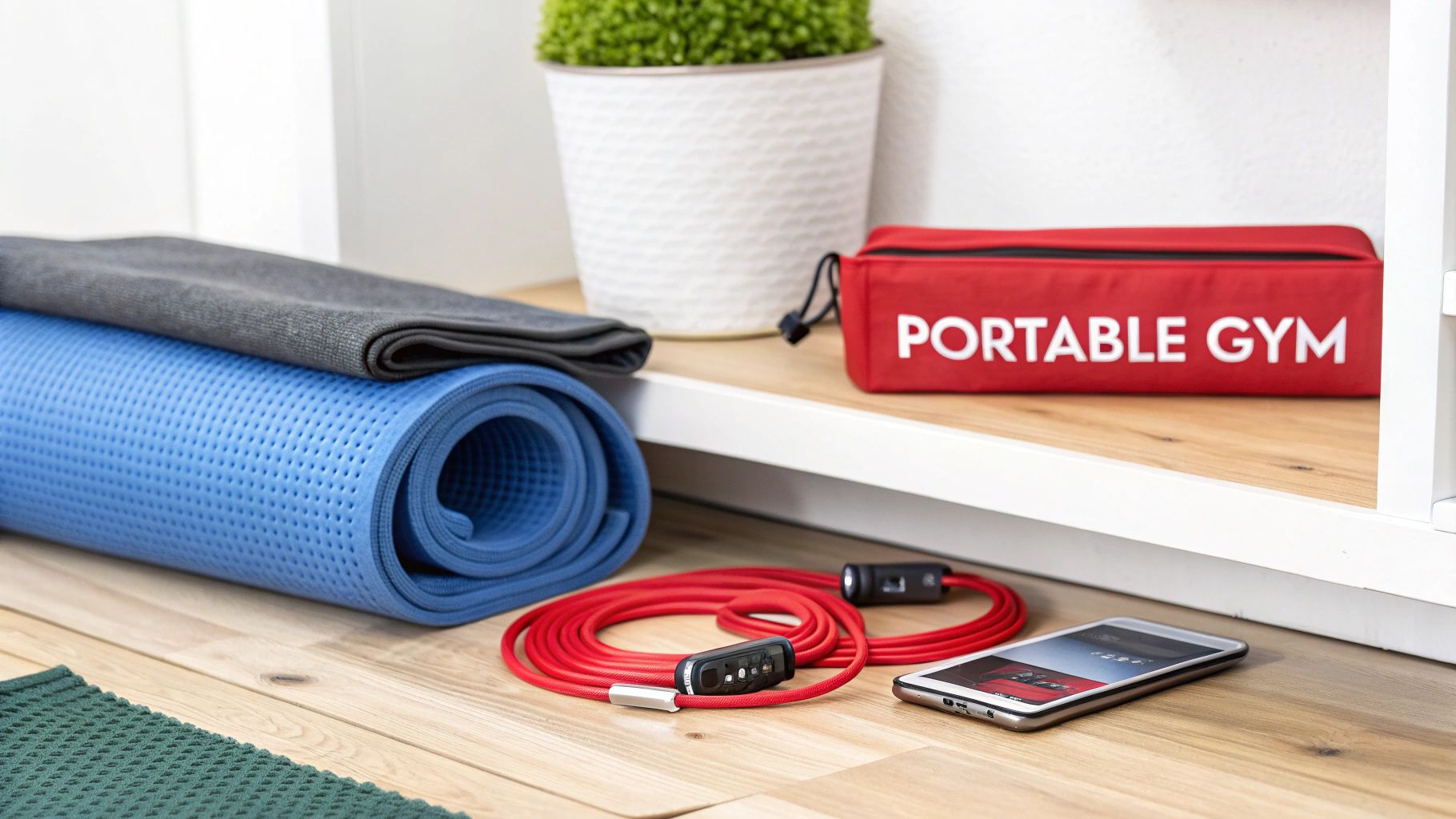
Life gets busy, and finding space for a full home gym can be a nightmare. This is exactly where the portability of resistance bands comes in. They are a full-body gym that you can toss in a drawer or a backpack, letting you challenge every muscle group without leaving the house or when you travel. Their ease of travel makes them an essential piece of functional training equipment for anyone on the go.
Think about lifting a dumbbell: gravity does half the work for you on the way down. Bands are different. They provide dynamic, variable resistance, meaning your muscles are engaged and fighting through the entire range of motion, both on the concentric (lifting) and eccentric (lowering) phases. This continuous engagement is a huge advantage for building real-world, functional strength.
A Smarter Way to Train
Resistance bands aren't just a stand-in for weights; for many goals, they're actually a smarter choice. Their elastic nature allows you to move in ways that mimic everyday life, something a fixed-path gym machine simply can't do.
This makes them the perfect tool for:
- Building lean muscle without putting unnecessary strain on your joints.
- Improving stability by forcing those small, crucial stabilizer muscles to fire up.
- Enhancing mobility and flexibility through dynamic, controlled movements.
- Supporting injury rehabilitation by offering gentle, easily adjustable resistance.
The real magic of resistance bands is how they adapt to your body's strength curve. They challenge your muscles most at their strongest point in a lift and ease up where you're weakest, leading to a safer, more balanced workout.
If you're building out your home gym from scratch, our guide on the best portable home gym equipment can give you some great ideas to get started.
To see just how practical bands are compared to traditional weights, here's a quick side-by-side look.
Resistance Bands vs Traditional Weights at a Glance
For anyone working out at home, this quick comparison makes it clear why resistance bands are often the superior choice for functional training.
| Feature | Resistance Bands (e.g., MONFIT) | Traditional Weights (Dumbbells/Barbells) |
|---|---|---|
| Portability & Storage | Excellent; lightweight and compact, fits in a bag | Poor; heavy, bulky, requires significant space |
| Cost | Low; a full set is highly affordable | High; costs can run into hundreds or thousands |
| Versatility | High; targets all muscle groups with endless exercise variations | Moderate; effective for strength but limited in planes of motion |
| Joint Impact | Low; provides progressive tension without joint compression | High; gravity-based load can stress joints and connective tissue |
Ultimately, while both tools have their place, the convenience, safety, and versatility of resistance bands make them an unbeatable solution for achieving your fitness goals anywhere, anytime.
How Bands Build Real-World Strength and Muscle
Let's debunk a common myth right away: resistance bands are not just for light "toning" workouts. That idea completely misses the mark on the science behind how these simple tools build serious, functional strength. The secret sauce is a principle called variable resistance, and it's a game-changer compared to free weights.
Think about stretching a rubber band. The farther you pull, the tougher it gets. That’s exactly what resistance bands do to your muscles. They create a unique challenge that forges strength in a way that gravity-bound weights simply can't.
The Magic of Continuous Tension
When you lift a dumbbell, the load feels heaviest at one specific point in the movement. For a bicep curl, the struggle is real about halfway up, but near the top of the curl, the tension almost disappears. Bands completely flip that experience on its head.
With a band, the resistance actually increases as you move through the exercise. This forces your muscles to fire harder and harder right up to the point of full contraction. This constant engagement is what fitness pros call maximizing Time Under Tension (TUT), a key driver for hypertrophy, or muscle growth. Every single inch of the movement, both on the way up and the way down, becomes a chance to get stronger.
As the resistance ramps up through your range of motion, your body has to recruit more muscle fibers to finish the rep. This doesn't just build bigger muscles; it trains your body to generate force more powerfully, which is the very definition of functional strength.
Building Strength That Actually Matters
This unique resistance curve is precisely why bands are so good at building practical strength, the kind you use in everyday life. It’s the strength you need for lifting groceries, playing with your kids, or boosting your performance in a sport. You need to be strong through your entire range of motion, not just one part of it.
And this isn't just theory; it’s backed by solid science. Major studies have shown that training with elastic bands can produce strength gains that are right on par with using conventional equipment like dumbbells and weight machines. When researchers compared bands to free weights for both upper and lower body exercises, they found no significant difference in the results. It's settled: bands are a legitimate tool for getting stronger.
Of course, to get the most out of any training, you need to fuel your body correctly. Pairing your workouts with proper sports nutrition gives your muscles the raw materials they need to repair and grow. And if you're looking for specific movements to try, we've got you covered in our guide to resistance band exercises at home.
Choosing the Right MONFIT Band for Your Goals
Walking into the world of resistance bands can feel a bit overwhelming at first. With all the different shapes, sizes, and colors, how do you know which one is right for you? The good news is, it’s not as complicated as it looks.
Think of each MONFIT band as a specific tool in your personal gym kit. You wouldn't use a hammer to turn a screw, right? The same logic applies here. Matching the right band to your fitness goal is the key to unlocking its full potential, whether you're chasing raw strength, activating tiny stabilizer muscles, or just getting a good full-body workout on the go.
Your Guide to MONFIT Bands
To make things easy, let's look at the three main types of bands we offer at MONFIT and their practical training use cases. Once you see their primary purpose, you'll know exactly which one fits into your routine.
-
Tube Bands with Handles: These are your go-to dumbbell replacements. The handles give them a familiar, comfortable feel, making them perfect for classic strength exercises like bicep curls, chest presses, and overhead presses. They let you perform all the gym movements you know and love, but with the unique benefit of accommodating resistance.
-
Pull-Up Bands (Power Bands): These are the heavy hitters. As thick, continuous loops, they're built for serious work. While their most famous job is helping you conquer the pull-up, they're also fantastic for adding a ton of resistance to compound lifts like squats and deadlifts or for explosive speed work.
-
Loop Bands (Mini Bands): Don't let their small size fool you. These little loops are absolute game-changers for activation and stability. You’ll usually wear them around your thighs or ankles to fire up your glutes and hips. They're indispensable for warm-ups, corrective exercises, and fine-tuning your lower-body form. Find out more about how MONFIT's resistance loop bands can help you zero in on these critical muscle groups.
Every rep you perform to build muscle involves a few key phases, and bands are uniquely suited to challenge you through each one.
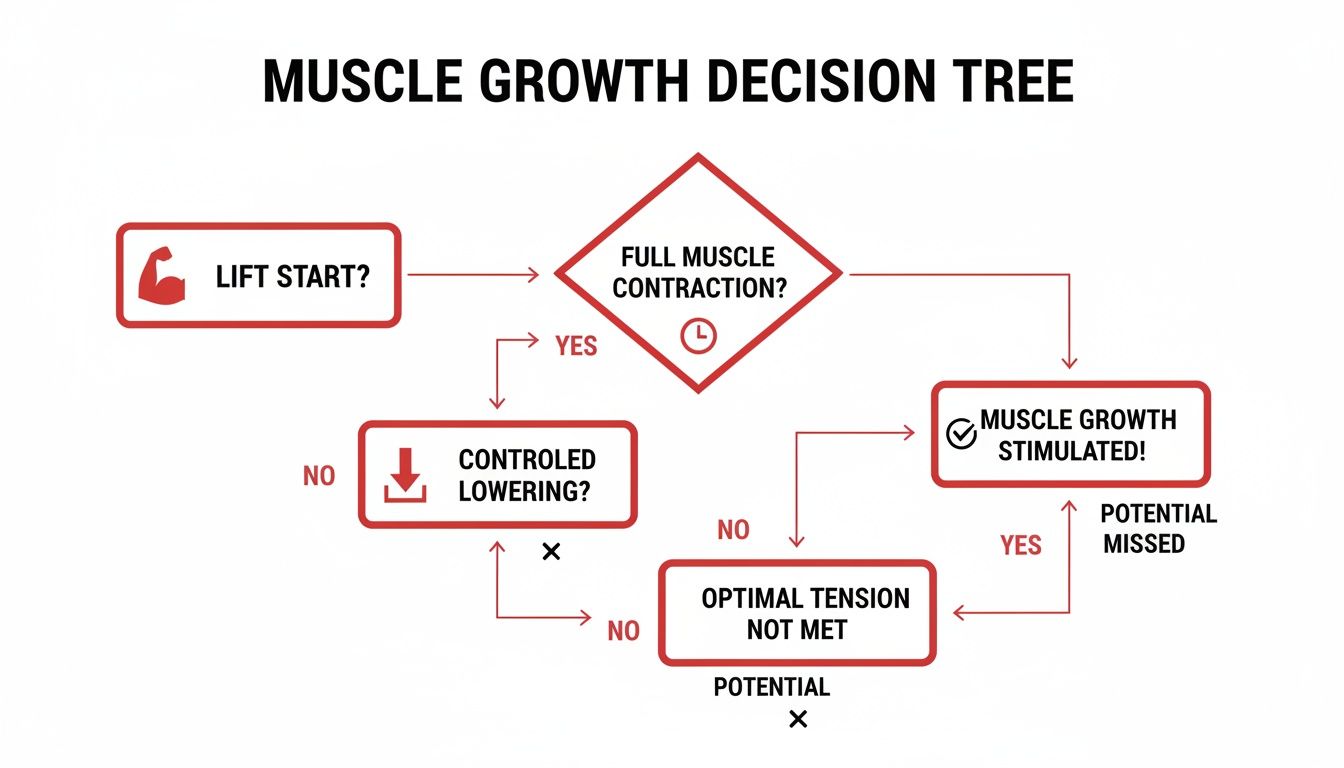
As you can see, growth isn't just about the "lift." It happens at the very top of the movement (peak contraction) and during the controlled negative on the way down. Bands keep the tension on through all of it, leaving no room for your muscles to slack off.
Matching Bands to Your Workout Goals
Now, let's get personal and connect these tools directly to what you want to achieve. Once you know your "why," choosing the right band becomes crystal clear.
The most effective training plans often mix and match. It’s not about picking just one type of band and sticking with it forever. A single workout might see you using a heavy Pull-Up Band for squats, a medium Tube Band for rows, and a light Loop Band to wake up your glutes before you even start.
To help you decide, I've put together a simple chart that breaks down which band is the best fit for different training styles and goals.
Which MONFIT Resistance Band Is Right for You?
This table offers a detailed comparison to help you choose the ideal band based on your workout style and fitness goals.
| MONFIT Band Type | Primary Use Case | Best For | Resistance Level |
|---|---|---|---|
| Tube Bands with Handles | Full-body strength, replacing dumbbells | Home gym workouts, travel fitness, isolation exercises | Light to Heavy |
| Pull-Up Bands | Assisted bodyweight, heavy resistance | Pull-up progression, powerlifting, speed training | Medium to Extra-Heavy |
| Loop Bands | Muscle activation, mobility, rehab | Glute warm-ups, hip stability, physical therapy | Extra-Light to Heavy |
Ultimately, the best band is the one that aligns with your specific needs. Use this guide as your starting point, and don't be afraid to build a collection over time to create a truly versatile, portable gym.
Improving Mobility and Supporting Joint Health
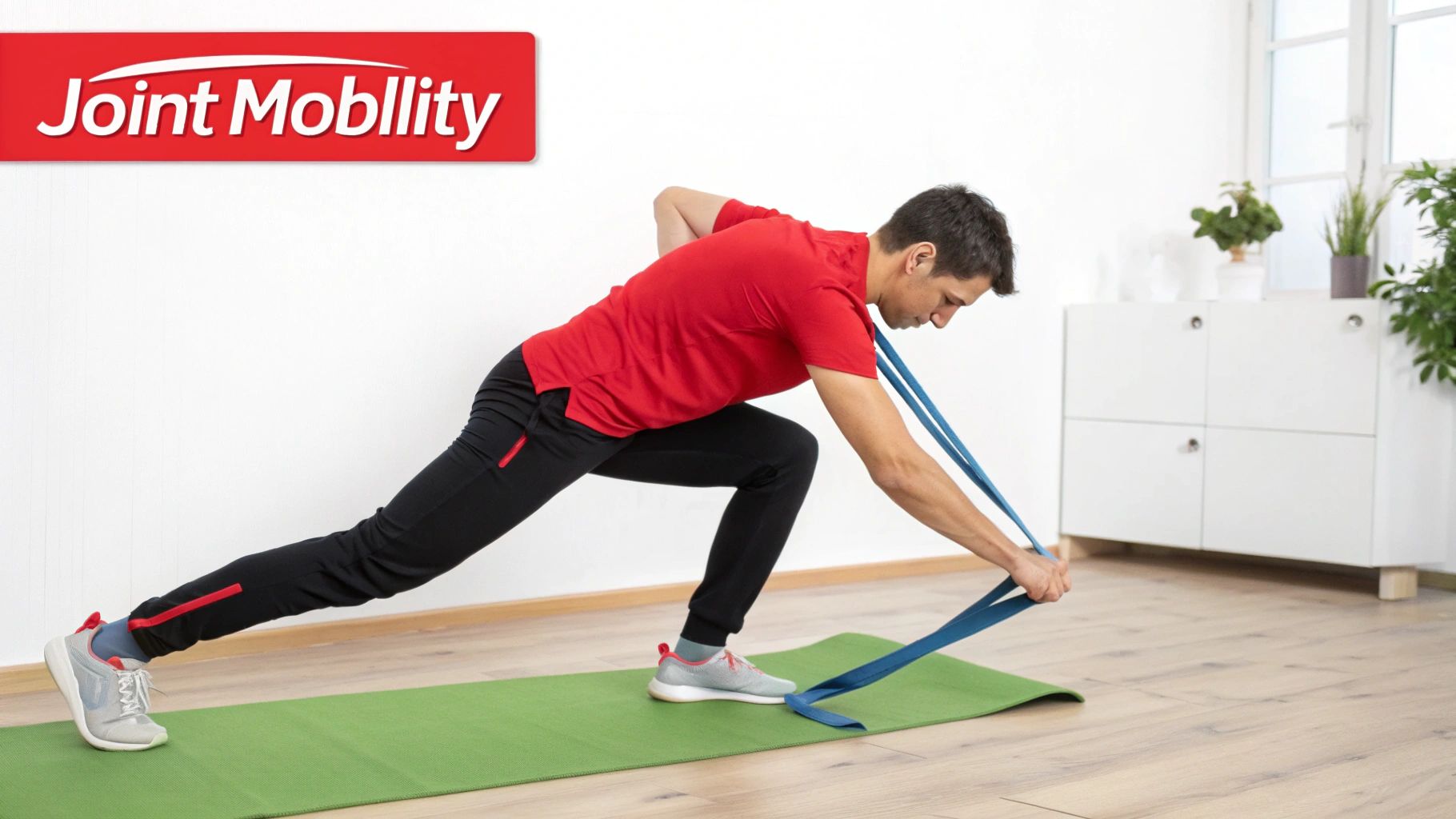
Real-world fitness isn't just about how much you can lift; it's about how well you can move through life without aches and pains. This is where resistance bands truly shine, offering incredible benefits for your mobility and long-term joint health.
Unlike heavy weights that use gravity to pull down and compress your joints, bands provide a controlled, low-impact tension. This gentle resistance is ideal for activating and strengthening the smaller, often-overlooked stabilizer muscles that protect major joints like your shoulders, hips, and knees.
Strengthening Your Body’s Support System
Think of these small stabilizer muscles as the unsung heroes of your body. When they're weak, the larger muscles are forced to pick up the slack, often leading to faulty movement patterns, instability, and a greater risk of injury. Loop bands are fantastic tools for zeroing in on these crucial support systems.
The constant tension from a band gives you immediate feedback through every inch of an exercise, helping you forge a stronger mind-muscle connection. This heightened awareness trains your body to fire up the right muscles at the right time, resulting in better form and more resilient joints. If you're keen on tracking your improvements, a practical guide to range of motion testing can be a great way to measure your progress.
There's a reason physical therapists have sworn by resistance bands for decades. They allow patients to safely rebuild strength during rehab without putting undue stress on healing tissues.
The consistent, smooth tension from a resistance band encourages movement through a full, healthy range of motion. This not only strengthens the muscles around a joint but also promotes lubrication and blood flow, which are vital for joint health.
Backed by Science for Better Movement
The power of bands for improving functional fitness isn't just theory; it's backed by solid research. A major meta-analysis covering 25 trials confirmed that elastic band training is a highly effective way to boost mobility.
The study found that band workouts led to significant gains in leg strength, balance, and overall movement quality, which in turn reduced the risk of falls among participants. Importantly, these benefits were observed in both healthy individuals and those with existing health conditions, proving just how versatile bands really are.
For those looking to take their mobility work a step further, specialized tools like floss bands provide even more targeted benefits. If you want to dive deeper into joint care and recovery, you might be interested in our MONFIT floss bands, which use compression to improve tissue mobility and range of motion.
Ultimately, by making bands a regular part of your routine, you're making a smart investment in your body's ability to move well for years to come.
Your First Full-Body Resistance Band Workout
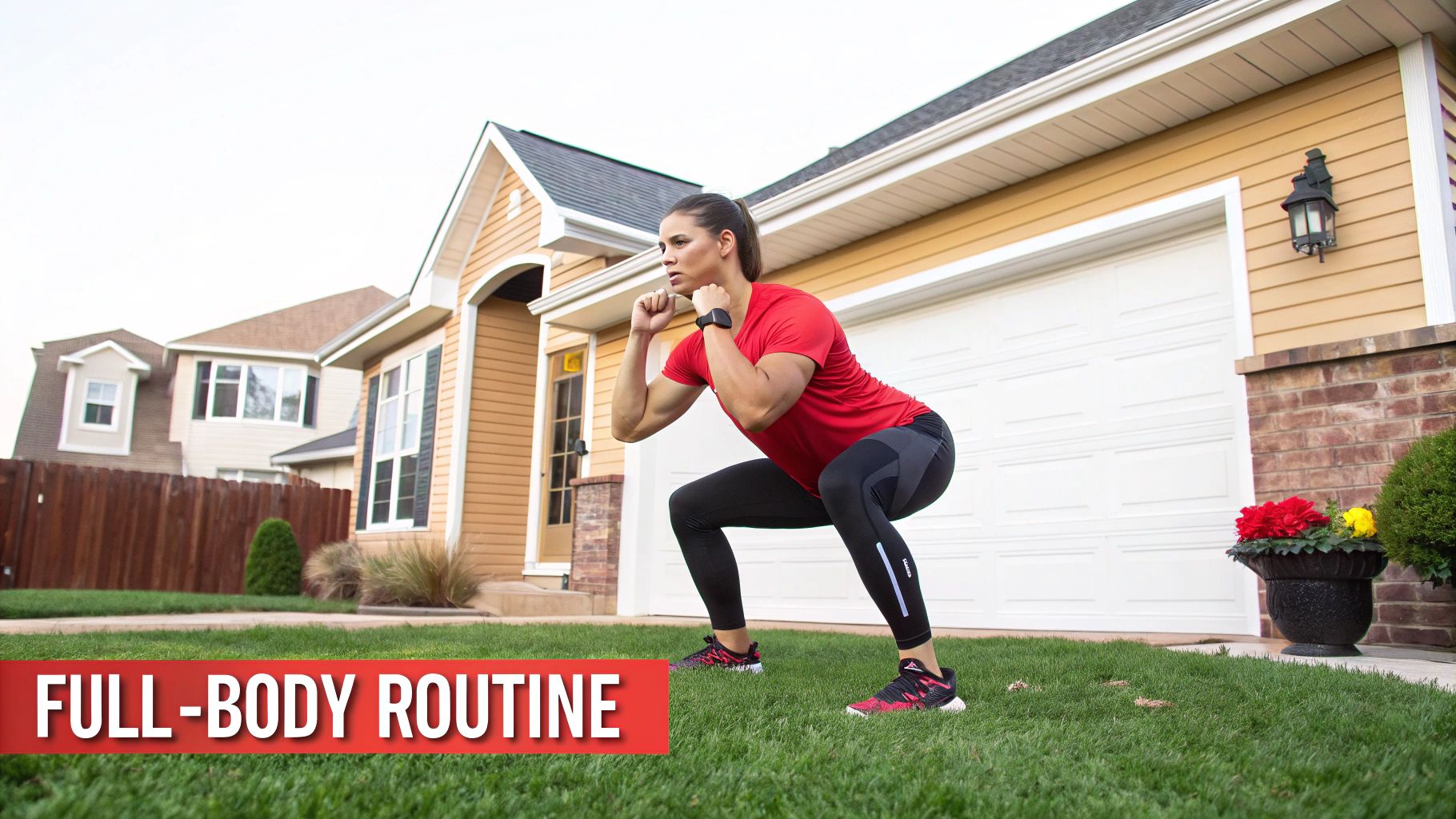
Okay, enough with the theory. Results come from putting in the work. Let's walk through a straightforward, full-body workout you can do right now with your MONFIT bands. I’ve designed this routine to hit every major muscle group for a balanced and seriously effective session.
This is your blueprint. No more guessing what to do. It’s built to deliver all the benefits we’ve talked about, from keeping your muscles under tension to firing up those all-important stabilizer muscles. Let’s get moving.
Your Warm-Up and Workout Plan
First things first: never skip your warm-up. Spend about 5 minutes getting your body ready with some light cardio, like jogging on the spot, and a few dynamic stretches: think arm circles and leg swings.
For the workout itself, aim for 2-3 sets of 10-15 repetitions for each exercise. Take a 45-60 second rest between your sets to catch your breath.
The most important thing to remember is to control the movement. We're not trying to fly through the reps. The goal is to feel your muscles straining against the band on the way up and on the way down.
Here’s your full-body circuit:
-
Banded Squats (Lower Body): Step onto a MONFIT Pull-Up Band with your feet about shoulder-width apart. Drape the other end of the band over the back of your shoulders. Drop into a squat, keeping your chest proud and back straight, then power back up to the start.
-
Bent-Over Rows (Back): Stand on the middle of a MONFIT Tube Band with both feet. Hinge forward at your hips, maintaining a flat back. Grab the handles and pull them toward your lower ribs, really squeezing your shoulder blades together at the top.
-
Overhead Press (Shoulders): Stand on a Tube Band with one or both feet for the right amount of tension. With the handles at shoulder height and palms facing forward, press straight up until your arms are fully extended.
-
Chest Press (Chest): Wrap a Pull-Up Band around your upper back and hold the ends in each hand. From a staggered stance, push your hands forward until your arms are straight, focusing on squeezing your chest muscles.
-
Bicep Curls (Arms): Stand on a Tube Band, holding the handles with your palms facing forward. Keeping your elbows pinned to your sides, curl the handles toward your shoulders.
-
Plank with Leg Lifts (Core): Slide a MONFIT Loop Band around your ankles and assume a solid plank position. Brace your core and lift one leg a few inches off the floor. Lower it with control and then switch to the other side.
This simple circuit creates a powerful metabolic effect by engaging multiple muscle groups. You're not just building strength; you're also boosting your heart rate and burning calories efficiently.
As you get stronger, progress is simple: just grab a band with more resistance or add another set or a few more reps. If you're brand new to all of this, we've got you covered with even more tips in our guide to resistance band exercises for beginners. Consider this workout your first step toward getting consistent results, no matter where you are.
Mastering Form and Avoiding Common Mistakes
Getting the most out of your resistance band workouts really boils down to one thing: the quality of your movement. The unique tension from bands is fantastic for rewarding good form, but it can also make it easy to cheat if you’re not paying close attention. Nailing your technique is what turns a so-so workout into a seriously effective one.
The golden rule here is to control both phases of every single rep. Think about it this way: your muscles should be fighting the band as you stretch it (the concentric part) and resisting it as it retracts (the eccentric part). One of the most common mistakes is just letting the band snap back after you've pulled it. Doing that robs you of half the benefit and can be a recipe for injury.
Fixing Common Form Errors
To get stronger and stay safer, keep an eye out for these classic slip-ups. Just being mindful of them will help you squeeze the maximum value out of every rep while protecting your joints.
-
Using Momentum: If you find yourself swinging your body to finish a rep, you're using momentum, not muscle. The fix is simple: slow down. Really focus on isolating the muscle you're trying to work. If you have to jerk the band to get it to move, the resistance is too heavy.
-
Letting the Band Go Slack: The moment a band loses tension, your muscles get a little break. To keep them working the whole time, make sure there’s at least a light stretch on the band from the very start to the very end of the movement.
-
Incorrect Anchoring: A stable anchor point is non-negotiable, whether you’re standing on the band or looping it around a door. If your anchor slips mid-exercise, the band can snap back and hit you. Always give it a good tug and double-check that it’s secure before you start.
Choosing a resistance level that forces you to compromise your form is a fast track to poor results. It's always better to perform an exercise perfectly with a lighter band than to struggle through it with a heavier one.
By making slow, deliberate movements your priority and steering clear of these common mistakes, you’ll stay safe and unlock the full muscle-building power that makes resistance bands such a fantastic tool.
Got Questions About Resistance Bands? We've Got Answers.
Even after seeing all the benefits laid out, you might still have a few things you're wondering about. That's perfectly normal. Let's tackle some of the most common questions we hear from people just starting out with resistance bands.
Think of this as your quick-start guide to clear up any lingering doubts before you jump in.
Can You Really Build Serious Muscle with Just Bands?
You absolutely can. The secret to building muscle isn't about lifting the heaviest thing you can find; it's about a principle called progressive overload. All that means is you have to consistently make your muscles work harder than they're used to. Bands are a fantastic tool for this.
When an exercise starts to feel easy, you can grab a thicker band, use two bands at once, or just add a few more reps to your set. It's that simple. Research has shown time and again that you can get strength gains with bands that are right on par with traditional weights. That's because the constant tension from a stretched band gives your muscles a unique challenge that you don't always get from a dumbbell.
How Often Should I Work Out with Bands?
For building overall strength and fitness, a great sweet spot is 2 to 4 full-body workouts per week. This gives your muscles plenty of work to adapt and grow, but just as importantly, it gives them time to rest and recover.
One of the best things about bands is how easy they are on your joints. Since they don't have the same heavy, gravity-driven impact as free weights, you might find you bounce back a little quicker between sessions. That said, always listen to your body. Make sure you get at least one full rest day between those big workouts. For lighter stuff like mobility drills or warming up, you can use the smaller loop bands every day.
The best workout schedule is the one you can actually stick to. It's far better to nail two solid workouts every single week than to aim for four, burn out, and quit after a month. Consistency is what gets you results in the long run.
How Do I Know Which Resistance Level to Start With?
It's all about finding that "just right" challenge. The perfect band is one that lets you finish all your reps (say, 10 to 15) with good, solid form, but makes those last 2-3 reps feel like real work. If you can fly through the set without breaking a sweat, the band is too light.
On the flip side, if you find your form getting sloppy just to finish the set, the band is too heavy. The best approach? Start lighter than you think you need to. Get the movement down perfectly first, then increase the resistance. This is why a set with multiple bands, like the ones from MONFIT, is so valuable: it lets you progress at your own pace.
Are Resistance Bands Safe for My Joints?
Yes, without a doubt. In fact, bands are one of the safest ways you can strength train, especially if you have sensitive joints. Free weights rely on gravity, which can sometimes put a lot of compressive force on your knees, shoulders, and back. Bands create a smooth, elastic tension that’s much kinder to your body.
This variable resistance also works with your body's natural strength. The tension is lowest at the start of an exercise (where you're weakest) and gradually increases as you move into the strongest part of the motion. This unique quality makes them a go-to tool for physical therapy and a smarter choice for anyone looking to train hard without the aches and pains.
Ready to feel the difference for yourself? The MONFIT collection of tube bands, pull-up bands, and loop bands has everything you need to create a home gym that’s effective, versatile, and goes wherever you do. Explore our full range of premium fitness tools today.
