


The best small home gym ideas aren't about cramming a commercial gym into your apartment. They're about smart, strategic choices—combining multi-functional equipment with clever storage to transform any corner into your personal workout zone. The key is to think vertically with wall-mounted storage for things like resistance bands and heavy jump ropes, and to pick versatile gear that gives you a full-body workout without taking over your home.
The Rise Of The Micro Gym
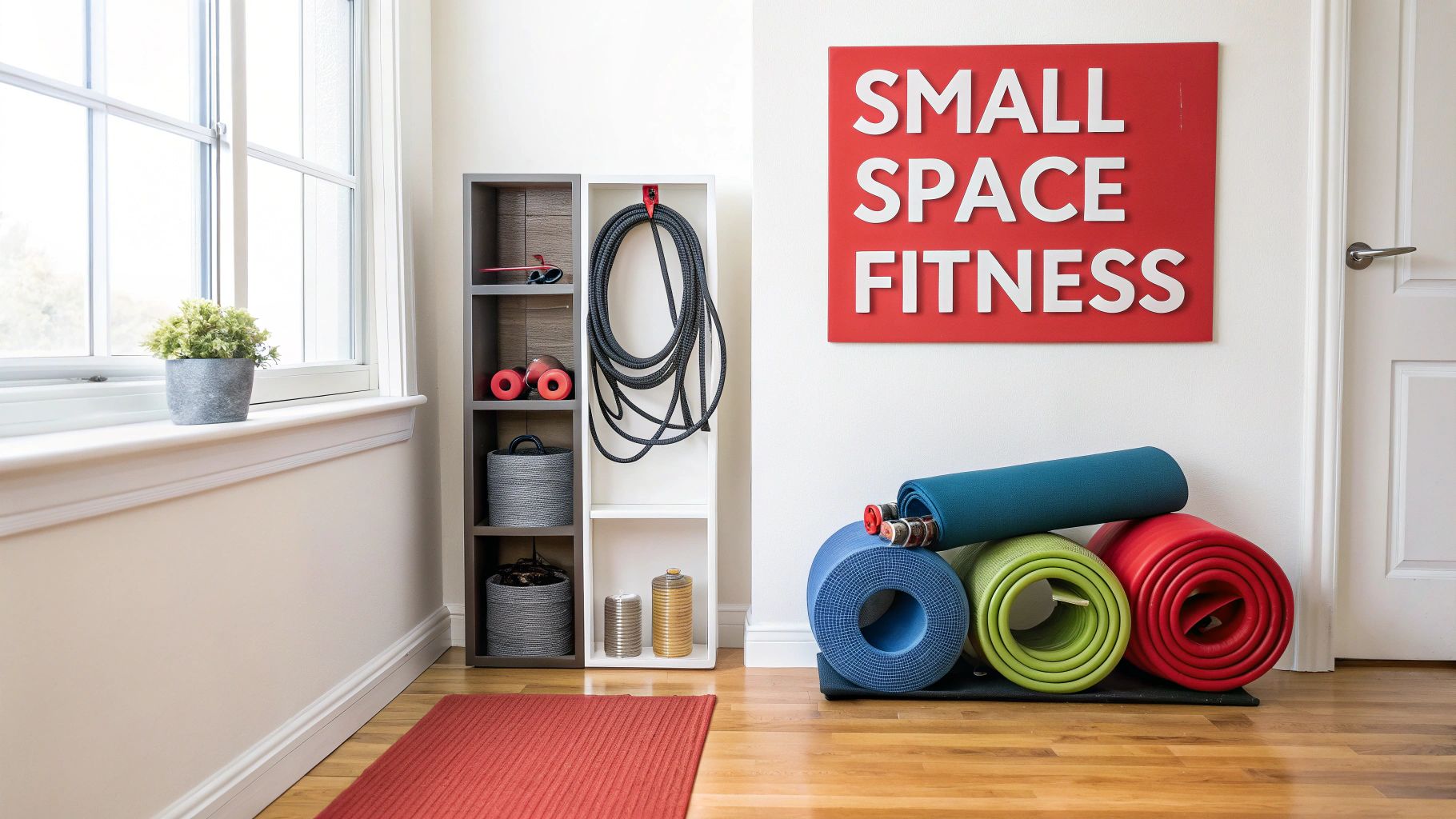
Let's be real: finding space for a home gym can feel like a losing game of Tetris. That sad, overlooked corner in your studio apartment, the awkward nook under the stairs, or even a sliver of balcony space can seem hopelessly small. But you don't actually need a huge, dedicated room to build a serious fitness routine. The modern approach to working out at home is all about efficiency, not excess.
An effective gym is measured by the quality of the sweat sessions it produces, not the square footage it takes up. This simple shift in mindset has fueled a massive movement toward home-based fitness, driven by our need for convenience in ridiculously busy lives. The commute to a crowded gym is quickly being replaced by the simple, beautiful practicality of having your workout gear just a few steps away.
Why Small Is The New Big
This trend toward compact workout spaces isn't just a fad; it’s a smart response to how we live now. People are prioritizing workouts that fit seamlessly into their day, and the fitness industry is finally catching up.
The numbers don't lie. The global home gym equipment market is booming, valued at around USD 12.4 billion in 2025 and on track to hit a staggering USD 19.6 billion by 2035. This incredible growth is directly tied to the rise of small-space home gyms, where busy professionals and HIIT fanatics are turning tiny corners into powerhouse training zones.
This is where your equipment choices become absolutely critical. Forget bulky, single-purpose machines. The focus now is on versatile tools that offer maximum impact with a minimal footprint.
For instance:
- Resistance Bands: These are the unsung heroes of the micro gym. They provide variable resistance for strength training, can help you master pull-ups, and are essential for mobility work—all while fitting neatly into a drawer.
- Heavy Jump Ropes: A killer tool for full-body cardio and conditioning. A good heavy rope delivers an intense workout without needing any more space than you do.
- Battle Ropes: Once found only in sprawling gyms, compact battle ropes are now designed for metabolic conditioning in smaller areas, making high-intensity training truly accessible at home.
The secret to a successful micro-gym isn't about having more equipment; it's about having the right equipment. Versatility and portability are your biggest allies in transforming a small area into a personal fitness sanctuary.
Here’s a quick-glance guide to the essential steps for creating your home gym. We'll expand on each of these points throughout the article.
Your Small Space Gym Blueprint Quick Guide
| Planning Step | Key Action | Recommended MONFIT Gear |
|---|---|---|
| Space Assessment | Measure your area and identify potential zones. | MONFIT Heavy Jump Ropes (require minimal floor space) |
| Equipment Selection | Choose multi-functional and compact gear. | MONFIT Resistance Bands & Power Bands Set |
| Layout & Storage | Plan for vertical storage and an efficient layout. | MONFIT Battle Ropes with Anchor (easy to store) |
| Safety First | Ensure proper flooring and clear workout space. | N/A |
This table is just the starting point. Throughout this guide, we'll give you actionable advice to turn any space—from a sliver of your living room to an unused closet—into a highly functional workout area. You'll learn how to choose the right gear and even explore some of the best home gym equipment brands to find what works for you. Forget the limitations; it's time to unlock the potential of your space.
How to Assess Your Space for a Home Gym
Before you even think about adding equipment to your cart, let's play strategist with your own home. The secret to a great workout zone in a tight spot isn't about having a ton of square footage; it's about seeing the hidden potential in the space you already have. Too many people make the classic mistake of only measuring the floor, but the best small space home gym ideas come from looking up, down, and all around.
Let's ditch the simple tape measure for a moment and really get to know what your space can offer. We’re not just finding a corner to roll out a yoga mat. We're identifying opportunities to build a motivating, efficient micro-gym that works for you. A little bit of this thoughtful planning now will save you from a cluttered, unusable mess later on.
Go Beyond the Floor Plan
Your walls are your most valuable, and most overlooked, asset. Floor space is always at a premium, but that vertical real estate is usually wide open. Start seeing your walls less as boundaries and more as a foundation for storage and exercise.
- Wall-Mounted Storage: Think about installing a pegboard. It’s a fantastic way to hang resistance bands, jump ropes, and other accessories, keeping your gear off the floor and even creating a cool visual display.
- Anchor Points: A securely installed wall or ceiling anchor can open up a world of exercises with things like battle ropes or tube resistance bands, all without taking up any permanent floor space.
- Vertical Shelving: A tall, narrow shelving unit is perfect for holding towels, water bottles, and smaller gear. It naturally draws the eye upward, which is a classic trick to make a room feel bigger than it is.
This "build up, not out" strategy is the key. When you use your vertical space, you reclaim the precious floor area you need for actual movement, turning a cramped corner into a functional workout zone.
Map It Out Visually
It’s one thing to read equipment dimensions online; it's another thing entirely to see how it will actually fit in your room. One of the best, low-tech tricks I've learned is to grab a roll of painter's tape and literally map out the footprint of each piece of equipment on the floor.
Thinking about where you’ll slam a MONFIT battle rope? Tape out the rectangle of space you'll need to swing it. Planning where your mat will go for push-ups and core work? Tape it. This simple step gives you an immediate, real-world sense of scale and flow, helping you sidestep that all-too-common mistake of buying gear that's just too big.
A critical part of this process is understanding your "active footprint." That’s the total area you need to move safely for your favorite exercises, not just the space the equipment takes up when it's sitting there.
This kind of visual mapping helps you avoid expensive mistakes and ensures you don't block off important pathways. To dive deeper into planning, check out our complete guide on how to build a home gym for even more detailed tips.
Consider the Unseen Factors
A great workout space is more than just well-placed equipment. The overall vibe of the area plays a massive role in whether you actually feel motivated to use it. Don't gloss over these essentials.
Your Flooring Matters If you’re into high-impact stuff like HIIT circuits or jumping rope, your floors (and your joints) are going to take a beating. For anyone with hardwood or tile, a set of high-density rubber mats is non-negotiable. They absorb shock, quiet the noise for your family or neighbors, and protect your floors from getting all scratched up.
Lighting and Airflow Nobody feels pumped to work out in a dark, stuffy closet. If you can, set up shop near a window to get as much natural light as possible. If that's not an option, a bright floor lamp can make a huge difference. Good airflow is just as crucial—a small, well-placed fan is a game-changer during an intense session, helping you stay cool and focused.
Choosing Your Compact and Multi-Use Equipment
You've scouted the perfect spot. Now for the fun part: building your workout arsenal. When you're working with limited square footage, your philosophy has to be simple: every single piece of gear must earn its keep.
Forget those bulky, one-trick-pony machines. We're talking about versatile, high-impact tools that deliver the biggest bang for your buck with a minimal footprint. The idea isn't just to buy equipment; it's to curate a system that adapts and grows with you. The smartest small space home gym ideas are built around tools that can handle dozens of different exercises, letting you hit every muscle group and keep progressing without cluttering up your life.
Let’s get practical and break this down by fitness goal.
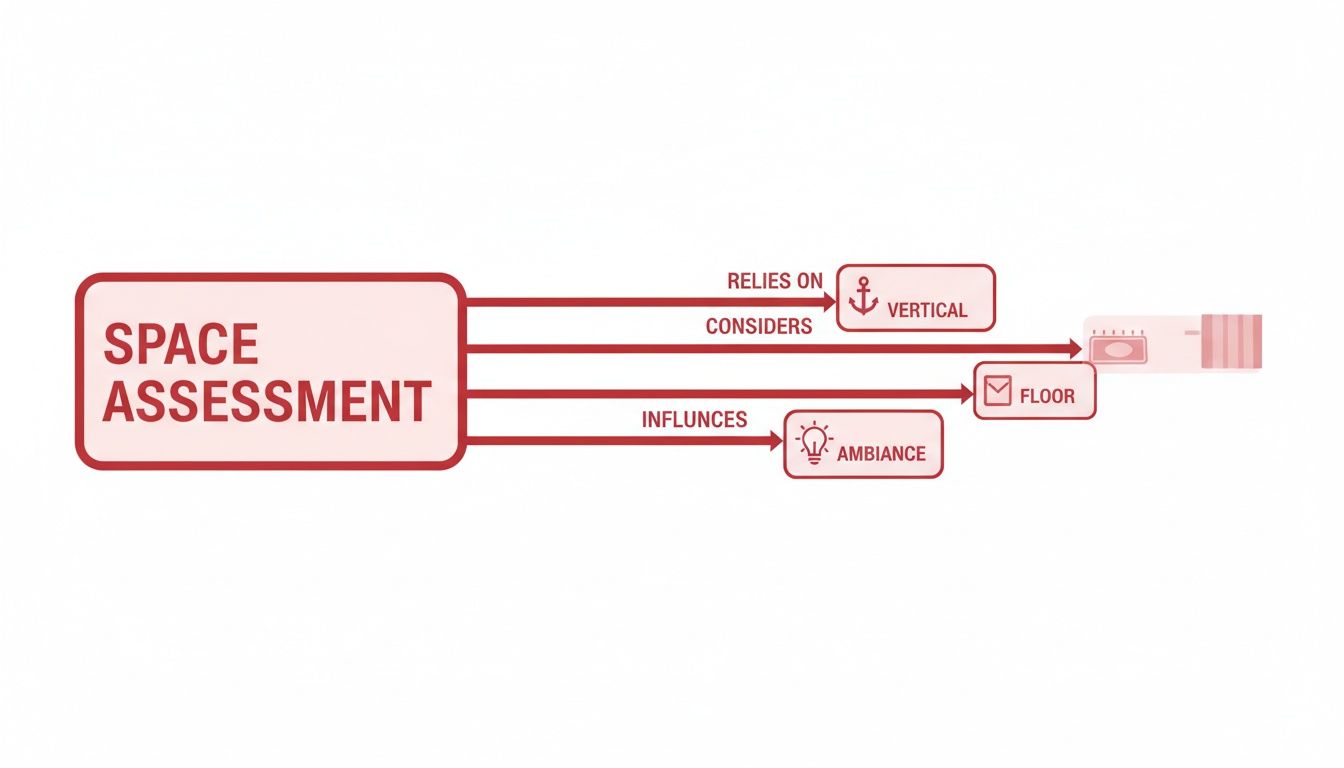
As you can see, a good plan looks at everything—your walls, your floor, even the lighting—before you ever add a single piece of equipment to your cart.
For Building Serious Strength
You don't need a hulking power rack and a mountain of iron plates to build real strength at home. The secret is achieving progressive overload—the non-negotiable principle for muscle growth—with smarter, more compact tools.
Resistance bands are the undisputed champs of small-space strength. A quality set of loop bands can honestly replace an entire dumbbell rack for a fraction of the cost and space.
- They grow with you. By combining bands or grabbing a thicker one, you can continuously up the challenge as you get stronger.
- They work your muscles differently. Unlike free weights, bands provide increasing tension through the entire movement, which can fire up your muscles in a new way.
- They're safer for solo training. Bands are low-impact and much easier on your joints, which is a huge plus when you're working out alone.
For your upper body, a door-frame pull-up bar paired with pull-up assist bands is an absolute game-changer. The bands give you the support you need to build the strength for your first unassisted pull-up, which is one of the best bodyweight exercises, period.
For Powerful Cardio and Conditioning
Who says you need a treadmill to get your heart pounding? Some of the most effective cardio tools can literally be stored in a shoebox. When you ditch the big machines, you reclaim valuable floor space for dynamic, full-body movements that are a lot more engaging anyway.
Take a heavy jump rope, for instance. This isn't the flimsy plastic rope from your elementary school playground. These are weighted to fire up your shoulders, back, and core right along with your legs. A quick 10-minute session can torch as many calories as a 30-minute run.
Likewise, compact battle ropes offer a killer metabolic conditioning workout. Anchor them to a sturdy point, and you've got a brutal upper-body and core session that builds explosive power and endurance. When you're done, just coil them up and tuck them away.
Your living room floor can become a high-intensity training zone with the right gear. The key is choosing equipment that forces your entire body to work, maximizing calorie burn and conditioning in a short amount of time.
This shift toward compact, powerful gear is a huge reason the home fitness market is booming. The industry is projected to hit USD 12.88 billion in 2025 and race toward USD 19.79 billion by 2032, growing at a steady 6.32% CAGR. With North America holding 37.46% of that market, it's clear that tools like wall-mounted resistance bands are exactly what people in apartments and small homes are looking for.
For Mobility and Pro-Level Recovery
A solid fitness routine isn't just about the work; it's about the recovery. This is another area where small, multi-purpose tools are your best friend. You can easily build a pro-level recovery station that fits neatly into a single drawer.
Floss bands are a secret weapon used by physical therapists to improve joint mobility and slash soreness. You just wrap a band tightly around a joint or muscle, move through a range of motion, and help break up all that gunk that's limiting your movement.
Foam rollers and massage balls are, of course, essential. They're perfect for working out muscle knots after a tough session, but you can also use them for core stabilization exercises. Just make sure to get a compact, high-density roller that won't turn into a sad pancake after a few months.
Match Your Fitness Goal with MONFIT Equipment
Finding the right gear can feel overwhelming, so I've put together this simple table to help you match your workout goals with the perfect MONFIT equipment for your space.
| Fitness Goal | Primary Equipment | Why It's Perfect for Small Spaces | Example Exercise |
|---|---|---|---|
| Build Muscle & Strength | Loop Resistance Bands | Replaces a full rack of dumbbells; stores in a small bag. | Banded Squats or Bicep Curls |
| Cardio & Fat Loss | Heavy Jump Rope | Burns massive calories in minutes; coils up for easy storage. | High-Knee Jumps |
| Functional Strength | Pull-Up Bar & Assist Bands | Uses vertical door space; bands help you progress safely. | Assisted Pull-Ups |
| Recovery & Mobility | Floss Bands & Foam Roller | Fits in a drawer; crucial for preventing injury and soreness. | Quad Rolling or Ankle Flossing |
This is just a starting point, but it shows how a few key items can cover all your bases without taking over your home.
Your small-space gym is only truly complete when it supports every part of your fitness journey, from the first rep to the final stretch. For a deeper dive into how different tools stack up, check out our guide on the best home gym equipment.
Smart Storage Solutions for a Clutter-Free Space
Let's be real: the best home gym is the one that magically disappears the second your workout is over. When you're working with limited square footage, clever storage isn't just a nice-to-have—it's the secret to keeping your living space sane and functional. The whole point is to create a workout zone that’s incredibly easy to set up and tear down. Your gear should always be accessible but never, ever in the way.
This is where you can get creative and blend fitness with your home decor. Instead of just shoving equipment in a corner, think about integrating it. The right solutions keep your home from looking like a commercial gym, so you can maintain that peaceful, uncluttered vibe you love.
Go Vertical to Reclaim Your Floor
Your walls are probably the most underutilized real estate in your home. By thinking vertically, you keep your floor clear for actual movement—burpees, anyone?—and stop your gear from becoming a late-night tripping hazard. This approach is the cornerstone of so many effective small space home gym ideas.
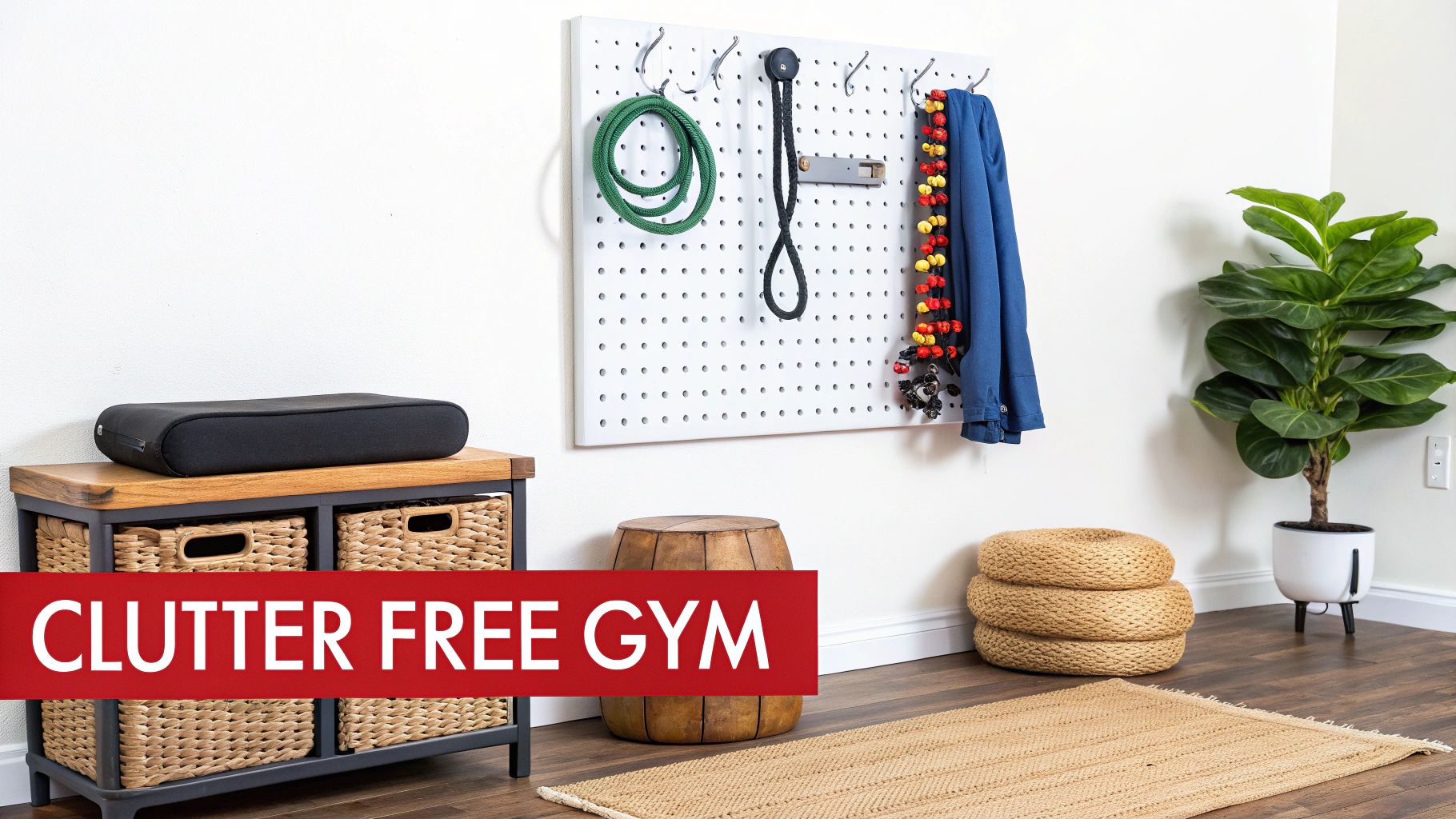
A wall-mounted pegboard is a perfect example of this. Forget the garage workshop vibe; a stylish wooden or metal pegboard can double as functional wall art. Use a few hooks and small shelves to hang your resistance bands, heavy jump ropes, and even a foam roller. It looks deliberate, keeps everything in arm's reach, and takes up zero precious floor space.
Floating shelves are another fantastic option. Arrange them artfully to hold smaller items like massage balls or your workout journal, transforming basic storage into a thoughtful design element.
Master the Art of Hidden Storage
Sometimes, the best storage is the kind you can't even see. Multi-functional furniture is your secret weapon for hiding equipment in plain sight, making sure your living room actually stays a living room.
- Storage Ottomans: These are a godsend for stashing heavier stuff like kettlebells or a full set of loop resistance bands. Once the lid is on, the evidence of your workout is completely gone. You can see how a set of resistance loop bands is perfect for this kind of setup.
- Under-Bed Carts: If your gym is in the bedroom, low-profile rolling carts are a game-changer. Just load them up with your gear and slide them out of sight until tomorrow.
- Decorative Baskets: A nice woven or fabric basket can hold yoga mats, towels, and lighter equipment while blending right in. Stick one next to the sofa, and no one will ever suspect it’s part of your gym.
The key is to choose storage that actually matches your home's aesthetic. When your gym storage looks like it belongs with your decor, it feels less like clutter and more like a smart, integrated part of your space.
This focus on accessible, portable gear is right in line with what's happening in the broader market. The at-home fitness industry is valued at USD 10.11 billion in 2025 and is on track to more than double to USD 20.56 billion by 2034. This explosion is being driven by people in urban areas looking for efficient workout solutions—making portable gear like heavy jump ropes and band kits a perfect fit for athletes in compact apartments. You can dive deeper into the trends of the at-home fitness equipment market here.
Create a Quick-Change Workout Zone
Having a dedicated "zone" helps you mentally flip the switch to workout mode, even if it's just a corner of the living room. The trick is making it easy to define and just as easy to dismantle. A beautiful, decorative folding screen is a perfect way to do this. Use it to hide your equipment when it's not in use, creating a clear visual boundary. When it’s time to train, just fold it away.
This "pop-up" gym approach removes the mental barrier to getting started. If your setup takes 30 seconds, you’re far more likely to stick with your routine. It's all about making fitness an effortless part of your day, not another logistical headache.
Get Inspired: Real-World Small Gym Setups
It's one thing to talk theory, but it's another to see how these ideas actually come together in a real home. The best small space home gym ideas are the ones you can truly picture yourself using. So, let's look at three practical setups that prove you don't need a dedicated room for a serious fitness routine.
Think of these as blueprints you can adapt. Each one uses the principles we've covered—going vertical, choosing multi-use gear, and being clever with the layout—to create a powerful workout zone in a place you might have overlooked.
The Studio Apartment Corner Gym
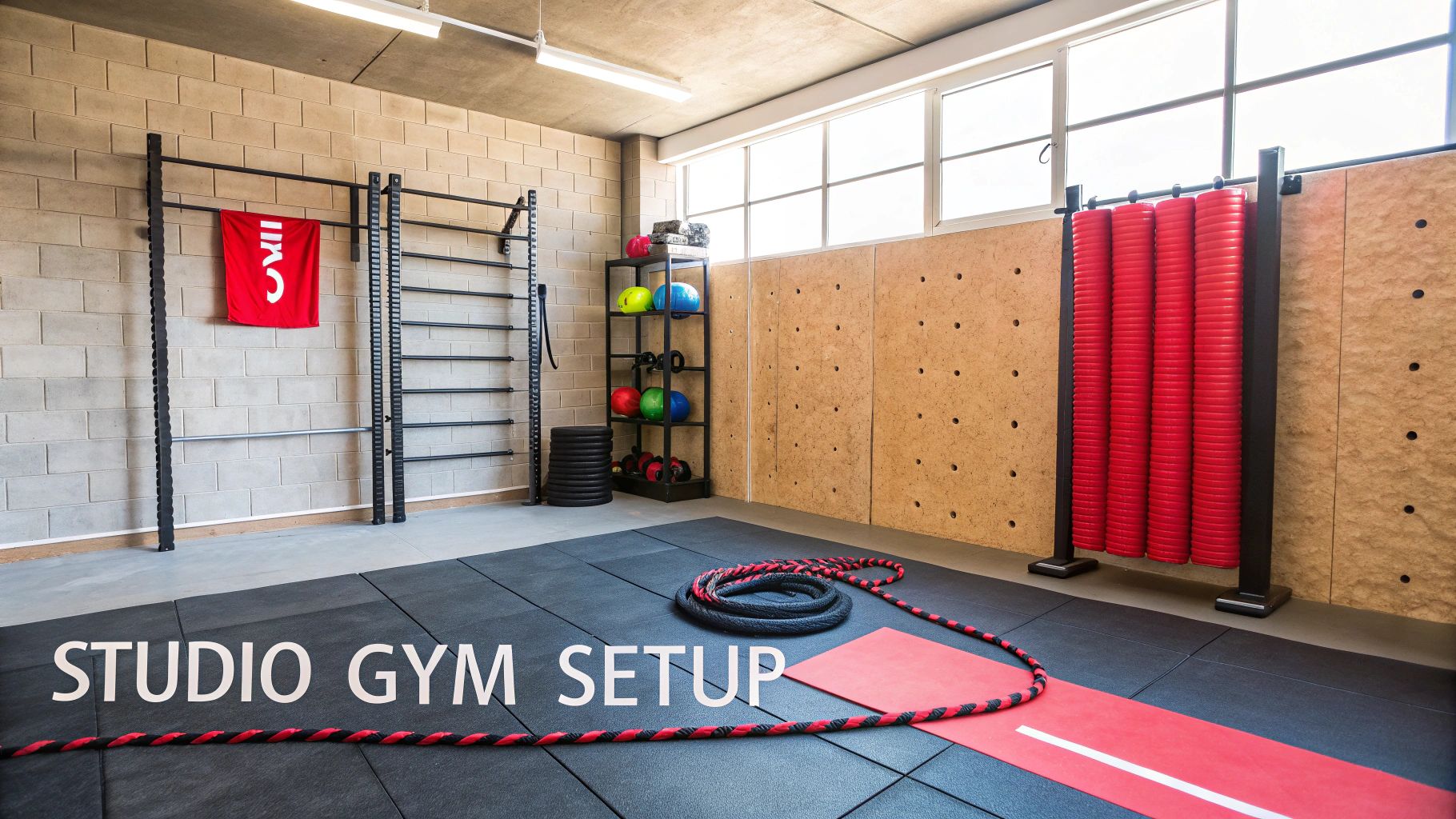
When you live in a studio, every square foot is prime real estate. This setup shows how a tiny 5x7 foot corner can become a high-intensity interval training (HIIT) machine. The secret? Build up, not out.
A tall, narrow shelving unit acts as the command center, holding your water bottle, timer, and towels. Below it, a set of MONFIT loop resistance bands are tucked away in a nice basket, ready for strength work. The star of the show, though, is a wall-mounted anchor holding a MONFIT battle rope. When you're done, the rope coils up on a stylish wall hook, looking more like an industrial design choice than workout gear.
Sample Corner HIIT Routine:
- Warm-up: Jump rope (real or phantom) for 3 minutes.
-
Circuit (Repeat 4 times):
- Battle Rope Slams: 30 seconds, all-out.
- Banded Squats: 30 seconds, focusing on good form.
- Push-ups: 30 seconds (drop to your knees if you need to).
- Rest: 30 seconds.
The whole thing is designed for a seamless switch from your workday to your workout in just a few minutes.
The Closet Gym Conversion
That closet you barely use? It's a goldmine for fitness. A simple conversion can turn a standard closet into a surprisingly capable station for strength and bodyweight training. Best of all, it's the ultimate "disappearing gym"—completely out of sight when you're done.
Start by taking out the clothing rod. In its place, install a sturdy, wall-mounted pull-up bar inside the top of the door frame. Just like that, you have an anchor for tons of upper-body exercises. The back of the closet door becomes a storage hub with a hanging shoe organizer; its pockets are the perfect size for resistance bands, a heavy jump rope, and mobility tools.
The floor space is all you need for a yoga mat, giving you room for core work, stretching, and bodyweight circuits. You’ve just created a micro-gym that takes up zero living space.
By repurposing an existing, often-cluttered space, you're not just adding a gym—you're adding organization and function back into your home. It’s a win-win for your fitness and your living environment.
The Balcony Workout Zone
If you’re lucky enough to have a balcony, you have an open-air gym waiting to happen. This setup takes your workouts outside, focusing on weather-resistant equipment that can handle the elements.
First, lay down some interlocking rubber floor tiles. They’ll protect your balcony surface, absorb impact, and clearly define your workout space. Next, choose gear that’s built to last outdoors. Think about a MONFIT heavy jump rope with durable handles and a coated cable that won't break down in the sun. A battle rope with a protective sleeve is another fantastic choice for outdoor use.
For storage, a small, weather-resistant deck box is your best friend. It keeps all your equipment safe and dry while also serving as a bench for box jumps or a spot to catch your breath between sets. Just be sure to check your balcony's weight capacity and make sure you have enough room for dynamic moves like rope swings. There's nothing like a dose of fresh air to boost your motivation.
Your Small Space Home Gym Questions Answered
Diving into building a home gym, especially when you're short on space, always brings up a ton of questions. It's really easy to get bogged down by the "what ifs" and "how-tos" before you even lay down a mat. I've been there. This section is all about tackling those common hurdles head-on with some straight-up, practical answers. The goal is to get you past the planning phase and into building a workout space you’ll genuinely use.
We’ll cover everything from the bare minimum space you actually need to how to get a great workout without your downstairs neighbors hating you.
How Much Space Do I Really Need for a Functional Home Gym?
Honestly, you probably need less space than you think. A truly functional home gym can work beautifully in an area as small as 5x7 feet. That’s basically just enough room for a good exercise mat and for you to fully extend your arms and legs without smacking a wall. The real secret isn't about massive square footage—it's about having a clear, flat, and safe area to move in.
If you’re planning on more dynamic movements like jumping rope or using battle ropes, the game changes a bit. Your main concern becomes vertical clearance, not just floor space. You’ve got to make sure you have enough height to move without taking out a ceiling fan or light fixture. At the end of the day, it all comes back to smart equipment choices. A full resistance band kit, for example, delivers an incredible full-body workout but takes up almost no operational space.
The best small home gyms are built around the space you have for movement, not the space you have for equipment. A clear 5x7 foot patch of floor is way more valuable than a bigger, cluttered room.
What’s the Most Important Piece of Equipment to Start With?
If you want the most bang for your buck in a tight spot, a high-quality set of loop resistance bands is a no-brainer. They’re incredibly light, don’t cost a fortune, and you can use them for just about anything—strength training, mobility work, physical therapy, and even getting a little help to finally nail that pull-up.
A solid set comes with varying resistance levels. This is key because it lets you use progressive overload to get stronger without ever having to buy more gear. If your goals are more cardio-focused, a heavy jump rope is another fantastic choice. It’s an intense, heart-pumping workout that hits your entire body and takes up virtually zero storage space.
How Can I Stay Motivated to Work Out at Home?
Keeping your motivation high at home is all about making your workout routine as easy and enjoyable as possible. If setting up is a chore, you’ll find any excuse to skip it.
Here are a few things that have always worked for me:
- Keep It Tidy and Ready: Your gym space should be good to go in less than a minute. If it takes you 10 minutes just to clear a space, you'll lose your drive before you even warm up.
- Ditch the Guesswork: Follow a structured program or use a workout app. When you know exactly what you’re supposed to do each day, you don't waste mental energy figuring it out. You just do the work.
- Build a Ritual: Make your workout a non-negotiable part of your schedule. Throw on a high-energy playlist, pick a specific time, and treat it like any other important appointment.
- Track Your Progress: Nothing fuels motivation like seeing real results. When you notice yourself getting stronger, mastering a new move, or hitting a PR, it's the best feeling in the world.
Are Home Workouts Disruptive to Neighbors?
This is a totally valid and considerate question, especially if you're in an apartment. The great news is you can absolutely get a killer workout without making a racket.
First things first: invest in a thick, high-quality exercise mat. It's a game-changer for absorbing impact and sound, which is crucial for anything like burpees or jumping jacks.
Another great strategy is to focus on low-impact movements. Equipment like resistance bands is practically silent but will still give you an incredibly challenging strength session. You can also just be mindful of the clock—save your more intense, high-impact workouts for reasonable hours, not super early in the morning or late at night. For more specific situations, feel free to explore our full list of frequently asked questions about home fitness.
Ready to build your perfect small-space gym? MONFIT provides the versatile, high-quality equipment you need to turn any corner into a powerhouse workout zone. Explore our collection of resistance bands, heavy jump ropes, and more to start your fitness journey today. Visit us at https://monfitness.com and get free shipping on orders over $100.
