


If you're trying to figure out the best resistance bands for your home workout, a solid set of tube bands with handles is almost always the perfect place to start. Why? They’re brilliant at replicating classic gym movements like rows and chest presses, giving you an intuitive, all-in-one tool for training your entire body. For anyone just starting out, they’re a game-changer.
Your All-in-One Home Gym Solution
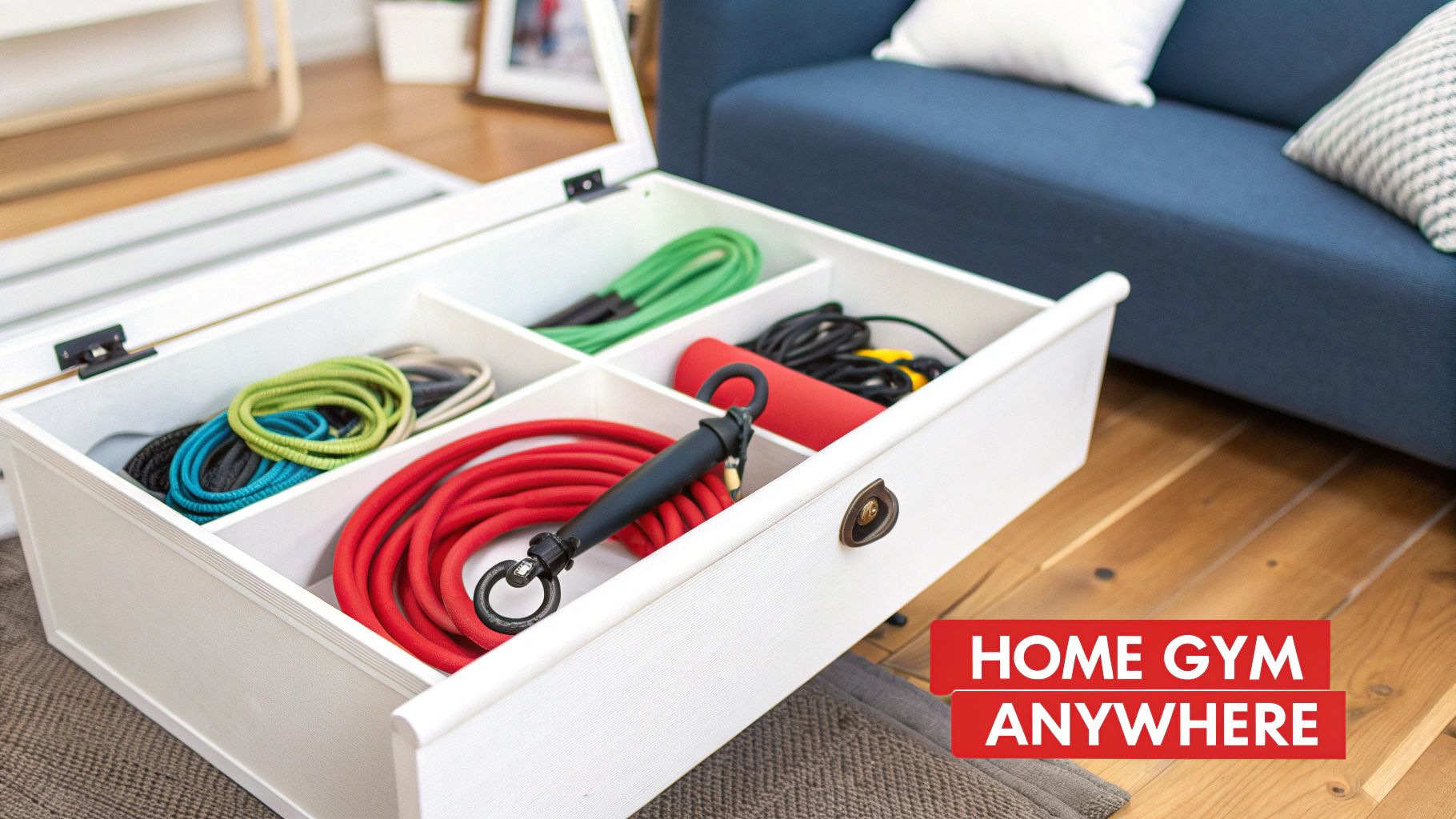
Picture having a complete functional training gym that fits inside a single drawer. That’s the magic of resistance bands. These incredibly simple and portable tools can do the job of bulky, expensive weights, whether your goal is to build serious strength, improve your mobility, or help your body recover.
This guide is designed to cut through the noise and give you a clear roadmap to finding the best resistance bands for home workout sessions. We'll break down all the different types of functional training tools—from tubes and pull-up bands to loops and floss bands—and help you match the right MONFIT set to your specific fitness goals. This is about more than just exercising; it's about unlocking a smarter, more affordable way to get real results without ever leaving home.
The Rise of At-Home Functional Training
The move toward working out at home isn't just a temporary fad. It's a genuine shift driven by our need for training solutions that are both convenient and truly effective. Resistance bands are a cornerstone of this movement, offering a powerful way to perform functional, full-body workouts anywhere.
The proof is in the numbers. The global resistance bands market has absolutely exploded, jumping from USD 799.1 million in 2019 to a projected USD 1.74 billion by 2026. That’s a staggering compound annual growth rate of 12.25%, a surge heavily influenced by the massive turn to home fitness during the pandemic.
This boom really drives home a core truth: you don’t need a packed, expensive gym to get strong. Functional training tools like resistance bands give you the power to build strength and flexibility right from your living room. They've become the true cornerstone of any efficient home gym setup.
Resistance bands are functional fitness in its purest form. They force your muscles to work through a complete range of motion, building practical, real-world strength that helps you do everything from carrying the groceries to playing with your kids.
Why Resistance Bands Are a Smart Choice
Picking the right gear is half the battle when it comes to staying consistent with your workouts. Resistance bands are one of the smartest investments you can make for your fitness. Here’s why they’re in a league of their own:
- Ultimate Portability & Ease of Travel: Bands are light, compact, and easy to pack. You can literally take a full-body workout with you in a suitcase and never have to skip a session, no matter where you are. This makes them the ultimate travel-friendly fitness tool.
- Cost-Effective Strength: Let’s be honest, a rack of dumbbells or a cable machine costs a fortune. A high-quality set of bands delivers an incredibly challenging workout for a tiny fraction of the price. For more ideas, check out our guide on the https://monfitness.com/blogs/news/best-home-gym-equipment.
- Joint-Friendly Resistance: Unlike free weights, which put constant tension on your joints, bands provide smooth, variable resistance. This makes them much easier on your body, which is a huge plus for beginners and experienced lifters alike.
Resistance bands are the total package for a home gym, offering incredible bang for your buck. For more expert tips on getting fit without traditional equipment, these simple at-home workouts are a fantastic resource.
Understanding the Different Types of Resistance Bands
Walking into the world of resistance bands can feel a little overwhelming at first. With so many different shapes and sizes, how do you know which one is right for you? It's a common question, but the answer is pretty simple once you understand the practical use cases for each type.
Not all bands are created equal. Each type is a specific tool designed for a particular job in your functional training toolbox. Think of it this way: you wouldn't use a sledgehammer for a finishing nail. Using the wrong band can hold you back or just feel awkward. So, let’s break down the main types to help you choose with confidence.
Tube Bands with Handles: The Portable Cable Machine
If you're just getting started with resistance training, tube bands are often the perfect entry point. These are exactly what they sound like: hollow, stretchy tubes with handles on each end. This simple design is brilliant because it lets you mimic almost any exercise you’d do on a cable machine at the gym, making them ideal for full-body workouts.
The handles are the key here—they give you a secure, comfortable grip that feels natural for traditional strength exercises.
- Chest Presses: Just anchor the band behind you and press forward. It’s a perfect cable press alternative.
- Bicep Curls: Stand on the middle of the band, grab the handles, and curl away. You’ll feel smooth, consistent tension through the whole movement.
- Overhead Presses: A fantastic, joint-friendly way to build strong shoulders without the strain of heavy dumbbells.
- Rows: Hook the band to an anchor in front of you and pull. It's one of the best ways to build a stronger back at home.
Most MONFIT tube band sets also include a door anchor and ankle straps, essentially turning any room with a door into your personal gym. They’re the ideal all-in-one tool for full-body workouts, especially when traveling.
Pull-Up Bands: The Ultimate Strength Builder
Pull-up bands are the heavy hitters of the band world. These are seriously thick, continuous loops made from layered latex, built to handle an incredible amount of tension. Their name gives away one of their most popular practical use cases—helping you conquer the pull-up—but they do so much more for building functional strength.
When used for pull-ups, the band acts like a personal spotter. You loop it over the bar, stick a foot or knee in the bottom, and its elastic force gives you a boost. This allows you to focus on form and build strength until you can do them on your own.
But their real secret weapon is adding heavy-duty resistance to big, compound lifts. You can stand on them to make squats and deadlifts brutally effective or loop them over your back to add a serious challenge to push-ups. MONFIT pull-up bands come in a range of strengths, with some providing over 150 lbs of tension, making them a true substitute for heavy free weights.
Loop Bands: The Glute Activation Specialists
Also known as mini-bands or hip circles, loop bands are those smaller, wider fabric or latex loops you see everywhere. They’re designed to be worn around your thighs, ankles, or even your wrists. These bands are specialists, and their main job is to wake up and strengthen the smaller stabilizing muscles, especially in your hips and glutes.
It’s no surprise that loop bands are the biggest and fastest-growing part of the market, holding over 40% market share globally. Their ability to target the lower body is unmatched. In fact, research shows that doing lateral walks with a loop band can activate your glutes 2.5 times more than doing the same movement with just your bodyweight. You can read more about this trend in this market research report.
They are an absolute game-changer for:
- Warming up the hips before you squat or deadlift.
- Isolating your glutes with exercises like glute bridges and clamshells.
- Improving squat form by forcing you to drive your knees outward against the band’s tension.
If you’re serious about building lower-body strength or protecting your knees, these bands are a non-negotiable part of your kit. You can explore our premium collection of resistance loop bands to find the right fit.
Floss Bands: The Mobility and Recovery Tool
Last but not least, we have floss bands. This is a totally different kind of tool, one designed for mobility and recovery, not just strength. Floss bands are thick, grippy strips of latex that you wrap tightly around a joint or muscle. The main benefit is improved joint mechanics and reduced soreness through compression.
Think of flossing as a powerful combination of deep tissue massage and a mobility session. By tightly compressing the tissue and then moving the joint through its full range of motion, you can help break up the “gunk” that makes your joints feel stiff and restricted.
You only keep the band on for a minute or two. When you unwrap it, a rush of fresh blood floods the area, which can help kickstart the recovery process and reduce soreness. Proper usage is key to safety and effectiveness, so it's important to learn the correct wrapping techniques before you begin. They are an incredible tool for anyone looking to improve joint health.
How to Choose the Right Resistance Bands for Your Goals
Figuring out which resistance band to buy can feel a bit overwhelming at first, but it doesn't have to be. Let's cut through the noise. Picking the right band is simply about matching the tool to your specific fitness goal. It all starts with a little self-assessment.
Think of it like this: you wouldn't use a tiny paring knife to chop a watermelon, right? The same logic applies here. The heavy-duty pull-up band that’s perfect for assistance is completely wrong for the subtle hip activation exercises you do before a run. Getting this right from the start makes all the difference.
This video gives a great overview of the key things to consider when you're making your choice.
We'll walk through a simple framework based on what you want to achieve, where you're starting from, and how you like to train. This way, you end up with equipment that actually helps you, rather than gathering dust in a corner.
Assess Your Primary Fitness Goal
First things first, what are you trying to accomplish? Your answer to this one question will immediately cut your options in half.
Are you looking to build serious muscle and get stronger? Or is your focus more on toning up, improving your mobility, and feeling more athletic? Maybe you’re on a mission to finally conquer the pull-up. Each of these goals has a band that's practically made for it.
For instance, if you're just starting out and want a do-it-all home gym, a set of MONFIT tube bands is a fantastic choice. The handles and attachments let you mimic just about any full-body exercise you’d do with dumbbells. But if your mission is to get that chin over the bar, you’ll need the serious support of a heavy-duty MONFIT pull-up band.
Match Your Fitness Level to the Right Resistance
Next up: be honest about your current strength. One of the best things about resistance bands is that they work for everyone, from total beginners to seasoned pros. The trick is picking the right level of challenge for you, right now.
A band that’s too light won’t give your muscles the push they need to grow. On the flip side, grabbing one that’s way too heavy is a recipe for bad form and potential injury. You've found the sweet spot when the last two or three reps of a set are a real struggle, but you can still do them perfectly.
The right resistance band should feel like a supportive training partner—it challenges you to work harder but never forces you into a movement that feels unsafe. Progress happens when you're working at the edge of your ability, not beyond it.
It's no secret why bands have become so popular. The global market hit USD 1.66 billion and is expected to soar to USD 2.92 billion by 2030, largely thanks to younger generations wanting effective, affordable fitness gear. With a good set costing between $20-50, it’s a world away from a rack of dumbbells that can easily run over $500. You can dig into more of this data over at Grandview Research.
This flowchart makes it even simpler, showing you exactly which path to take based on your main objective.
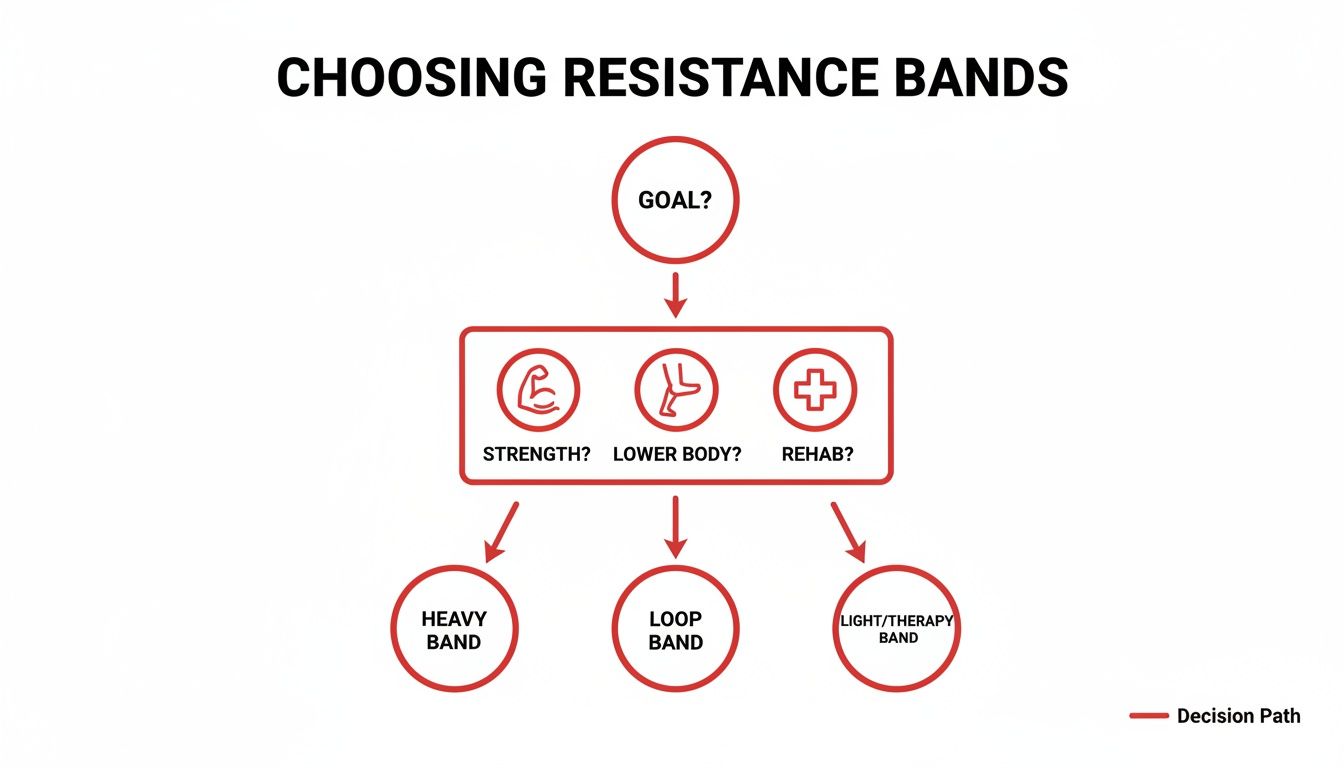
As you can see, once you know your goal, the choice becomes pretty clear. This helps make sure your gear actually supports the workouts you want to do.
Consider Your Preferred Workout Style
Last but not least, think about how you enjoy working out. Do you love high-energy circuits where you're moving fast and sweating hard? Or are you more into slow, controlled movements to build pure strength?
Your personal style will determine which type of band feels most natural in your hands.
- For HIIT and Full-Body Circuits: Tube bands with handles are your best friend. The quick-clip design means you can swap resistance levels in seconds, keeping your workout flowing and your heart rate high.
- For Heavy Lifting and Bodyweight Assistance: Thick, powerful pull-up bands are what you need. They’re designed to withstand the tension of heavy squats, deadlifts, and, of course, assisted pull-ups.
- For Activation and Lower-Body Burnouts: Mini loop bands are a must-have. They’re perfect for zoning in on your glutes and hips, making them ideal for warm-ups or a brutal finisher on leg day.
Choosing the right band isn’t just about the band itself—it’s about setting yourself up for success. To dig deeper, check out our article on the many benefits of resistance band workouts. When your gear, goals, and workout style are all in sync, you’re on the fast track to getting real results at home.
Building Your Full-Body Resistance Band Workout
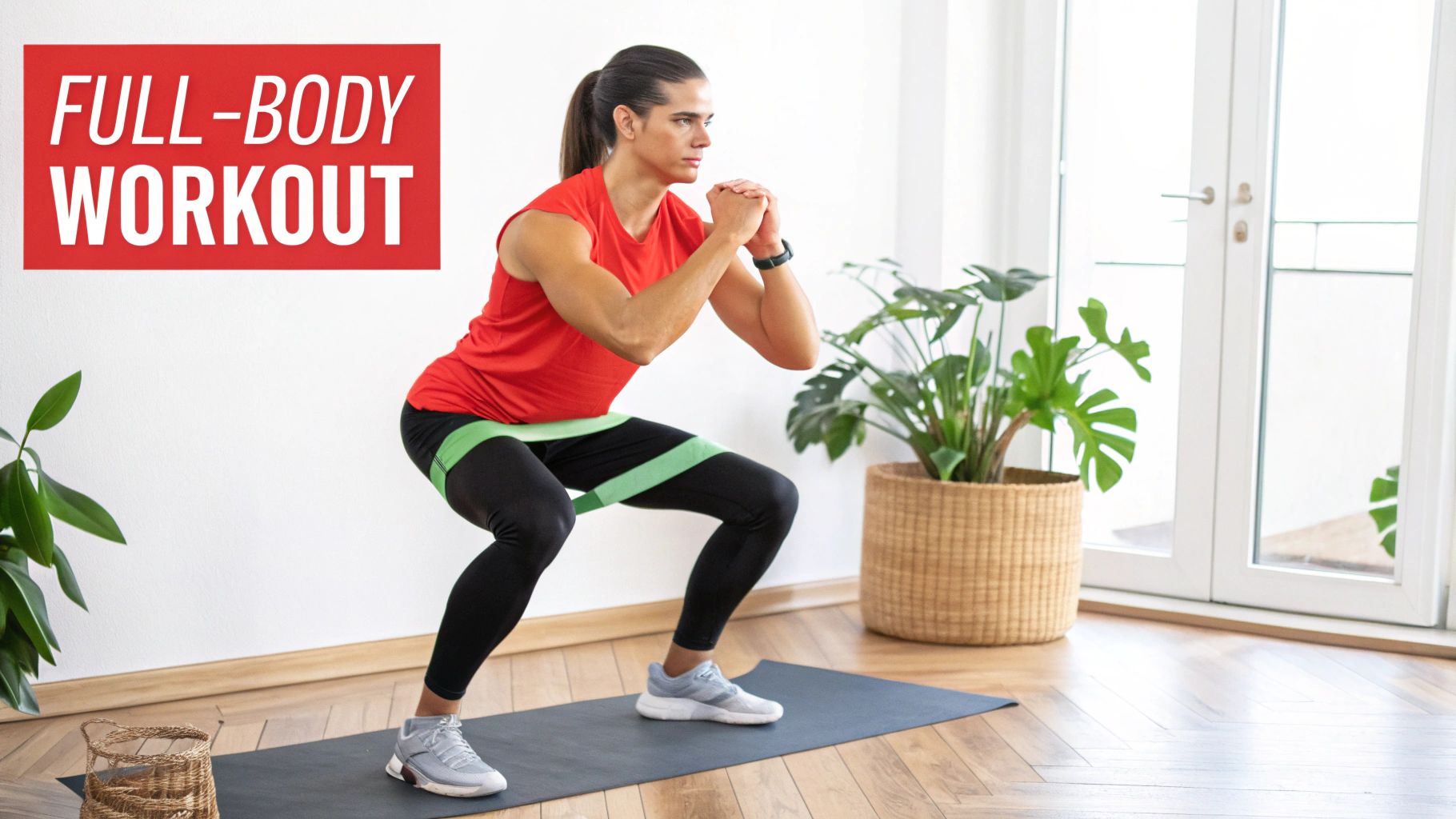
Alright, you've got the gear—now it's time for the practical application. Let's move from theory to action with two simple but powerful full-body routines you can start today. These workouts perfectly illustrate why resistance bands are such a fantastic tool for home fitness, giving you a full-body challenge that's both effective and incredibly safe.
First up is a routine designed for beginners to get comfortable with the core movements and build a solid foundation. The second workout is for anyone ready to crank up the intensity and really push their limits to see faster results.
Beginner Full-Body Foundation
If you're just starting out, your main goal is to build confidence and nail your form. This workout is all about slow, controlled movements where you can really feel the right muscles engaging. A set of MONFIT Tube Bands with Handles is the perfect partner for this routine.
Aim to complete 2-3 rounds of the following circuit. Take a 60-second breather between each round.
- Banded Squats (12-15 reps): Step onto the middle of the band with your feet about shoulder-width apart, gripping the handles up at shoulder height. Keep your chest proud and lower yourself down like you’re sitting back into a chair.
- Banded Bent-Over Rows (12-15 reps): Stand on the band, hinge forward at your hips (keeping your back flat!), and pull the handles up towards your torso. Really focus on squeezing your shoulder blades together at the top.
- Standing Chest Press (12-15 reps): Anchor your band behind you at chest height. Take a step forward until you feel tension, then press the handles straight out in front of you.
- Glute Bridges (15-20 reps): Lie on your back with your knees bent. Slide a MONFIT Loop Band around your thighs, just above your knees. As you lift your hips to the sky, actively push your knees outward against the band.
This circuit hits every major muscle group, giving you a well-rounded base of functional strength. For a closer look at what's happening under the hood, this anatomical guide to resistance band exercises is a great resource.
Intermediate and Advanced Full-Body Burnout
Ready to feel the burn? This routine mixes things up with pull-up bands and tube bands to seriously increase the challenge and spark new muscle growth. We're focusing on intensity and big compound movements that get more done in less time.
Go for 3-4 rounds of this circuit, keeping your rest to 45-60 seconds between rounds.
- Banded Deadlifts (10-12 reps): Grab a heavy MONFIT Pull-Up Band. Stand on one end of the loop with both feet, holding the other end with both hands. Hinge at your hips to lower down, then drive up with power.
- Overhead Press (10-12 reps): Stand on a tube band or pull-up band, then press the handles (or the band itself) straight overhead until your arms are locked out.
- Band Pull-Aparts (15 reps): Hold a lighter band with both hands straight out in front of you at shoulder height. Pull the band apart by squeezing your shoulder blades together—this is amazing for posture!
- Banded Push-Ups (As many reps as possible): Drape a MONFIT Pull-Up Band across your upper back, looping the ends around your hands on the floor. Now, perform your push-ups against that extra resistance.
This workout is no joke. It's designed to challenge your muscles and get your heart rate up for a serious metabolic boost.
Unlocking Continuous Progress with Progressive Overload
Getting stronger isn't about finding one workout and doing it forever. The real secret to making progress—and keeping it—is a principle called progressive overload. All it means is that you have to consistently make your workouts a little bit harder over time. Luckily, that’s incredibly easy to do with bands.
Progressive overload is the engine of all fitness progress. By systematically increasing the demand on your muscles, you force them to adapt and grow stronger. Without it, you'll hit a plateau.
Here are the best ways to apply progressive overload using your MONFIT bands:
- Increase Resistance: This is the most straightforward. Once you can hit your target reps and sets with good form, it's time to grab the next heavier band.
- Increase Repetitions: Don't have a heavier band yet? No problem. Just try to squeeze out a few more reps. If you did 12 last week, shoot for 14 this week.
- Increase Sets: Simply add another round to your workout. If you've been doing three rounds, it's time to tackle four.
- Decrease Rest Time: Trim your rest periods. Shaving 15 seconds off your rest between sets makes your body work harder and builds endurance.
- Change the Tempo: Slow things down. Try taking a full 3 seconds to lower the weight (the eccentric part) on a bicep curl. You'll feel the difference immediately.
By playing with these variables, you keep your body guessing and guarantee that you'll keep getting stronger and seeing results. For even more ideas to keep your workouts fresh, check out our complete guide to at-home resistance band exercises: https://monfitness.com/blogs/news/resistance-band-exercises-at-home
Safe Anchoring and Proper Band Care
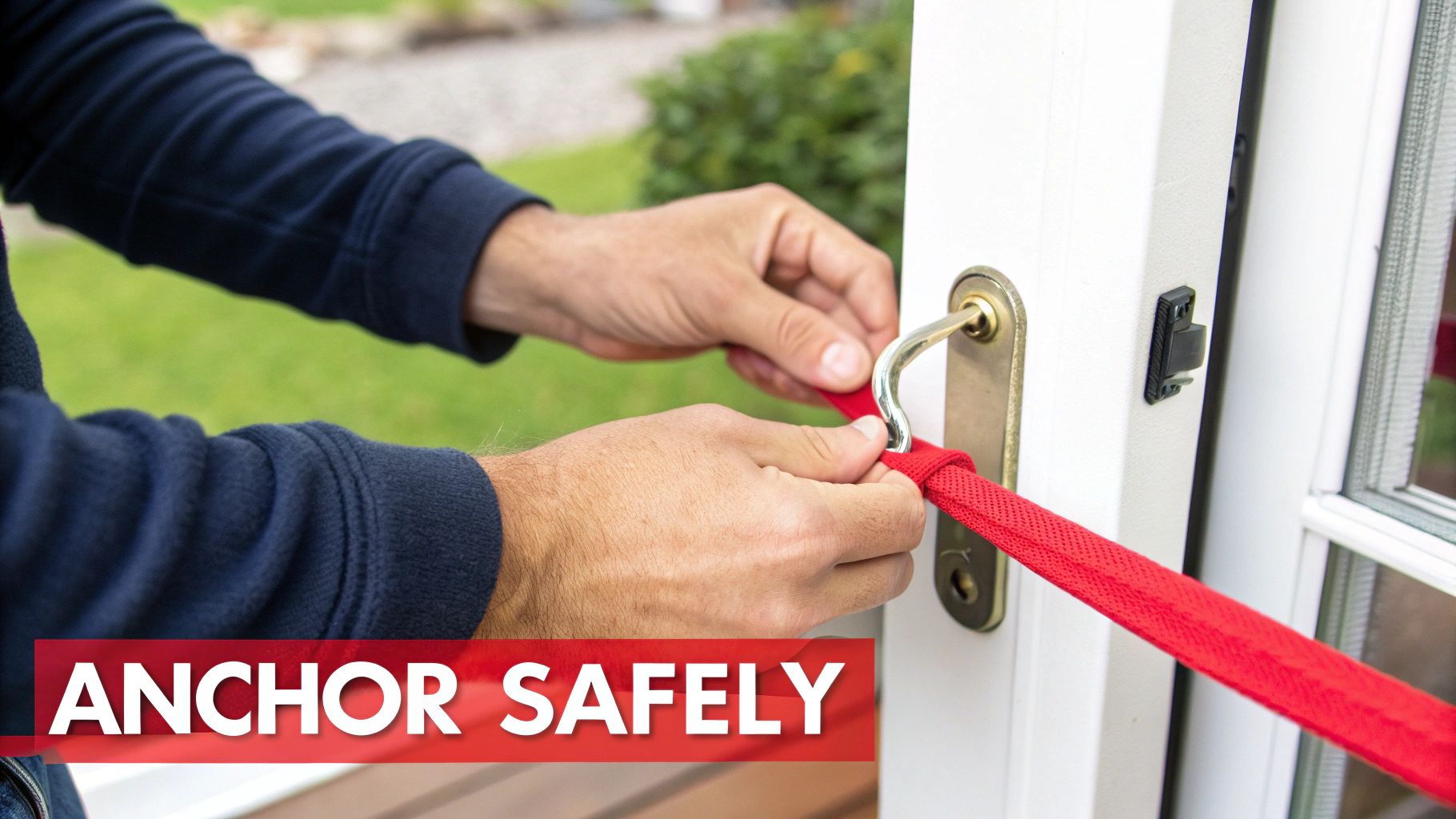
To really get the benefits from your resistance band workouts, you need two things: a secure setup and gear that actually lasts. These two ideas—safety and longevity—are completely linked. When you train with confidence, you protect both yourself and your investment in your equipment. Let’s be real, a snapped band or a failed anchor point can cause a nasty injury, but these risks are super easy to avoid once you know what to look for.
Think of your anchor point as the foundation of the entire exercise. If it’s weak, the move is compromised from the start. Before you even think about pulling on that band, you have to be absolutely sure your setup is rock-solid. This isn't just a friendly suggestion; it’s the most critical part of a safe and effective session.
Finding and Using a Secure Anchor Point
For a lot of great exercises, like chest presses or rows, you’ll need to hook your bands to something stationary. The most common way to do this at home is with a door anchor, which is just a simple strap that cleverly uses the door frame as a base. But here's the catch: not all doors are up to the task.
Follow these steps every single time—no exceptions.
- Choose the Right Door: Stick with a solid, sturdy door that closes toward you. Never, ever anchor a band to a door that opens away from you. The force you generate could literally pull the door open mid-rep.
- Lock It Up: If the door has a lock, use it. This prevents anyone from accidentally barging in while you're in the middle of a set. A quick "workout in progress" sign on the other side is another great way to give a heads-up to family or roommates.
- Inspect Your Anchor: Look for things that absolutely will not move. A support column in the basement, a securely bolted squat rack, or even a super-heavy piece of furniture that has zero chance of budging are all good options. Stay away from things like table legs that could easily tip over.
- Check for Rough Edges: If you're wrapping a band around a pole or post, run your hand over the surface first. Any rough textures or sharp edges can act like a tiny knife, slowly shredding the latex and leading to a sudden, dangerous snap.
Your resistance band is only as safe as its anchor. That one minute you spend checking your setup is the most important part of your workout. It prevents accidents and makes sure every rep is both safe and effective.
Essential Band Care for Maximum Longevity
Just like any other piece of quality gym equipment, your MONFIT bands need a little bit of care to stay in prime condition. It’s pretty simple stuff, but it makes a huge difference in extending their lifespan and preserving the snappy, strong elasticity you need. If you neglect them, they’ll wear out way faster than they should.
Inspecting Your Bands for Wear and Tear
Before every single workout, give your bands a quick once-over. This takes maybe 10 seconds and is your best defense against a band snapping on you.
- Look for any small nicks, cuts, or tears. On tube bands, pay special attention to the areas near the handles where they connect.
- Check for any discoloration or faded spots. This can be a sign of sun damage, which weakens the material.
- Gently stretch a small section of the band and look closely for tiny cracks or abrasions that you might miss when it's slack.
If you find any damage at all, even if it looks tiny, retire the band immediately. It’s just not worth the risk. A well-maintained band is a safe band.
Frequently Asked Questions About Resistance Bands
It's totally normal to have questions when you first start exploring resistance bands. As you get set to pick the right ones for your home setup, you're bound to wonder about the little details. I'm here to clear up the most common questions we get, giving you straight answers from years of experience so you can train with confidence.
Let's dive into some of the practical things you're probably curious about.
Can I Build Serious Muscle with Only Resistance Bands?
Absolutely. One of the biggest myths in fitness is that you need a mountain of iron weights to build muscle. It's just not true. Muscle growth, or hypertrophy, comes down to one simple thing: progressive overload. All that means is you have to consistently make your muscles work harder than they're used to.
And let me tell you, heavy-duty resistance bands can provide a serious challenge.
The key to building muscle isn't the tool you use—it's the stimulus you create. Pushing your muscles close to failure with a band triggers the same growth response as a dumbbell. Your body doesn't know the difference; it just knows it needs to adapt and get stronger.
Take MONFIT's heaviest pull-up bands, for example. They can offer well over 150 lbs of resistance. That’s more than enough tension to make squats, deadlifts, and presses incredibly difficult. The real secret is to focus on slow, controlled movements, especially on the way down (the eccentric part of the lift), and to keep making it harder over time. That's the signal your muscles need to grow.
What Is the Difference Between Loop Bands and Pull-Up Bands?
Great question. They might look similar, but they have completely different jobs. Even though they're both loops of latex, their size and strength dictate their practical use cases.
Think of it this way: a small detail brush and a big paint roller are both for painting, but you'd never mix up their tasks.
- Loop Bands (Mini-Bands): These are the smaller, wider bands, often fabric or latex, that you’d typically put around your thighs or ankles. Their main job is to wake up and strengthen the smaller stabilizing muscles, especially your hips and glutes. They’re the go-to tool for exercises like glute bridges, clamshells, and monster walks.
- Pull-Up Bands: These are the big guns—much longer, thicker, and more powerful. They’re built for major, full-body compound movements. You can loop one over a pull-up bar to get some help with your bodyweight or stand on it to add a ton of resistance to squats, deadlifts, and overhead presses.
So, the short answer is: use loop bands for targeted activation and isolation work, and grab the pull-up bands for assistance and heavy strength training.
How Do I Know When to Move Up to a Heavier Band?
This is so important for making real progress and avoiding those frustrating plateaus. There’s a simple, time-tested guideline that trainers have used for decades called the "2 for 2 Rule."
Here’s how it works: If you can do two more reps than your target on an exercise for two workouts in a row—all with perfect form—it’s time to level up.
Let's walk through an example.
- Your goal is to hit 12 reps on bicep curls.
- On Monday, you nail 14 reps without cheating the movement.
- On Wednesday, you do it again, hitting 14-15 reps with solid form.
That’s your green light. The next time you do curls, it’s time to grab the next MONFIT band up. The last few reps of your set should feel tough, but you should still be able to finish them safely. This is how you ensure you're always giving your muscles the right challenge to get stronger. For more answers to common training questions, feel free to check out our detailed MONFIT FAQs page.
Are Resistance Bands Good for Mobility and Recovery?
Yes, they're fantastic for both—but you have to use the right tool for the job. Different bands in your arsenal play very different roles in keeping you moving well and feeling good.
The lighter bands, like thin tube or loop bands, are perfect for dynamic warm-ups and mobility drills. They let you move your joints through their full range of motion, which helps lubricate them and fire up the small stabilizing muscles that prevent injuries. It's why you see them in physical therapy clinics all the time.
But for more intensive recovery work, a specialized tool like a floss band is where it's at. Floss bands use compression to work their magic. By wrapping a joint or muscle tightly, you can help break up the fascial "gunk" that makes you feel stiff, flush out metabolic waste to reduce swelling, and improve how your joints move overall. Remember to learn the proper usage techniques for floss bands to ensure safety and get the best results.
So, you’d use a light MONFIT loop band for a pre-workout warm-up, but you’d reach for a MONFIT floss band after your workout to work on a tight shoulder or stiff knee.
Ready to build a versatile, effective, and portable home gym? MONFIT provides the premium-quality resistance bands you need to achieve any fitness goal, from building serious strength to improving your mobility. Explore our complete collection and find the perfect set to start your journey today.