


When you're working with limited square footage, the best home gym equipment for small spaces is the kind that works as hard as you do. Think versatile, multi-use gear like adjustable dumbbells, a good set of resistance bands, and a heavy jump rope. These pieces can deliver a killer full-body workout without taking over your living room, making fitness a reality even in a tiny studio apartment.
The Small Space Fitness Revolution Is Here
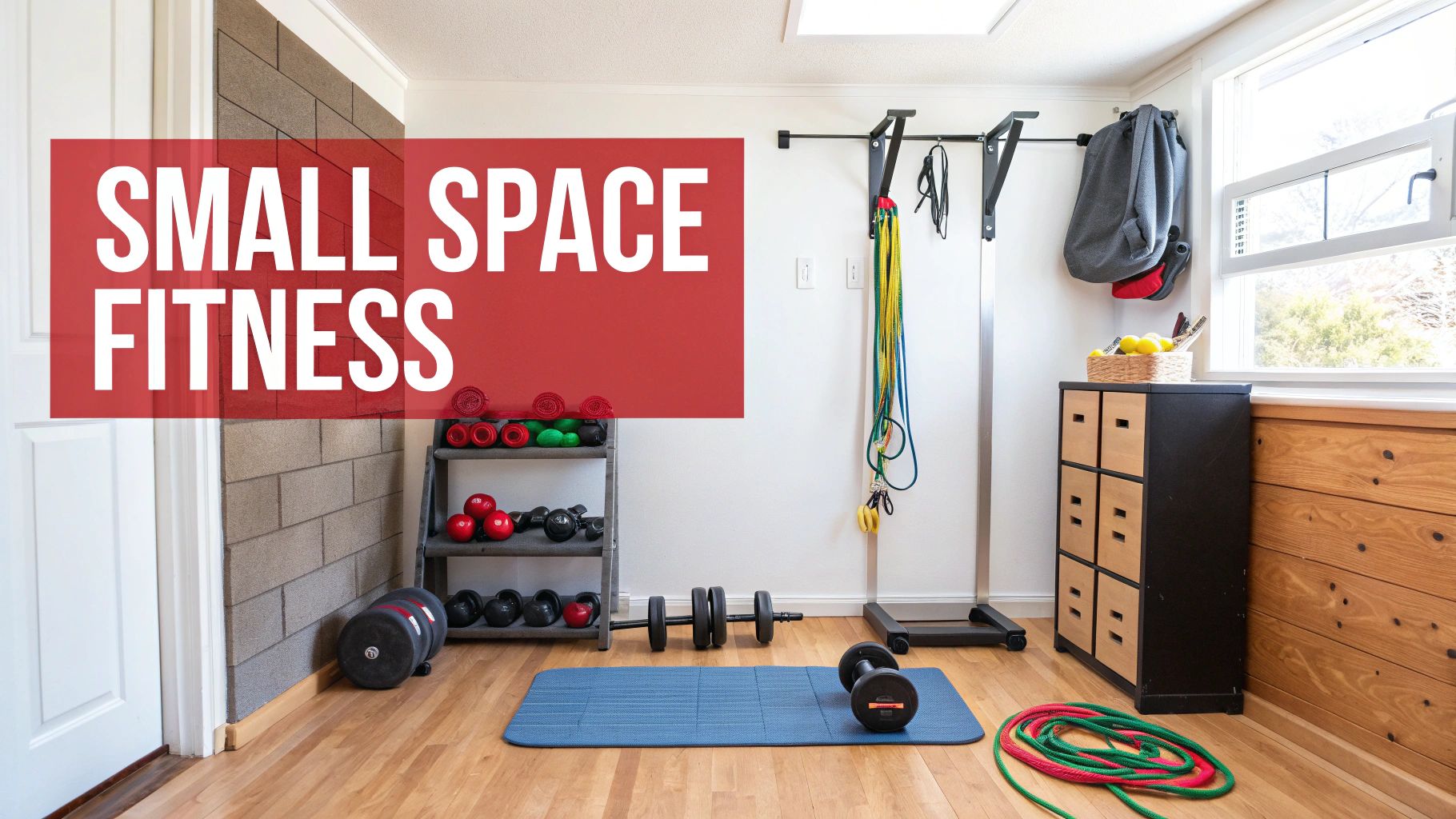
Ever look at a corner of your apartment and think, "There's no way a gym could fit in there"? I get it. For years, the prevailing wisdom was that you needed a dedicated, spacious room for a real workout. But that myth is officially busted.
Today’s world demands smarter, more flexible fitness solutions, and thankfully, the industry is stepping up. The global home gym equipment market is set to explode, projected to hit USD 19.6 billion by 2035—a significant jump from USD 12.4 billion in 2025. This isn't just a random trend; it's a direct response to people in apartments and smaller homes wanting high-quality gear that fits their life. You can explore more insights on the home fitness market trend to see just how big this shift is.
This entire guide is built around one core idea that makes it all possible: functional density.
What Is Functional Density
Simply put, functional density is about getting the most bang for your buck out of every square foot. It’s choosing equipment that offers maximum versatility for its physical size.
Think of it like this: would you rather carry a single pocket knife or a whole toolbox? A Swiss Army knife gives you a dozen tools in one compact package. That's the mindset we're applying to your gym.
Adopting this approach has some serious perks:
- Maximizes Workout Options: A quality set of resistance bands can mimic a bulky cable machine, and adjustable dumbbells give you an entire rack of weights in a footprint smaller than a shoebox.
- Eliminates Clutter: When your gear is easy to put away, your living room stays a living room. Everything can be tucked under a bed or stashed in a closet when you’re done.
- Saves Money: Investing in a few versatile, well-made pieces is way more economical than buying a bunch of single-use machines that will likely collect dust.
By focusing on smart equipment choices and layouts, you can create a powerhouse workout zone in a space you never thought possible. This isn’t about sacrificing quality; it’s about being strategic.
In the end, building a home gym in a small space is all about creativity and efficiency. It’s definitive proof that you don’t need more room—you just need the right gear.
To give you a quick overview, here's a look at the most essential pieces that pack a punch without taking up space.
Essential Space-Saving Equipment at a Glance
This table breaks down the top equipment categories perfect for a compact home gym. It’s a great starting point for seeing how you can build a powerful workout setup with just a few key items.
| Equipment Type | Primary Use | Key Space-Saving Benefit |
|---|---|---|
| Adjustable Dumbbells | Strength Training | Replaces an entire rack of traditional dumbbells. |
| Resistance Bands | Strength & Mobility | Lightweight, rollable, and easy to store anywhere. |
| Compact Benches | Support for Lifts | Folds flat for storage under a bed or in a closet. |
| Foldable Squat Racks | Heavy Compound Lifts | Folds against the wall to reclaim floor space. |
| Jump Ropes | Cardiovascular Training | Takes up virtually no space and is highly portable. |
Choosing just a couple of items from this list can completely change what's possible for your at-home fitness routine. It's all about making every inch count.
Building Your Compact Workout Arsenal
Creating a home gym in a tight space isn't about cramming a commercial gym into your living room. It's more like putting together a special ops team than fielding an entire army. Every single piece of equipment has to be versatile, powerful, and easy to put away. It has to earn its spot.
Think of your setup as having three core pillars: Resistance and Strength, Cardio and Conditioning, and Flexibility and Recovery. Let's break down the best gear for the job—tools that deliver maximum impact with a minimal footprint. If you choose wisely, you can build a gym that's just as effective as a big-box version, without sacrificing your home to do it.
Resistance and Strength: The Foundation
You can't have a balanced fitness routine without building strength, but you definitely don't need a monster power rack to get it done. The goal is to find gear that offers scalable resistance—meaning it can get tougher as you get stronger—without taking over the room. This is where smart, space-saving design really makes a difference.
The undisputed champions here are:
- Adjustable Dumbbells: These are the ultimate space-savers, period. A single pair can replace an entire rack of 15 or more traditional dumbbells. With a quick twist of a dial, you can go from light warm-ups to heavy presses and rows. They kill the clutter and give you the progressive overload you need to build real muscle.
- MONFIT Resistance Bands: If adjustable dumbbells are the champs, resistance bands are the Swiss Army knife of strength training. A good set of MONFIT tube bands with handles and a door anchor can mimic almost any exercise you'd do on a clunky cable machine. From chest presses and lat pulldowns to curls and extensions, they provide consistent tension through the entire movement, which is fantastic for muscle stimulation.
- Compact and Foldable Benches: While you can get a lot done without one, a bench just opens up a whole new world for your strength workouts. It gives you the stability you need for dumbbell presses, rows, and all kinds of core work. The key is to find a model that folds flat enough to slide under a bed or stand up in a closet.
With just these three pieces, you've got the core of a powerful, well-rounded strength program ready to go.
Cardio and Conditioning: For Heart Health
A healthy heart is non-negotiable, but let's be real—treadmills and ellipticals are massive space hogs. The trick is to find equipment that gets your heart pumping hard without needing a permanent parking spot. These are the tools you pull out, use, and then tuck away.
It's true that the market for smart, connected fitness is growing. But for sheer practicality and affordability, the classics still rule. Projections show that while smart equipment's market share in North America might hit 34.90% by 2025, good old-fashioned gear like MONFIT's heavy jump ropes and battle ropes will still hold a 65.10% share. Why? Because they just work, no subscription required.
Here are the top picks for space-saving cardio:
- MONFIT Heavy Jump Ropes: This is not the jump rope from your elementary school playground. A weighted rope, even just a pound or more, fires up not just your legs but also your core, shoulders, and arms. It turns a simple cardio drill into a full-body metabolic workout, torching calories in no time. The best part? It coils up and fits in a drawer.
- Foldable Rowing Machines: For a cardio workout that hits your whole body without pounding your joints, nothing beats a rower. A single stroke engages over 85% of your body's muscles. Many modern rowers are built for small spaces, with frames that fold up vertically so you can store them against a wall.
- Battle Ropes Alternatives: Traditional battle ropes need a huge amount of floor space to be effective. The modern solution? Anchor-point systems. By hooking a MONFIT battle rope to a secure point, you can perform all the same high-intensity slams, waves, and whips in a much smaller footprint.
These options prove you can get a killer cardio session without dedicating half a room to a bulky machine.
Flexibility and Recovery Tools
The workout isn't over when you finish your last rep. Recovery is where the magic happens—it’s when your body actually gets stronger. Skipping this part is a rookie mistake that leads to injuries and burnout. Luckily, the best recovery tools are naturally small and perfect for any home gym.
Recovery isn't a luxury; it's an essential part of the training cycle. Integrating these tools into your routine will improve performance, reduce soreness, and keep you consistent.
These small but mighty tools should be in every setup:
- Foam Rollers: A must-have for releasing muscle tightness and knots. It's basically a deep-tissue massage you can give yourself. Pro tip: many are hollow, so you can stuff other small items inside to save even more space.
- MONFIT Floss Bands: These are fantastic for improving joint mobility. You wrap a band tightly around a joint or muscle and move through a range of motion. This helps break up tissue restrictions and gets the blood flowing where it needs to go.
- Loop Resistance Bands: Tiny but incredibly versatile, MONFIT loop bands are perfect for activation work like glute bridges and for mobility drills. A whole set can practically fit in your pocket.
By thoughtfully picking items from these three pillars, you can build a complete workout arsenal. This curated collection ensures you can build strength, boost your cardio, and recover properly, all from the comfort of home. For a deeper dive into curating your perfect setup, check out our comprehensive guide on the best home gym equipment.
Designing Your Workout Zone for Any Room
Picking the right space-saving equipment is half the battle. The other half? Carving out a spot that actually makes you want to work out. A smart layout can turn a forgotten corner into a functional, motivating fitness hub. You don't need a whole separate room—a slice of your studio apartment, the corner of a spare bedroom, or even part of your living room can become your personal powerhouse.
The idea is to create a space that’s both practical and inspiring. Let's walk through three different blueprints for common small-space situations, each designed to be efficient, easy to keep tidy, and ready for action the moment motivation strikes.
The Minimalist Corner: Under 50 sq ft
Think that tiny corner of your bedroom or home office is useless? Think again. Even with less than 50 square feet to play with (picture a 5' x 10' area), you can build an incredibly effective workout spot by focusing on high-impact gear with a low-impact footprint.
The secret here is to think vertically and choose equipment that packs away in seconds, keeping your living space clear when you're done.
- Equipment Combination: A set of MONFIT Resistance Bands with a door anchor, a MONFIT Heavy Jump Rope, and a good yoga mat. This simple trio hits all the bases—strength, cardio, and recovery—without taking up any permanent floor space.
- Storage Solution: A few wall-mounted hooks are perfect for hanging your bands and jump rope. A slim, upright yoga mat holder can disappear behind a door or a dresser. Everything stays off the floor and out of mind until you need it.
This minimalist setup proves that a dedicated workout zone is more about smart choices than sheer square footage. It's the perfect launchpad for anyone just starting their home fitness journey or dealing with seriously tight quarters.
The Convertible Room for Multi-Use Spaces
This is probably the most common scenario: a room that has to serve as a living room, office, or bedroom first and a gym second. The whole strategy here is "convertibility"—the power to switch from daily life to workout mode in minutes. It all comes down to clever gear that vanishes when you’re finished.
You'll need a bit more room for this, maybe around 75 square feet, but it opens up a much wider world of exercise possibilities. Here, we're bringing in foundational pieces that can be folded up or rolled away.
The concept map below shows the pillars of a compact fitness arsenal, built around portable tools for resistance, cardio, and recovery.
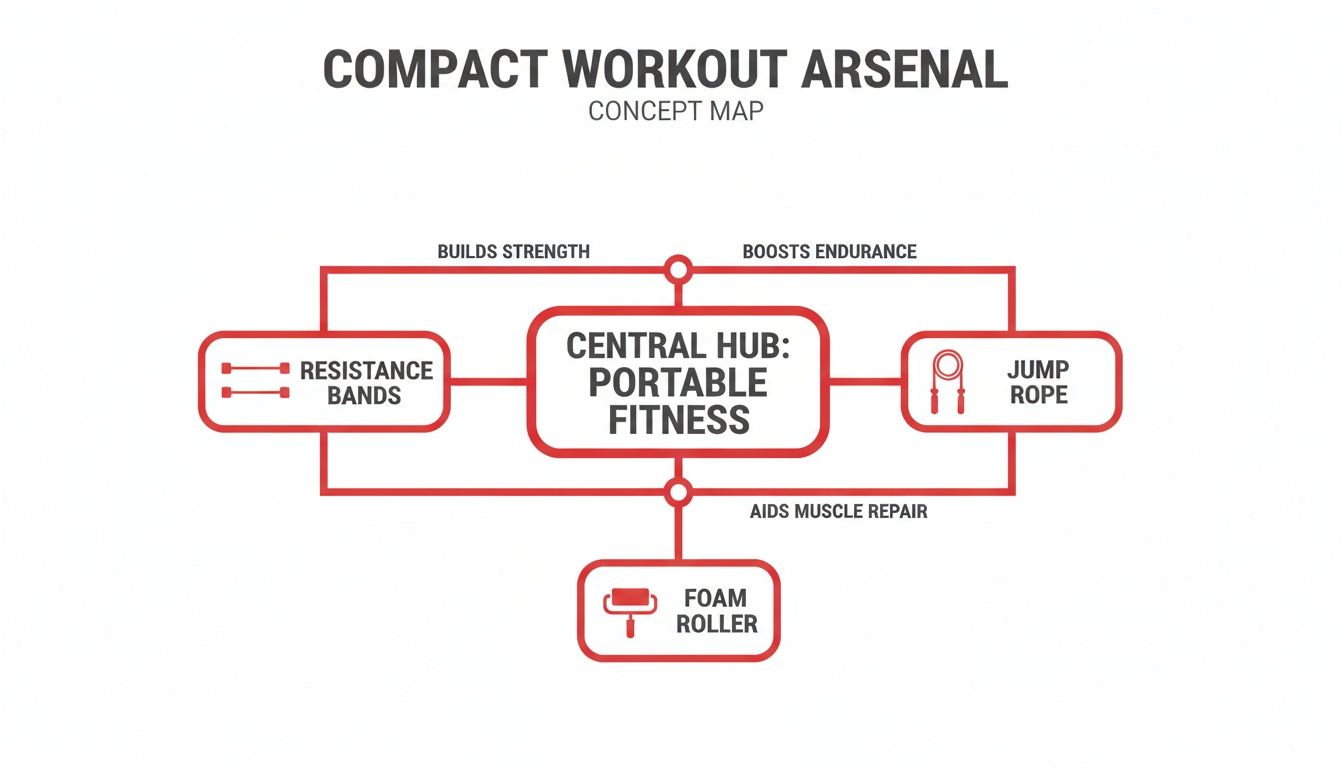
This visual really drives home how a few key, portable items can provide a well-rounded routine and form the backbone of a great convertible gym.
- Equipment Combination: Add a pair of adjustable dumbbells and a foldable workout bench to your minimalist kit. This one move unlocks hundreds of new strength exercises, from dumbbell presses to Bulgarian split squats.
- Storage Solution: Look for a bench that folds flat enough to slide under a sofa or bed. The adjustable dumbbells can live on their compact trays in a closet or under an end table. An ottoman with hidden storage is also a brilliant spot to stash your bands, rope, and other accessories.
If you want to dive deeper into planning from the ground up, check out our guide on how to build a home gym for more foundational tips.
The Balcony Powerhouse for Outdoor Potential
Don't sleep on your balcony or small patio! An outdoor space gives you fresh air and natural light, creating a mental break from your indoor living area that can be a massive motivator. It’s the perfect place for those more dynamic, high-intensity workouts you might be hesitant to do inside.
This setup is built for workouts that involve more movement and impact. You just need to be sure your gear is either weather-resistant or easy to bring back inside.
- Protect Your Floor: Start with interlocking rubber tiles. They’ll protect your balcony's surface, cushion your joints, and officially mark out your workout zone. They’re also great for dampening noise for any neighbors below.
- Anchor Down for Intensity: Installing a secure wall or ceiling anchor is a game-changer. It lets you use a MONFIT Battle Rope for killer metabolic conditioning without needing a ton of space to swing it around.
- Choose Durable Gear: Stick with equipment that can handle the elements or is easy to carry. Kettlebells, the MONFIT Heavy Jump Rope, and resistance bands are all great choices. For storage, a waterproof deck box will keep everything safe from sun and rain.
By using one of these blueprints as your guide, you can create a workout zone that truly fits your home and your life. After all, the best home gym is the one you actually use, and a well-designed space removes all the excuses standing between you and a great workout.
Unlocking Your Gains with Compact Workout Routines
Having the right gear for a small space is a brilliant first step, but it’s the work you put in that truly builds results. Think of it this way: your equipment is the ingredients, and your workout plan is the recipe. Without a solid recipe, even the best ingredients won't create a masterpiece.
This is where we get into the "how-to." These workout templates are designed specifically for the kind of compact, efficient gym we've been talking about. They prove that the size of your space has absolutely no bearing on the size of your gains. Let's show you how to combine these simple tools to build strength, torch calories, and feel incredible.
The 20-Minute Full-Body HIIT Session
High-Intensity Interval Training (HIIT) is the perfect solution for busy people working out in tight quarters. The whole idea is to go all-out for short bursts of effort, followed by brief recovery periods. This approach burns a massive number of calories in a very short time and keeps your metabolism fired up for hours after you're done.
For this routine, all you need is a MONFIT Heavy Jump Rope and a set of resistance bands. The key is to move from one exercise to the next with minimal downtime to keep that heart rate elevated.
- Warm-up (3 minutes): Ease into it with some light jump roping, arm circles, leg swings, and a few bodyweight squats. Get the blood flowing.
- The Circuit (15 minutes): Go hard on each exercise for 45 seconds, then take 15 seconds to catch your breath. Run through the entire circuit three times.
- Cool-down (2 minutes): Don't skip this! Finish with some light stretching, focusing on your calves, quads, chest, and shoulders.
This quick HIIT session is a powerhouse for your cardiovascular health and for fat loss. The explosive cardio from the jump rope paired with the tension from the resistance bands ensures you're hitting every major muscle group.
Here's a simple plan to follow for a quick and effective workout.
Sample 20-Minute Full-Body HIIT Routine
| Exercise | Equipment Needed | Work Interval | Rest Interval |
|---|---|---|---|
| Heavy Rope Skips | MONFIT Heavy Jump Rope | 45 seconds | 15 seconds |
| Banded Push-ups | Resistance Band | 45 seconds | 15 seconds |
| Banded Squats | Resistance Band | 45 seconds | 15 seconds |
| Band Pull-Aparts | Resistance Band | 45 seconds | 15 seconds |
| Alternating Lunges | Bodyweight | 45 seconds | 15 seconds |
Just follow the table, moving from one exercise to the next, and you'll have a killer workout done in under 20 minutes.
The Essential Strength Circuit
You don't need a giant, clunky machine to build real muscle and a resilient body. This circuit is built around adjustable dumbbells—the undisputed king of strength training in a small gym. We'll focus on big, compound movements that work multiple muscle groups at once, giving you the most bang for your buck.
With this workout, the goal is controlled, powerful movements with perfect form. Pick a weight that makes the last couple of reps a real challenge, but not so heavy that your form breaks down.
- Warm-up (5 minutes): A few minutes of light cardio and some dynamic stretches will do the trick.
-
The Workout: Perform 3 sets of 10-12 reps for each exercise. Rest for 60-90 seconds between each set to recover.
- Goblet Squats: Hold one dumbbell vertically against your chest.
- Dumbbell Bench Press: Use a foldable bench if you have one, or simply perform these from the floor.
- Bent-Over Rows: Hinge at your hips and keep your back flat as a board.
- Overhead Press: You can do this seated or standing for a bit more core work.
- Cool-down (5 minutes): Finish up with some static stretching.
This straightforward routine is a complete full-body strength workout. It's all the proof you need that a single pair of dumbbells can deliver serious results.
The Core and Mobility Finisher
No workout is truly complete without some attention to your core and mobility. A strong core is the foundation for every single movement you make, while good mobility keeps your joints healthy and wards off injuries. This little routine is the perfect way to cap off any workout, but it also works great on its own on your active recovery days.
All you'll need is a foam roller and a set of loop bands.
- Banded Glute Bridges (3 sets of 15 reps): Place a loop band just above your knees. This simple trick really helps fire up your glutes. To master your form, check out our guide on using resistance loop bands for activation exercises.
- Plank (3 sets, hold for 30-60 seconds): The classic. Keep your body in a perfectly straight line from your head to your heels.
- Foam Rolling (5-10 minutes): Slowly roll out your big muscle groups—quads, hamstrings, back, and calves. This helps release tension and kickstarts the recovery process.
Let's be clear: space constraints are no longer a valid excuse. The at-home fitness revolution is surging, with the market projected to more than double from USD 10.11 billion in 2025 to USD 20.56 billion by 2034. This incredible growth is driven by people just like you who are realizing that a small corner of their home can house some seriously big fitness ambitions. You can read the full research on the booming at-home fitness market to see just how the industry is adapting.
How to Choose the Right Gear for Your Space
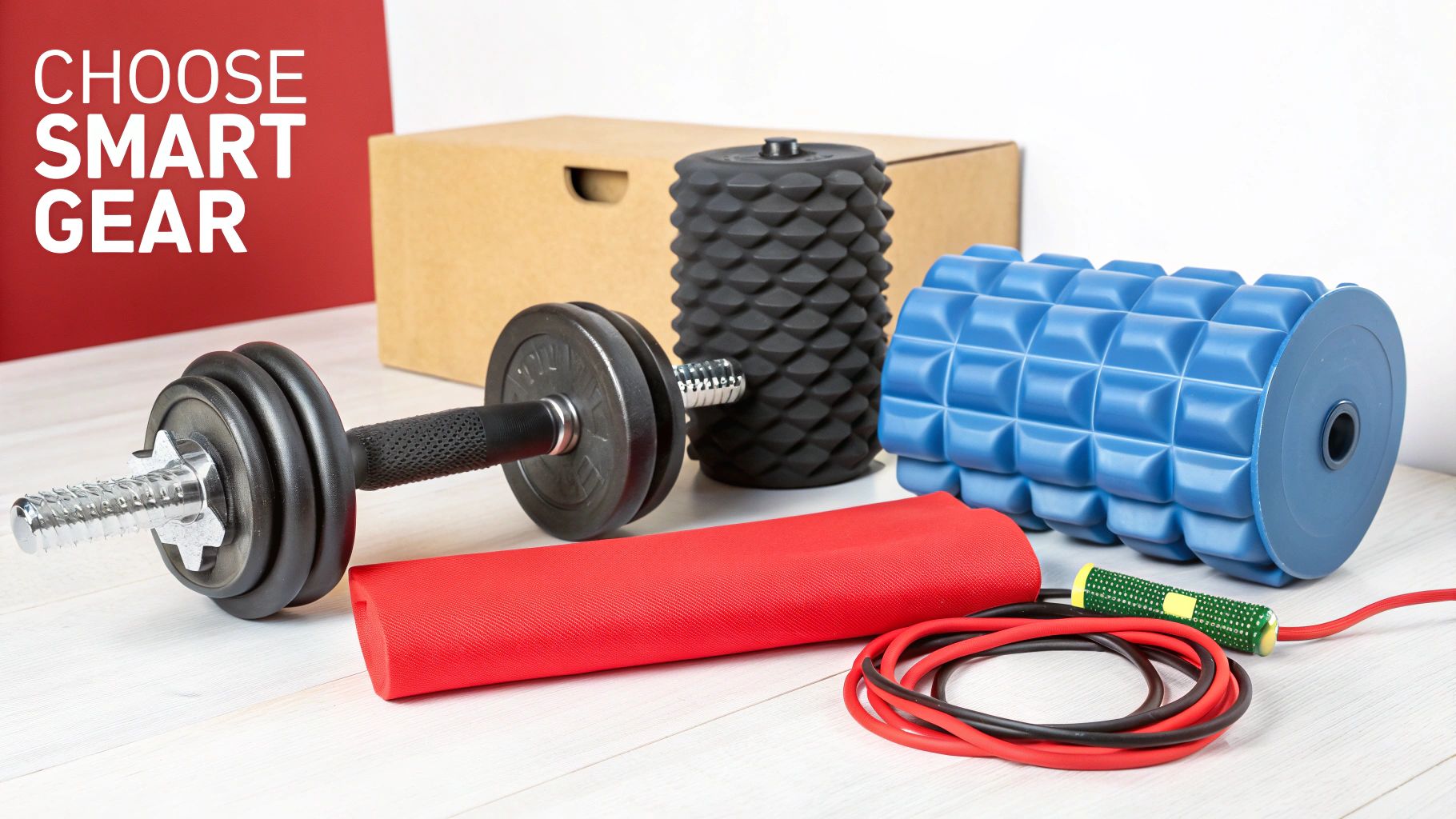
Before you pull out your wallet, it’s time to think like a strategist. The goal here isn't just to buy a bunch of equipment; it's to invest in a fitness setup that actually fits your home and your goals. We've all seen that exercise bike that slowly morphs into a clothes rack. Rushing this step is how that happens.
To make a smart decision, every piece of home gym equipment for small spaces needs to pass a simple four-part test. This checklist is your secret weapon for choosing gear you'll use for years, not just a few weeks.
The Four Pillars of Smart Equipment Selection
Think of these as the absolute must-haves for any piece of gear you're considering. If something doesn't tick all four boxes, it probably doesn't deserve a spot in your home.
-
Versatility (The "Swiss Army Knife" Test): Can this one tool do multiple jobs? Single-purpose machines are the biggest space-wasters you can buy. You want gear that can tackle a whole range of exercises. A solid set of resistance bands, for example, can be used for strength training, mobility work, and even pull-up assistance, doing the job of several larger machines.
-
Durability (The "Built to Last" Test): Is this thing going to survive your workouts? Cheap equipment is tempting, but it’s often made with flimsy materials that wear out in no time. Investing in well-made gear from a trusted brand means you won't be buying a replacement in a year. When you're weighing your options, it helps to know about the best home gym equipment brands that are known for quality.
-
Storability (The "Disappearing Act" Test): When you're done sweating, where does it go? This is a huge deal for anyone working with limited square footage. Your equipment needs to be lightweight, foldable, or compact enough to stash in a closet or slide under a bed. If putting your gear away is a workout in itself, you'll be less likely to pull it out in the first place.
-
Scalability (The "Grows With You" Test): Will this equipment still challenge you six months from now? Fitness is all about progress. Gear like adjustable dumbbells or a complete set of resistance bands lets you dial up the difficulty as you get stronger. This ensures your investment stays useful long after you've crushed your initial goals.
By filtering every potential purchase through these four pillars, you stop just buying stuff and start building a system. It's an approach that guarantees every piece earns its keep, maximizing both your space and your results.
Let’s see how this works with a real-world example.
Putting the Checklist into Action
Imagine you're trying to decide between a cheap set of fixed-weight kettlebells and a premium set of MONFIT resistance bands that come with multiple tension levels.
Let's break it down.
| Factor | Fixed-Weight Kettlebells | MONFIT Resistance Bands |
|---|---|---|
| Versatility | Good for swings, squats, and presses, but the exercise variety is pretty limited. | Excellent. Can mimic cable machines, help with pull-ups, and support a ton of mobility drills. |
| Durability | Usually solid, but the grips on cheaper versions can be a real weak point. | High. They're built with durable latex and secure attachments designed for constant stretching. |
| Storability | Bulky and heavy. They take up a surprising amount of floor or shelf space. | Excellent. Roll them up and they fit into a small bag or a single drawer. Simple. |
| Scalability | Poor. Once you get stronger, you have to buy a whole new, heavier kettlebell. | Excellent. Just grab a stronger band or combine two for more resistance. Your workout grows with you. |
Looking at the table, the resistance bands are the clear winner for a small space. While kettlebells are great, the bands offer far more versatility, storability, and scalability, making them a much smarter long-term investment.
Stick to this simple but powerful checklist, and you’ll make confident, regret-free decisions every time.
Common Questions About Small Space Gyms
Switching to a home workout setup always brings up a few questions. That’s a good thing. It’s smart to think through the details—like noise, floor protection, and whether you can actually get results—before you start. Getting these things right is what builds a space you’ll be excited to use day after day.
Here, we’re going to tackle the most common questions people have about building a gym in a tight spot. My goal is to give you clear, straight-up answers so you can move forward and start your fitness journey with total confidence.
What's the Best Single Piece of Equipment If I Can Only Afford One Thing?
When you’re working with a tight budget and even tighter space, you need one tool that does it all. If you can only choose one piece of home gym equipment for small spaces, a high-quality set of resistance bands is the hands-down winner. Think of it as the Swiss Army knife of fitness.
A good kit, like the ones from MONFIT, can mimic a surprising number of exercises you'd typically do on bulky cable machines or with an entire dumbbell rack. You can use them for just about everything:
- Strength Training: Hit your chest presses, rows, bicep curls, and shoulder presses.
- Pull-up Assistance: Loop a heavy band around a pull-up bar to give you that boost you need to build strength.
- Mobility Work: Use the lighter bands for targeted stretching and getting your joints moving properly.
They’re incredibly light, pack away into almost nothing, and can be adapted for a genuine full-body workout. For pure functional density, nothing else even comes close.
How Can I Work Out in an Apartment Without Disturbing My Neighbors?
This is a huge one for anyone living in a shared building, and for good reason. The secret is to shift your focus to low-impact, quiet exercises and use some smart sound-dampening tricks. You don’t have to sacrifice intensity, just the noise.
For instance, instead of jumping up and down on a bare floor, use a MONFIT heavy jump rope on a thick, high-quality exercise mat. That mat is your best friend; it absorbs both sound and impact, protecting your floors and keeping your downstairs neighbors happy. Resistance band exercises are another fantastic choice because they're virtually silent.
If you’re thinking about cardio, a foldable rowing machine is a much quieter option than a treadmill. And of course, just be considerate with your timing—avoid dropping weights or doing intense workouts late at night or super early in the morning. A good rubber mat is the single best investment you can make for keeping the peace.
Do I Need to Protect My Floors? How?
Yes, absolutely. Protecting your floors isn't optional. It saves your home from damage, gives you a safer and more stable surface to work on, and even helps cut down on noise. One dropped dumbbell can easily chip tile, dent hardwood, or tear up vinyl flooring.
Protecting your floor isn't just about preventing scratches; it's about creating a dedicated, safe, and stable foundation for every workout you do.
Here are the best ways to get it done:
- Interlocking Rubber Floor Tiles: These are the gold standard. They’re tough, easy to clean, and you can customize the exact size and shape of your workout zone.
- Thick Fitness Mat: At the very least, get a heavy-duty fitness or yoga mat. Put it under any equipment and use it for all your floor exercises. It’ll stop scratches and absorb sweat, protecting both hardwood and carpet.
Taking this simple step keeps your home in great shape and makes your workout space feel more legitimate and permanent.
Is It Possible to Build Serious Muscle in a Small Home Gym?
This is a myth I hear all the time—that you need a commercial gym packed with machines to see real strength gains. The truth? You can absolutely build serious muscle and strength in a small home gym. The biological trigger for muscle growth, known as progressive overload, works the same no matter where you are.
Progressive overload just means you have to continually increase the demand on your muscles over time. You don't need a massive footprint to make that happen.
Here’s how you can do it:
- Increase the Weight: With adjustable dumbbells, you can steadily add more weight as you get stronger.
- Increase the Tension: Move up to stronger MONFIT resistance bands or double them up for greater resistance.
- Improve Form and Reps: You can also challenge your muscles by perfecting your form, slowing down the movement, or simply doing more reps.
Consistency, good form, and the commitment to push yourself are far more important than how many square feet you have. As you get started, you might find our guide on the best home gym equipment for beginners useful for making those first critical decisions.
Ready to build your own powerful, compact workout arsenal? MONFIT provides the versatile, durable, and space-saving equipment you need to achieve your fitness goals from home. From our heavy jump ropes to our comprehensive resistance band kits, every piece is designed to deliver maximum results with a minimal footprint. Explore our full collection and start building your perfect small-space gym today.