


So, you're thinking about building a home gym? The first question on everyone's mind is always the same: what's this actually going to cost me?
The answer can be anything from a couple hundred dollars for some solid, functional basics to well over $5,000 for a setup that rivals a commercial gym. The good news? You can build an incredibly effective and versatile gym for under $500. A powerful home workout space is absolutely within reach, no matter your budget.
Breaking Down the Investment Tiers
Figuring out the money side of a home gym is the first real step. It’s not about just buying the most expensive gear you can find; it’s about making smart investments in equipment that actually fits your fitness goals, your home, and your wallet. The home gym market is booming—it's projected to hit $11.6 billion by 2035—which means more options for us.
For most people, a simple setup with essentials like resistance bands and a pull-up bar will only run you $200-$500. If you want to get serious about strength training, adding things like a barbell and some weights will likely push that into the $1,000-$3,000 range. And for the high-end smart equipment? That's where you start seeing price tags of $5,000 or more.
To make this easier, let’s break it down into three common-sense tiers. Each one offers a different level of capability, designed for different goals and budgets.
Budget Tier: The Functional Fitness Starter
This is the perfect starting point for beginners, anyone tight on space, or people who just love functional fitness and HIIT workouts. The name of the game here is getting the most bang for your buck with versatile, portable tools. We're talking gear that delivers a full-body workout without a single dedicated machine in sight.
Mid-Range Tier: The Hybrid Strength Builder
Ready to get serious about lifting? The mid-range tier is where you introduce the classic free weights. This setup is all about combining the flexible, functional tools from the budget tier with the raw muscle-building power of barbells, dumbbells, and a solid rack. It’s a truly well-rounded workout zone.
For most people, a mid-range gym hits the sweet spot for long-term value. It gives you the core equipment you need for progressive overload and serious strength gains, all without the premium price tag of specialized machines.
Premium Tier: The Performance Zone
This is for the dedicated athlete or the serious fitness enthusiast who wants a no-compromise training space. The premium tier is designed to mirror what you’d find in a high-end commercial gym, complete with heavy-duty strength equipment, specialized cardio machines, and often smart tech for tracking your performance. This is a true investment in a top-tier training environment.
To give you a clearer picture, this infographic breaks down the typical investment you can expect for each of these three home gym tiers.
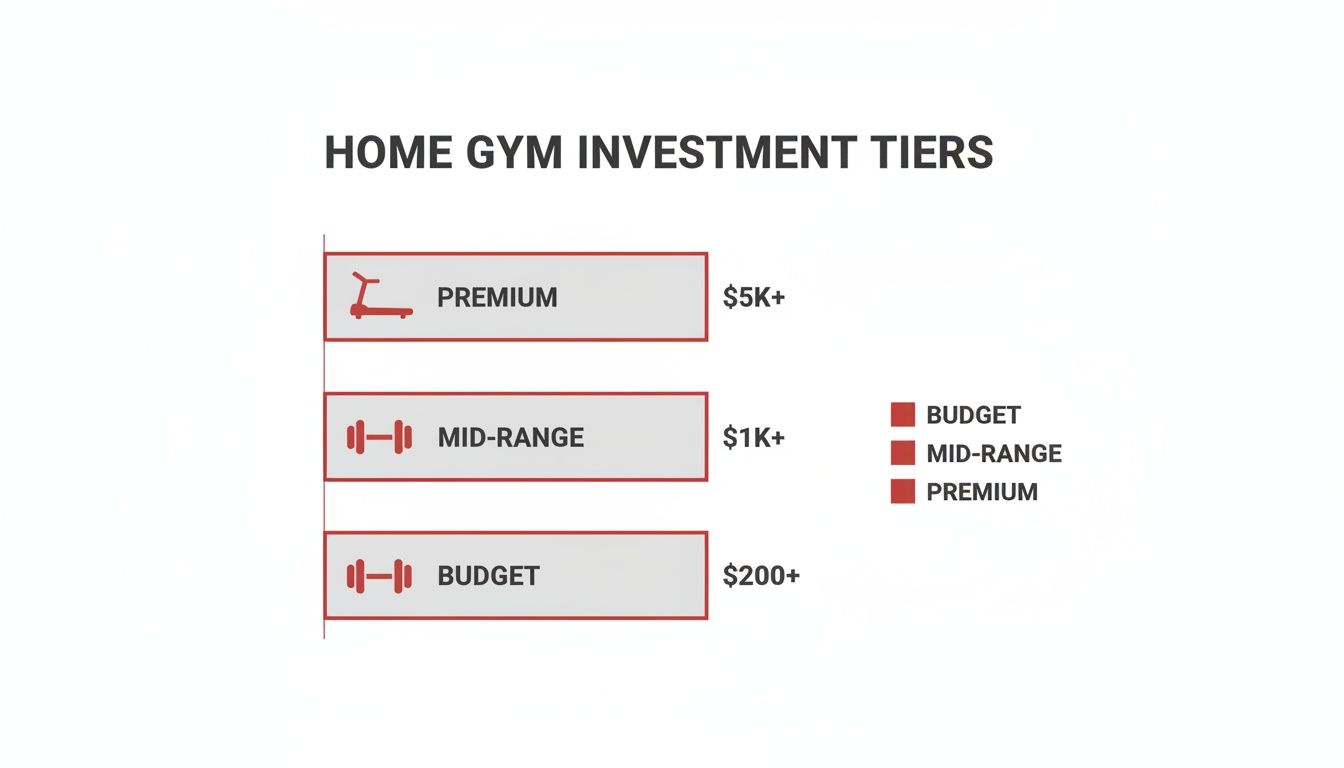
As you can see, the cost really climbs as you move from versatile, foundational gear to bigger, more specialized equipment. For a deeper dive into planning your space, check out our complete guide on how to build a home gym.
Home Gym Cost Tiers at a Glance
To quickly summarize, here's what you can generally expect from each budget level.
| Budget Tier | Typical Cost Range | Included Equipment | Best For |
|---|---|---|---|
| Budget | $200 – $500 | Resistance bands, pull-up bar, yoga mat, jump rope, kettlebells | Beginners, HIIT, functional fitness, and small spaces |
| Mid-Range | $1,000 – $3,000 | Barbell, weight plates, squat rack, adjustable bench, dumbbells | Intermediate lifters focused on strength training and muscle growth |
| Premium | $5,000+ | Power rack, full dumbbell set, cardio machines, specialty bars, smart tech | Dedicated athletes and enthusiasts wanting a commercial-grade setup |
This table should give you a solid baseline for figuring out which path makes the most sense for your goals and your bank account.
Breaking Down Your Equipment Costs by Category
Figuring out the total cost of a home gym feels a lot less intimidating when you break it down by category. Think of it like cooking a meal: you have your main course (strength gear), your sides (cardio), and the essential spices that pull it all together (functional and mobility tools). Each category has a huge price range, letting you piece together a setup that fits your goals and your wallet.
So, let's get into the nitty-gritty of where your money will actually go. This will show you not only how things add up but also where you can find some serious bargains. Knowing the typical price ranges is your best defense against overspending.
Cardiovascular Equipment Costs
Cardio is the engine of your fitness, and what you spend here can be anything from pocket change to the price of a small car. The real secret is to pick a machine that you’ll actually want to use day after day.
- Jump Ropes: The undisputed champion of budget cardio. You can grab a basic speed rope for as little as $10. For a more intense, full-body workout, high-quality, MONFIT-style heavy ropes usually run between $25 and $60.
- Stationary Bikes: An entry-level folding bike is a great starting point at $150-$300. If you're a bit more serious, mid-range spin bikes with smooth magnetic resistance fall into the $400-$800 bracket. The high-end, tech-heavy smart bikes can easily top $1,500.
- Treadmills: For light use, a simple walking pad or folding treadmill can be had for $300-$600. A more robust machine built for serious runners will set you back $800-$2,000, while the commercial-grade beasts you see in gyms can push past $3,000.
- Rowing Machines: You can find budget-friendly magnetic or hydraulic rowers starting around $200-$400. The gold-standard air rowers that are a staple in most gyms typically cost between $900 and $1,300.
Strength Training Equipment Costs
This is the bedrock of your gym. Good strength equipment is one of the best investments you can make in your fitness journey because quality steel and iron will literally last a lifetime.
Your strength equipment is the core of your home gym. While it can be a significant part of your initial cost, quality free weights and racks hold their value incredibly well and provide limitless training possibilities.
For a lot of people, it all starts with the barbell. A solid Olympic barbell will cost you around $150-$350. After that, you need plates. Bumper plates, which are perfect for deadlifts and Olympic lifts, go for about $2.00-$3.50 per pound. That means a starter set of 160 lbs could run you anywhere from $320 to $560.
Here's a look at other common strength staples:
- Dumbbells: A light pair of dumbbells might only be $50, but a full rack of them can quickly hit $500 or more. This is where adjustable dumbbells shine as a space-saver, typically costing $300-$700 for a pair that replaces an entire rack of individual weights.
- Kettlebells: A single, do-it-all kettlebell (say, 35 lbs) costs around $50-$90. Building a small collection of three different weights will likely land you in the $150-$250 range.
- Power Racks and Squat Stands: A basic squat stand is a great starting point for $250-$500. For more security and versatility, a full power rack or "cage" generally starts at $400 and can climb to $1,000+ for premium models with all the bells and whistles.
- Weight Bench: A simple flat utility bench can be found for $100-$150, but a high-quality adjustable bench that offers incline and decline positions will usually cost between $200 and $450.
Functional and Mobility Tool Costs
This is my favorite category because it’s where you find the most versatile, high-value, and space-saving gear. These tools are the secret sauce—they fill in the gaps, help prevent injury, and keep your workouts from getting stale.
The home gym setup cost doesn't have to be overwhelming, especially if you start here. A basic setup focused on functional tools can cost just $150-$400, while a fully kitted-out space can approach $2,000-$10,000. It's no surprise the home fitness market is projected to grow by another $4.96 billion in the coming years, driven by the popularity of things like resistance bands and stationary bikes.
Here are a few key items and what they cost:
- Resistance Bands: A complete MONFIT kit with loop bands, tube bands with handles, and pull-up assist bands is a ridiculously versatile tool for $40-$150.
- Pull-Up Bar: A simple doorway bar is a classic for a reason and costs $25-$50. A sturdier, wall-mounted version will run you $60-$120.
- Yoga Mat: You can get a basic mat for $20, while thicker, more durable options can go up to $80.
By mixing and matching pieces from these categories, you can build a gym that feels like it was made just for you. For more inspiration, check out our guide to the best home gym equipment for every kind of goal.
Smart Planning for Small Spaces and Budgets
Let's be real: most of us don't have a spare garage bay just waiting to be converted into a state-of-the-art gym. If your workout zone is a corner of the living room or a slice of the bedroom, a tight budget and limited space aren't deal-breakers. They just mean you have to be smarter about your choices.
The game isn't about "how much stuff can I cram in here?" It's about "how much can each piece of equipment do for me?" This is where you need to start thinking in terms of cost-per-function. It’s the single most important metric when you're trying to figure out your home gym setup cost without breaking the bank.
Think of it like stocking a kitchen. You could buy a separate gadget for every single task—an apple corer, a banana slicer, an avocado tool. Or, you could just buy one great chef's knife that does it all. That knife is your multi-functional gym equipment.
This mindset completely changes your return on investment. A bulky, single-purpose leg extension machine can easily set you back over $500, hog a massive amount of floor space, and only work one muscle group. Compare that to a complete resistance band kit for under $150. Suddenly you can do squats, presses, rows, and core work—all with something that tucks away in a drawer.
Championing Multi-Use and Space-Saving Gear
When every square inch of your home is prime real estate, clunky machines are your worst enemy. The goal is to find gear that delivers a killer workout but packs away neatly when you're done. These are the true heroes of the modern home gym, proving you don’t need a massive footprint to get seriously fit.
Here are a few of my favorite space-saving champions:
- Portable Battle Ropes: Traditional battle ropes are awesome, but they need a ton of room. The newer, portable versions use heavy-duty elastic resistance to give you that same heart-pounding metabolic workout in a tiny fraction of the space.
- Stackable Resistance Bands: MONFIT-style tube bands with handles are a game-changer. You can clip multiple bands onto the handles to progressively increase the resistance, giving you a challenge that can rival a full dumbbell rack.
- Adjustable Kettlebells or Dumbbells: Yes, the upfront cost is higher. But one adjustable dumbbell can replace an entire rack of 15 individual weights, saving you a staggering amount of space and, ultimately, a lot of money.
Just think about it. For a HIIT enthusiast or a busy professional, a setup with battle ropes (around $80), a solid resistance band set ($50-$150), and a pair of heavy jump ropes ($30) comes in between $200-$400. That small investment gives you strength and conditioning benefits that rival what you'd get from $5,000 worth of machines.
It’s no wonder the market is shifting. Home fitness enthusiasts now account for over 50% of the revenue share in the multi-billion dollar fitness industry, and the demand is clearly for these kinds of smart, compact tools.
High-Impact vs. Low-Cost Equipment Comparison
To really see the cost-per-function principle in action, let's compare some common fitness goals. The table below shows how a small investment in versatile gear can deliver the same, if not better, results than a huge investment in a single-purpose machine.
| Fitness Goal | High-Cost Option (Example & Cost) | Low-Cost MONFIT Alternative (Example & Cost) |
|---|---|---|
| Full-Body Strength | Single-Station Cable Machine ($1,500+) | Stackable Resistance Band Set ($50-$150) |
| Cardio & Conditioning | Treadmill or Elliptical ($1,000+) | Portable Battle Ropes ($80-$120) |
| Leg Development | Leg Press Machine ($800+) | Kettlebell + Loop Bands ($100) |
| Upper Body Pulling | Lat Pulldown Machine ($700+) | Doorway Pull-Up Bar + Bands ($75) |
As you can see, you don't need to finance a piece of equipment that's more expensive than your couch to build serious strength and fitness. Smart, low-cost alternatives get the job done efficiently and leave you with more money and more space.
Actionable Strategies for Smart Prioritization
Building a home gym on a budget is a marathon, not a sprint. The trick is to start with a solid foundation and add pieces intelligently as your fitness evolves and your budget allows. This keeps you from buying expensive equipment that just ends up as a fancy coat rack.
Start with the essentials that support the workouts you are doing right now. Don't buy for the person you want to be in a year; buy for the workout you're going to do next week. Consistency is built with gear you can actually use, not machines you aspire to.
Here’s a simple, three-step plan to get you started:
- Build Your Foundation First: Get the absolute basics covered. A quality mat, a set of resistance loop bands, and a jump rope will handle your cardio, strength, and mobility needs for less than $100. Use this simple kit consistently for a month to build the habit.
- Add a "Workhorse" Piece: Now, figure out what you enjoy most. If it's pure strength, get a solid kettlebell or a doorway pull-up bar. If it's high-intensity conditioning, a set of heavy ropes is your best bet. This one item will become the core of your routine.
- Expand with Accessories: Once you have a consistent routine, you can start filling in the gaps with smaller, targeted accessories. This could be floss bands for recovery, a foam roller for mobility, or an extra-heavy band to help with assisted pull-ups.
Finally, don't forget storage. To learn more about maximizing a tight area, check out our guide on finding the perfect home gym equipment for small spaces. By embracing that cost-per-function mindset and focusing on versatile gear, you can build a powerhouse of a gym that respects both your wallet and your floor plan.
Uncovering the Hidden Costs of Your Home Gym
When you start adding up the cost of a home gym, it's easy to just focus on the big-ticket items like a squat rack or a treadmill. But the final number on your spreadsheet is almost always higher than your initial shopping list. Think of it as the "true cost" of your setup—it includes a bunch of smaller, often-overlooked expenses that can sneak up on you.
It’s a lot like buying a car. The sticker price is just the starting point. You still have to factor in taxes, insurance, and maybe even a new set of tires. Your home gym is the same deal. Planning for these "hidden" costs from the get-go is the key to avoiding a budget blowout.
These extra expenses really break down into two buckets: the one-time costs to get your space ready, and the ongoing expenses to keep everything running smoothly. Both are critical for building a workout space that’s not just functional, but safe and motivating.
Preparing Your Workout Space
Before you even think about moving in a single dumbbell, your room might need some attention. These upfront investments are non-negotiable for a serious setup because they protect your house and make your workouts way better.
The absolute first thing to consider is the floor. Dropping a 45-pound plate on your nice hardwood or tile floor is a mistake you only make once. Heavy-duty rubber flooring is the gold standard for a reason.
- Rubber Mats: You can expect to pay around $2 to $4 per square foot for good interlocking rubber tiles. For a pretty standard 10x10 foot space (100 sq ft), you’re looking at an extra $200 to $400.
- Mirrors: A big wall-mounted mirror isn't just for vanity; it's crucial for checking your form and it makes a small space feel way bigger. A decent gym mirror will probably set you back $150 to $300.
- Lighting: Working out in a dimly lit basement is a real motivation killer. Swapping out an old fixture for bright LED shop lights can cost between $50 and $200, but the boost in energy you'll feel is priceless.
Don't treat your space as an afterthought. Investing in proper flooring and lighting is not just about aesthetics; it's about creating a safe and effective training zone that protects both you and your home.
Installation and Ongoing Expenses
Okay, so your space is prepped. You're not quite done yet. Some gear needs to be professionally installed, and a lot of modern equipment comes with monthly fees you need to build into your budget for the long haul.
For instance, if you're not comfortable finding studs and drilling into them, you might want to hire a handyman to mount your pull-up bar or heavy bag. That could easily add another $75 to $150 in labor. The same goes for huge, complex power racks—some companies offer assembly services for an extra fee, which can be a lifesaver.
Even more significant these days are the recurring costs tied to smart fitness.
- App Subscriptions: That fancy smart treadmill or bike often requires a monthly subscription to unlock all the classes and features. These usually run from $20 to $40 a month, which tacks on an extra $240-$480 a year.
- Maintenance: Your gear needs a little TLC to last. We're talking about things like lubricant for a treadmill belt, replacing stretched-out resistance bands, or cleaning your barbell to prevent rust. If you budget a little, maybe $50 a year, you can cover these small but necessary costs.
- Warranty Considerations: Always, always check the warranty before you buy. That cheap piece of equipment with a 90-day warranty could end up costing you a fortune in repairs. It's often smarter to pay a little more for an item with a lifetime frame warranty. Some brands offer extended warranties for a fee, which might be a good call for your most expensive machines.
By thinking about these "hidden" costs ahead of time, you can build a budget that reflects the real total. It ensures your home fitness journey starts on the right foot, without any surprise bills to derail your progress.
Sample Home Gym Shopping Lists for Every Budget
Theory is great, but let's be honest—nothing makes the cost of a home gym feel more real than seeing an actual shopping list. It’s the moment abstract numbers turn into tangible pieces of gear you can picture in your space. To help you see exactly what your money can buy, I've put together three sample shopping lists, each tailored to a different budget and fitness goal.
Think of these as more than just price tags; they’re a roadmap. They show you how to build a smart, effective workout space whether you're starting with a few hundred dollars or ready to invest a few thousand. You'll get a clear picture of the kinds of workouts each setup enables, so you can perfectly match your spending to your ambitions.
The $300 Functional Fitness Starter
This budget is all about getting the most bang for your buck. It’s perfect if you're into HIIT, just starting your fitness journey, or need a powerful, portable gym you can pull out and put away in minutes. We're focusing on high-quality, multi-use tools that give you a killer full-body workout without a single bulky machine in sight.
This setup is the Swiss Army knife of home fitness. It’s proof that you don't need a huge budget to get serious results.
- MONFIT Resistance Band Set: This is the heart of your new gym. A full kit with loop bands, pull-up assist bands, and handled tubes opens the door to hundreds of strength exercises—squats, presses, rows, you name it. (Estimated Cost: $60)
- MONFIT Heavy Jump Rope: Forget those flimsy speed ropes you remember from the playground. A weighted rope fires up your shoulders, core, and back, turning basic cardio into a full-body conditioning blast. (Estimated Cost: $45)
- Doorway Pull-Up Bar: An absolute must-have for building a strong back and upper body. Pair it with your resistance bands for assistance, and it becomes a tool anyone can use, no matter their current strength level. (Estimated Cost: $35)
- One Quality Kettlebell (16-24 kg / 35-53 lb): A single kettlebell is a true powerhouse. It's all you need for building raw strength, stability, and explosive power through swings, goblet squats, and presses. (Estimated Cost: $70)
- High-Density Exercise Mat: Do your floors and joints a favor. A good mat is essential for floor work like planks, push-ups, and all your post-workout stretching. (Estimated Cost: $30)
- Foam Roller: I consider this a non-negotiable for recovery. It helps you work out muscle knots and improve mobility, which is key to staying consistent and injury-free. (Estimated Cost: $25)
Total Estimated Cost: $265
Workout Style: This setup is purpose-built for high-intensity interval training (HIIT), functional strength, metabolic conditioning, and bodyweight-plus workouts. It's the definition of a minimalist approach that delivers maximum impact.
The $1,500 Hybrid Strength Builder
With a mid-range budget, you can get into the world of traditional barbell and dumbbell training while holding onto the functional tools from the starter kit. This setup is for the person who's serious about building muscle and strength through progressive overload but still wants to stay agile with conditioning and mobility work. It really is the sweet spot for a well-rounded, lifelong fitness habit.
This combination of free weights and functional gear gives you the best of both worlds—a solid foundation for serious lifting.
- Squat Stand with Pull-Up Bar: This becomes the centerpiece of your gym. It gives you a safe rack for squats, bench presses, and overhead presses. (Estimated Cost: $400)
- Olympic Barbell: A quality 45 lb barbell isn't just a purchase; it's a long-term investment that will be the foundation for all your major compound lifts. (Estimated Cost: $200)
- 160 lb Bumper Plate Set: This is a fantastic starter set of weights. They’re durable enough to be dropped during deadlifts but versatile enough for any barbell movement you can think of. (Estimated Cost: $350)
- Adjustable Weight Bench: Absolutely crucial. This one item unlocks a huge range of exercises, from the classic bench press to dumbbell rows and incline work. (Estimated Cost: $250)
- Adjustable Dumbbells: These are a game-changer for saving space and money. Instead of a massive rack, you get a whole range of weights in one compact footprint, perfect for accessory work. (Estimated Cost: $300)
Total Estimated Cost: $1,500
Workout Style: This gym is primed for classic strength programs (like a 5x5), bodybuilding splits, powerlifting, and CrossFit-style WODs.
The $5,000+ Premium Performance Zone
Alright, this is the dream setup. This is for the dedicated athlete who wants zero compromises and a training environment that rivals most commercial gyms. This budget gets you a heavy-duty power rack for ultimate safety, a full spread of weights, and a top-tier cardio machine for conditioning at an elite level.
This isn't just a home gym; it's a true investment in peak performance.
- Full Power Rack: A major upgrade from a squat stand. A full cage with spotter arms offers unmatched safety, giving you the confidence to push your limits on heavy lifts, even when you're training alone. (Estimated Cost: $800)
- Full Dumbbell Set (5-50 lbs): While adjustables are great, nothing beats the convenience and pure durability of a full rack of fixed dumbbells for a serious lifter. Grab and go. (Estimated Cost: $1,200)
- Premium Cardio Machine (e.g., Concept2 Rower or Echo Bike): Time to pick your poison. Choose a best-in-class machine known for being nearly indestructible and brutally effective for high-intensity conditioning. (Estimated Cost: $1,100)
- Additional Bumper Plates (300+ lbs total): As you get stronger, you'll need more weight. This larger set of plates ensures your progress never stalls. (Estimated Cost: $500)
- Specialty Bar (e.g., Trap Bar): A trap bar is a fantastic tool for building pulling strength with deadlifts and loaded carries, often with less stress on the lower back. (Estimated Cost: $250)
- Rubber Flooring for the Entire Space: Go wall-to-wall with rubber tiles. It protects your foundation, quiets the noise, and makes your entire space feel like a professional facility. (Estimated Cost: $400)
- Complete MONFIT Functional Kit: Go all-in with battle ropes, heavy jump ropes, and a full band set to cover every possible conditioning, warm-up, and recovery need. (Estimated Cost: $250)
Total Estimated Cost: $4,500+
Workout Style: This zone is built for advanced strength and conditioning, sport-specific training, powerlifting, and high-volume endurance work. It can handle anything you throw at it.
Looking at these lists, you can start to see how a strategic home gym setup cost can grow with you. For more tips on getting started the smart way, take a look at our complete guide to home gym essentials on a budget and learn how to build a powerful space without breaking the bank.
Is a Home Gym a Smart Financial Investment?
It’s easy to get sticker shock when looking at equipment prices, but let’s zoom out and look at the bigger picture. Is this actually a smart move for your wallet? The answer becomes crystal clear when you stack up a one-time investment against the never-ending drain of monthly gym fees.
Here in the U.S., the average gym membership runs about $50 a month, which adds up to $600 a year. With that number in mind, let's see just how quickly a home gym starts paying you back.
Calculating Your Break-Even Point
This is the magic moment when your home gym officially stops being an expense and starts saving you money. The math is simpler than you might think.
- Budget Tier ($300): Your no-frills setup pays for itself in a mere 6 months.
- Mid-Range Tier ($1,500): This more serious gym breaks even in about 2.5 years.
- Premium Tier ($5,000): Your dream gym becomes profitable after roughly 8 years.
Once you cross that break-even point, every single workout is essentially free. You're not just saving money; you're building equity in your health and your home.
Of course, the real value goes way beyond the numbers. Think about the time you get back from not commuting, the gas money you save, and the sheer convenience of having your workout space just a few steps away. That kind of accessibility is what builds a consistent routine—and consistency is where real results come from.
Choosing quality gear from the best home gym equipment brands is more than just a purchase; it's a long-term investment in yourself. You’re building an asset that supports both your physical and financial health for years, delivering returns a monthly membership never could.
Got Questions About Home Gym Costs? We’ve Got Answers.
As you start getting serious about building your home gym, the questions always start to bubble up. It's one thing to have a plan, but another thing entirely to navigate the real-world details of what to buy and when. Let’s clear up some of those common sticking points so you can invest with confidence.
Think of this as the final check-in before you hit "add to cart." We’ll tackle the most frequent questions we hear from people just like you, making sure you get the most bang for your buck.
What’s the Bare Minimum I Need to Get Started?
Believe it or not, you can get a seriously effective home gym up and running for under $100. The trick is to focus on versatile tools that do a lot more than their price tag suggests.
A good set of resistance loop bands for strength training, a solid jump rope for cardio, and a basic mat for floor exercises are all you really need. This simple trio can give you a killer full-body workout. It's the perfect way for beginners to build a routine without a huge upfront investment, especially if you're short on space.
Is It Cheaper to Buy Piece by Piece or Go for a Bundle?
Ah, the classic question. Going piece by piece gives you ultimate control. You can spread the cost out over time and hand-select every single item to make sure it's exactly what you want. No compromises.
On the other hand, equipment bundles can offer some hefty savings compared to buying everything separately. If you find a kit where you know you'll use every single piece—like a complete resistance band set—it’s often the smarter financial move. Just make sure you're not paying for extras that will just sit in a corner gathering dust.
A great bundle saves you money on gear you were already going to buy. A bad bundle just leaves you with expensive dust collectors. Choose wisely based on your actual workout plans.
How Should I Budget for Future Upgrades?
A smart home gym budget isn't just about what you need today; it's about planning for the stronger, fitter person you're going to be. If you have big goals, like getting into heavy lifting, you know you'll eventually need more weight plates or a better rack.
A simple but powerful strategy is to start a dedicated "gym upgrade" fund. Just set aside a small, consistent amount—even $20-$50 a month—earmarked for new gear. This little habit transforms a future big-ticket purchase from a stressful hit to your wallet into a planned, manageable investment. It ensures your gym can keep up as you get stronger.
Ready to build a powerful, space-savvy home gym without breaking the bank? MONFIT is all about premium, compact equipment designed for maximum impact. Check out our lineup of resistance bands, heavy jump ropes, and battle ropes to create a workout space that works for you. Shop the MONFIT collection today and get started on your journey.
