


When you think about essential home workout equipment, your mind might jump to big, expensive machines. But the truth is, the most effective home gyms start with a few versatile, high-impact tools. Things like resistance bands, a solid jump rope, and a quality yoga mat are the real workhorses, letting you build strength, ramp up your cardio, and improve mobility without needing a ton of space or cash.
These aren't just accessories; they're the foundation for getting serious results right from your living room.
Why Building a Home Gym Is a Smart Move
Let's be real: crowded gyms, inconvenient class times, and that commute you dread? It's a grind. Building your own workout space is about taking back control. It’s about creating a gym that fits your life and your goals, not the other way around.
This guide isn't another generic checklist. We're going to treat your home workout equipment essentials like a custom toolkit. The perfect setup for you depends entirely on what you're trying to achieve—whether that’s building raw strength, torching calories, or focusing on mobility and recovery. The right gear can deliver elite-level results without you ever having to leave the house.
The New Era of Home Fitness
The fitness world has made a permanent shift. Working out at home is no longer just a backup plan; it's a powerful, sustainable way for millions to stay in top shape. The numbers don't lie.
The global home fitness equipment market is on track to hit an incredible USD 31.01 billion by 2029, climbing at a steady 11.6% annual growth rate. This isn't just a blip; it's a fundamental change in how we approach our health, sparked when gym closures forced everyone to get creative. Discover more insights about the home fitness market.
This boom means we have access to better, more innovative gear than ever before. For athletes who live and breathe Cross-training or HIIT, tools like MONFIT's loop bands and floss bands have gone from "nice-to-have" to absolutely critical for pushing metabolic conditioning and speeding up recovery.
Defining Your Own Essentials
So, what makes a piece of equipment "essential"? It’s not about owning the most stuff. It's about owning the right stuff. A killer home gym is built with purpose. Think of this guide as your roadmap. We’ll help you choose the perfect setup by zeroing in on three key things:
- Your Personal Goals: Are you chasing muscle gain, fat loss, or just moving better? Your answer is your starting line.
- Your Available Space: You don't need a spare garage. We'll show you how to turn even a small corner into a functional workout zone.
- Your Budget: An effective home gym doesn’t need to break the bank. We’ll map out a smart way to build your arsenal over time.
By sticking to these principles, you can confidently build a collection of home workout equipment essentials that will grow with you for years. If you want a more detailed blueprint, check out our guide on how to build a home gym.
Matching Equipment to Your Fitness Goals
The best home gym isn’t the one packed to the rafters with gear—it’s the one with the right equipment for you. Just buying a bunch of random items is like trying to build a bookshelf with kitchen utensils. To get the results you're after, you have to match your home workout equipment essentials directly to your specific fitness goals.
Think of it this way: your fitness journey rests on three core pillars. Each one needs the right set of tools for the job. Let's break down how to choose your gear based on whether you're building strength, cranking up your cardio, or focusing on mobility. This isn't just a shopping list; it's a strategic plan for success.
Strength and Power Development
When your main goal is to build muscle and raw power, you need one thing: resistance. But not all resistance is created equal. While dumbbells and barbells are the old-school classics, modern tools like heavy resistance bands and pull-up bands offer a unique advantage called variable tension.
Picture lifting a dumbbell. The weight feels heaviest right at the start and can almost feel lighter at the top of the movement. Heavy resistance bands do the complete opposite. The tension increases the more you stretch them, forcing your muscles to fire harder through the entire range of motion, especially at the point where you're squeezing the muscle the hardest.
This is a total game-changer for muscle growth and activation.
- Heavy Resistance Bands: These are your secret weapon for big lifts like squats, deadlifts, and presses. They light up your stabilizing muscles and can add hundreds of pounds of resistance without needing a massive, space-hogging weight rack.
- Pull-Up Bands: The perfect partner for mastering one of the best upper-body exercises ever created. They give you just enough assistance to perform pull-ups with perfect form, letting you gradually reduce the support as you get stronger. You can also use them to add a new challenge to push-ups and dips.
By bringing these tools into your routine, you’re constantly surprising your muscles with new challenges, which is exactly what you need to smash through plateaus and build real, functional strength.
Cardio and Conditioning
To torch calories and build the kind of endurance that just won't quit, you need equipment that demands high-intensity effort. Big, bulky cardio machines get the job done, but they can be monotonous and take up half the room. The real home workout equipment essentials for conditioning are portable, powerful, and get your entire body in on the action.
The market shows this is what people want. Cardiovascular home gym equipment is projected to grab a massive 63% revenue share in 2025. This proves why tools like heavy jump ropes and battle ropes are so popular—they brilliantly mix cardio with strength. During the lockdowns, online sales for portable gear like this shot up by 50% in some areas as people looked for effective HIIT sessions, which can boost endurance 25% faster than steady-state cardio. MONFIT’s heavy jump ropes, for example, fire up 80% of your muscle groups for a pro-level conditioning workout that you can tuck away in a drawer. You can dive deeper into the home gym equipment market and its growth here.
An effective conditioning tool does more than just get your heart rate up. It should build athleticism, improve coordination, and challenge your muscles from head to toe, delivering a full-body workout in a fraction of the time.
Consider these two conditioning powerhouses:
- Heavy Jump Ropes: These aren't your playground speed ropes. They're weighted to engage your shoulders, core, and back, all while delivering an intense cardio burn. A quick 15-minute session can incinerate over 200 calories and feels more like a full-body strength day.
- Battle Ropes: There’s a reason you see these in every high-performance gym. Battle ropes are simply unmatched for building metabolic conditioning and upper-body power without pounding on your joints. They are a must-have for any HIIT circuit.
If you're just starting out and wondering what to grab first, take a look at our guide on the best home gym equipment for beginners.
Mobility and Recovery
The final, and most frequently ignored, pillar of fitness is mobility and recovery. This is about so much more than just a light stretch. Real mobility work is about improving how your joints function, increasing your usable range of motion, and actively preventing injuries before they happen. This is where specialized bands become absolutely essential.
Think of your muscles and joints like a high-performance engine. If you don't do regular maintenance, performance suffers and things start to break down. Mobility tools are your personal maintenance kit, keeping your body running smoothly and powerfully.
Here are the key players for keeping your body in peak condition:
- Loop Bands (Mini Bands): These small but mighty bands are critical for waking up the smaller stabilizer muscles, especially around your hips and shoulders. They’re perfect for warm-ups and exercises designed to correct muscle imbalances.
- Floss Bands: These latex bands use compression to improve joint mobility and ease aches and pains. By wrapping a joint and then moving it through its range of motion, you can break up sticky tissue and restore fluid, pain-free movement.
- Tube Bands with Handles: With their comfortable handles and consistent tension, these are fantastic for physical therapy-style movements. They let you zero in on specific muscle groups for both rehabilitation and "pre-habilitation" to bulletproof your body against future issues.
To make it even clearer, here’s a quick-glance table to help you match your goals to the perfect equipment.
Essential Equipment by Training Goal
| Training Goal | Essential MONFIT Equipment | Primary Benefit | Ideal For |
|---|---|---|---|
| Strength & Power | Heavy Resistance Bands | Builds muscle with variable, space-saving resistance. | All levels, from beginners needing assistance to advanced lifters adding challenge. |
| Cardio & HIIT | Heavy Jump Ropes, Battle Ropes | Torches calories and boosts endurance with full-body engagement. | Anyone seeking efficient, high-intensity workouts that build athleticism. |
| Conditioning | Battle Ropes, Heavy Jump Ropes | Develops metabolic endurance and power without high joint impact. | Athletes and fitness enthusiasts looking for next-level conditioning. |
| Mobility & Rehab | Loop Bands, Floss Bands, Tube Bands | Improves joint health, fixes imbalances, and aids in recovery. | Everyone. Crucial for injury prevention, warm-ups, and cool-downs. |
Choosing the right tools from the start puts you on the fast track to achieving your goals. It’s about working smarter, not just harder, by equipping your home gym with purpose.
Choosing the Right Resistance and Materials
Buying home workout gear isn’t just a purchase; it's an investment in your health, safety, and the results you want to see. Let's be honest, not all equipment is built the same. Understanding what separates high-quality construction from a cheap knockoff is the first step to building a home gym that lasts.
This is about becoming a smart consumer. It means looking past the price tag and focusing on what really counts: resistance levels that actually challenge you and materials that can take a beating. Think of it like buying a good set of tires for your car—you wouldn't skimp on quality, because safety and performance are on the line. The same logic applies here.
Let's break down what you need to look for in resistance bands, ropes, and other essential tools, so you can be confident your money is going toward gear that will support you for years to come.
Demystifying Resistance Levels for Bands
Picking the right resistance band is a bit like finding the right gear on a bike. Too easy, and you're just spinning your wheels without going anywhere. Too hard, and you'll stall out, risking bad form and injury. The sweet spot is a resistance that makes the last few reps of any set a real challenge, but one you can complete while maintaining proper technique.
A good set of resistance bands, like the ones from MONFIT, will always offer a range of levels, usually color-coded so you can grab the one you need without a second thought. This variety is crucial for applying the principle of progressive overload—the secret sauce to getting stronger, which simply means gradually increasing the demand on your muscles over time.
Here's a straightforward way to choose and progress with your bands:
- Start Light: If you're new to an exercise, always grab the lightest band first. The goal here is to nail the movement and feel the right muscles working, not to strain yourself.
- Aim for the 12-15 Rep Zone: The right resistance will let you perform 12 to 15 reps with perfect form. If you can breeze past 15 without breaking a sweat, it's time for a tougher band.
- Level Up: Once you can consistently hit that 15-rep mark with good form, move up to the next band in the set. This is how you "level up" in your training, forcing your muscles to adapt and grow stronger.
This chart shows how different pieces of gear fit into the bigger picture of your fitness goals—whether you're focused on strength, cardio, or mobility.
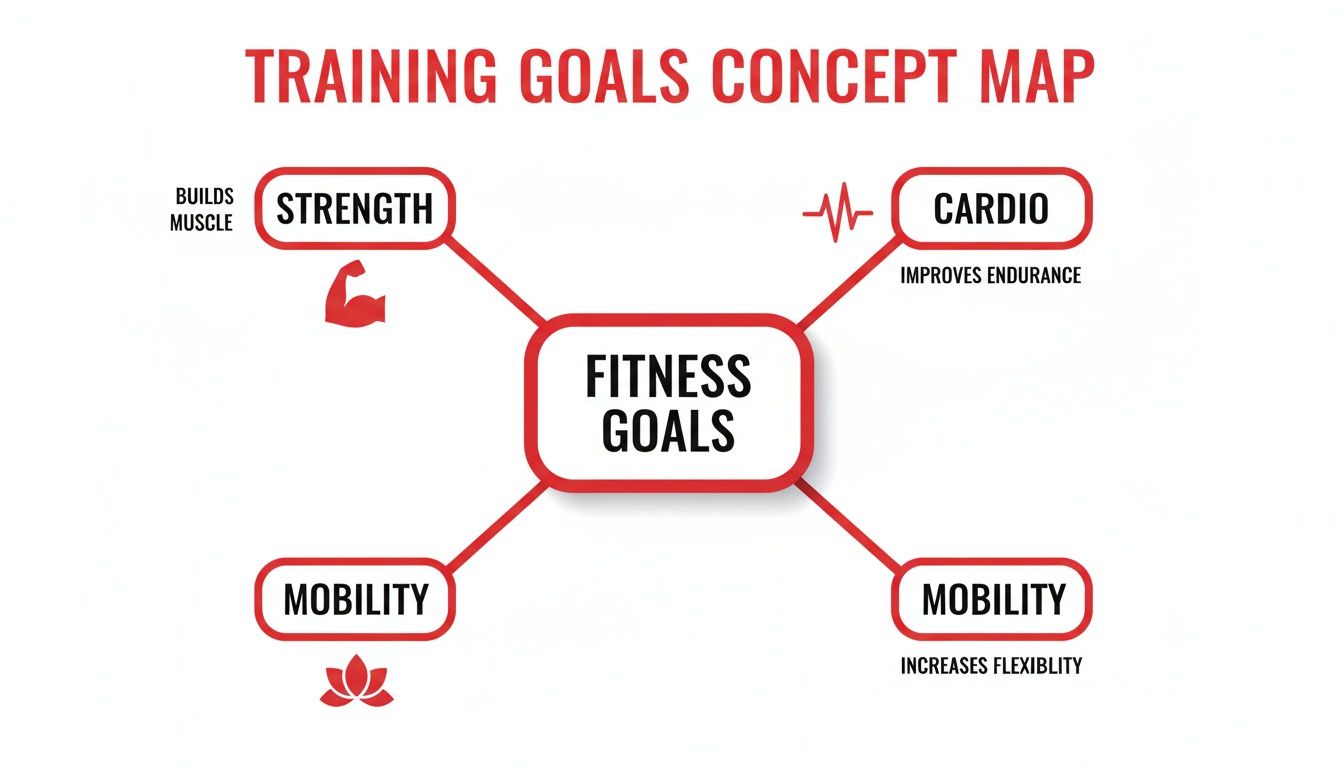
As you can see, while some tools are highly specialized, versatile pieces like resistance bands are true all-rounders, supporting every aspect of a well-rounded fitness plan.
The Critical Importance of Material Quality
When it comes to equipment that’s constantly being stretched and pulled, material quality is absolutely non-negotiable. We've all heard the horror stories of cheap, single-molded resistance bands snapping mid-exercise—a surefire way to get injured. In contrast, high-quality bands are made from durable, layered latex, a construction that makes them exponentially stronger and longer-lasting.
Think about the difference between a single piece of thread and a thick, woven rope. That layered construction means that even if a tiny micro-tear develops on one layer, the other layers are there to hold things together, preventing a sudden and dangerous break. When you're shopping, always look for bands made from 100% natural latex with this layered build.
This focus on quality extends to all your other home workout essentials, too.
- Heavy Jump Ropes: The best ones have solid, ergonomic handles that won't slip out of your hands when you start sweating. The rope itself should be a durable polymer blend that doesn’t fray easily, and the connection points should have smooth ball bearings for a frictionless, tangle-free rotation.
- Battle Ropes: A top-tier battle rope is woven from a tight poly-dacron blend that stops it from shedding fibers all over your floor. A protective nylon sleeve covering the rope is a game-changer, as it dramatically reduces the wear and tear from friction.
Making these material features a priority means your gear will be ready to perform, day in and day out. For a closer look at what separates the good from the great, check out our guide on finding the best home gym equipment brands.
Your Phased Home Gym Buildout Plan
Building a home gym is a journey, not a sprint. You don’t need to buy everything at once or drop a small fortune to create a space that delivers incredible results. The smartest way to go about it is a phased approach, letting you make strategic, affordable investments over time as your commitment and strength grow.
This method takes the financial pressure off and gives you time to really master each piece of equipment before you add something new. Think of it like leveling up in a game: you start with the basics, get good with them, and then unlock more advanced tools. We’ll break this down into three simple, budget-friendly phases.
Each stage builds on the last, so every dollar you spend adds a new layer of capability to your training. This turns the overwhelming idea of a "home gym" into a manageable, exciting project.
Phase 1: The Foundation (Under $100)
This is where it all begins. For less than what you’d pay for a couple of months at a commercial gym, you can get the core home workout equipment essentials that unlock hundreds of different exercises. The goal here is versatility—finding tools that can hit strength, cardio, and mobility all at once.
Your first move should be to grab two high-impact items that offer the most bang for your buck. These are the undisputed champions of foundational fitness gear.
- A Quality Set of Loop Bands: Consider these your all-in-one strength solution. They're perfect for waking up your glutes, working on shoulder stability, and adding a challenge to bodyweight moves like squats and push-ups.
- A Heavy Jump Rope: Forget those flimsy speed ropes from gym class. A weighted jump rope turns a simple cardio exercise into a full-body conditioning blast, firing up your core, shoulders, and back.
With just these two pieces, you have everything you need for effective, full-body workouts. You can build a solid base of strength, ramp up your cardio, and start locking in a consistent workout habit right at home.
Phase 2: The Strength Builder ($100 to $250)
Once you’ve got a consistent routine going with your foundational gear, it’s time to add tools specifically for building serious strength and speeding up recovery. This phase is all about layering on intensity and hitting your muscles in new ways.
You're now shifting from general fitness to targeted strength development. This is where you’ll start to see significant gains in muscle and power.
This progressive approach is catching on. In North America, which is expected to command a 37.46% global share of the home fitness market by 2025, it’s becoming the new standard. With a market valued at USD 4.83 billion, the trend is fueled by rising health awareness and a residential construction boom that has spurred the inclusion of dedicated 'fitness rooms' in 30% more households. Learn more about the at-home fitness equipment market trends.
Here’s what to add to your collection next:
- A Complete Pull-Up Band Set: These thicker, longer bands are your ticket to mastering pull-ups—one of the best upper-body exercises on the planet. They can also add hundreds of pounds of variable resistance to big lifts like squats and deadlifts without needing a single weight plate.
- Floss Bands: Think of these as your secret weapon for recovery and mobility. By using compression to improve joint movement and blood flow, floss bands help you bounce back faster, reduce soreness, and deal with nagging aches before they turn into real injuries.
This phase gives you what you need to tackle advanced bodyweight movements and add serious resistance to your training, pushing you right past those frustrating plateaus.
Phase 3: The Conditioning Powerhouse ($250+)
In this final phase, you bring in the game-changer—a piece of equipment dedicated to elite-level conditioning. You’ve built your foundation and added strength tools; now it’s time to unlock maximum power and metabolic endurance.
This is where you invest in a specialized tool that delivers the kind of high-intensity workout you'd normally find at a performance training center. Your final core purchase is a battle rope.
A battle rope is one of the most effective tools out there for building raw power, explosive strength, and cardiovascular endurance all at the same time—and with zero impact on your joints. It's a low-risk, high-reward investment that truly rounds out your home gym, giving you a complete setup that rivals many commercial facilities. With this final piece, your phased buildout is complete, leaving you with a versatile, powerful, and comprehensive home training sanctuary.
Setting Up Your Workout Space for Success
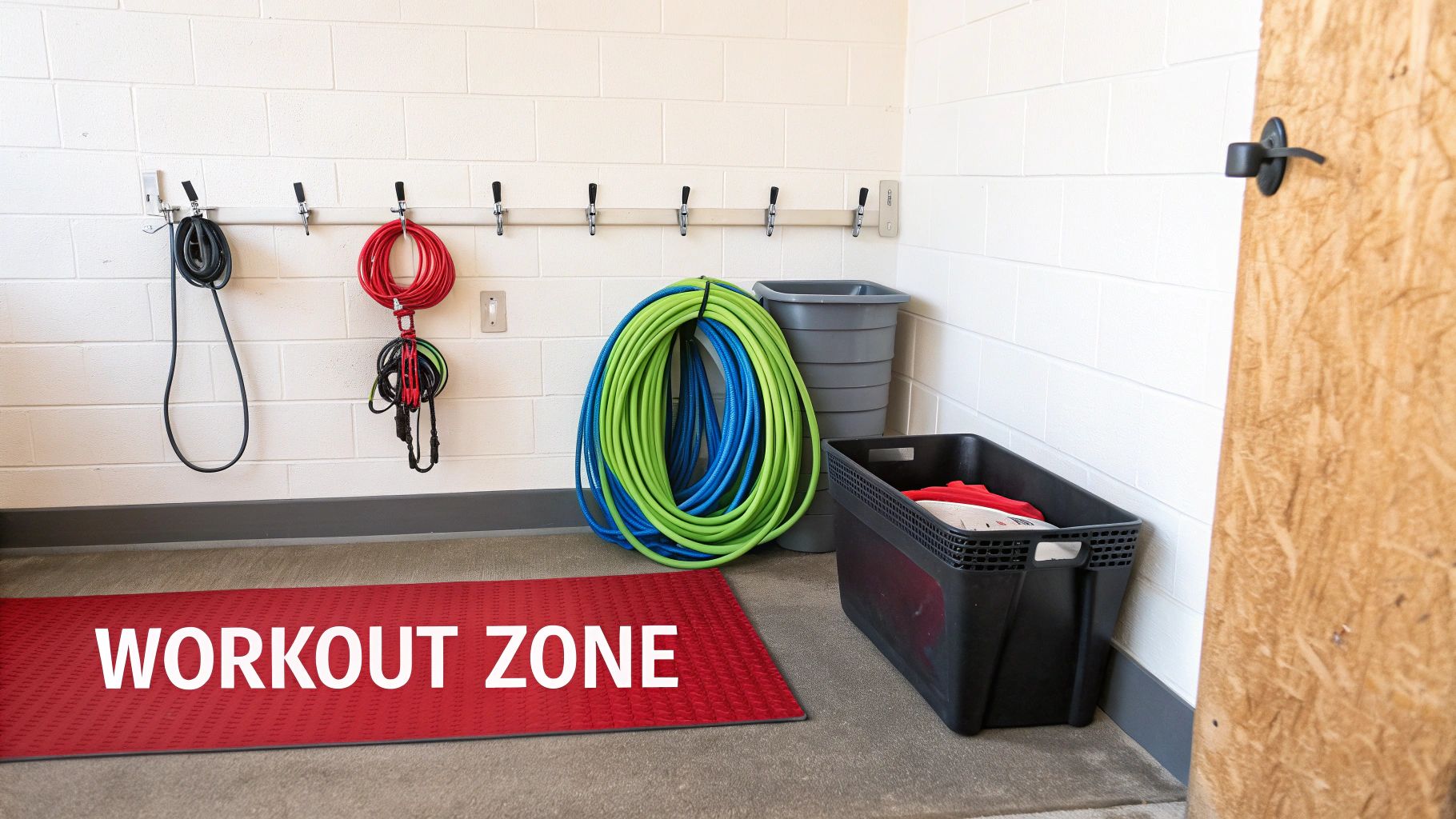
The best home gym isn't the one with the most expensive machines—it's the one you actually use. The real secret to building a consistent routine is creating a space that’s functional and inviting. Your main goal should be to eliminate every possible excuse between the thought, "I should work out," and actually getting started.
Think of it like a chef's kitchen. If everything is buried in drawers and hard to find, cooking feels like a chore. But when your knives are sharp and your spices are within reach, you feel ready and inspired. The same exact principle applies to your home workout equipment essentials.
Maximize Your Space with Smart Storage
You don't need a spare bedroom to create an effective workout zone. Honestly, even a small corner of your apartment can work wonders if you get clever with storage. The trick is to keep your equipment accessible but out of the way, so it doesn't just turn into stressful clutter.
Smart storage is all about thinking vertically and using those often-ignored nooks and crannies. Instead of letting your gear become a tripping hazard, give every piece a proper home. This keeps your space tidy and protects your equipment from getting damaged.
- Wall-Mounted Hooks: A game-changer for hanging resistance bands, tube bands, and jump ropes. They stay off the floor, don't get tangled, and are easy to grab and go.
- Under-Bed Bins: Those low-profile plastic bins are perfect for stashing gear you don't use daily, like battle ropes or floss bands. Completely out of sight, out of mind.
- A Dedicated Basket or Crate: Sometimes the simplest fix is the best one. A nice-looking basket can hold your loop bands, workout chalk, and other small accessories, keeping them all in one spot.
If you're looking for more ways to make your limited space work, check out these creative small space home gym ideas.
Critical Setup and Maintenance Tips
Once you've got your gear organized, a few quick setup checks are crucial for making sure your workouts are safe and effective. Before you jump into your first session, just take a minute to look around. This simple habit can save you from injuries and protect your home from accidental dings and scrapes.
A well-maintained workout space is a safe workout space. Taking just five minutes a week to inspect your gear and environment can extend the life of your equipment and prevent mishaps before they happen.
Make sure your setup actually supports the kind of training you plan to do:
- Check Your Clearance: Before you start swinging a heavy jump rope or slamming a battle rope, do a quick check for overhead and side-to-side space. A quick practice swing can prevent a smashed light fixture or a scuffed wall.
- Find a Secure Anchor: When you’re using pull-up bands for assisted moves or rows, always use a solid anchor point. A dedicated pull-up bar or a wall anchor is infinitely safer than a doorknob, which can easily snap off under tension.
- Inspect Your Gear Regularly: Get into the habit of giving your resistance bands a quick once-over, looking for any small nicks, tears, or signs of wear. Wipe down your jump rope handles to keep them from getting grimy. A little bit of care ensures your home workout equipment essentials stay safe and effective for years to come.
Sample Routines to Put Your New Gear to Work
Alright, you’ve got the tools. Now it's time to make them work for you. Having great gear is one thing, but knowing how to put it all together for a truly effective workout is where the magic happens. This is the fun part—where we turn all that potential into real results.
I've put together three of my favorite routines to get you started right away. They're straightforward, powerful, and each one hits a different fitness goal. You'll quickly see just how much you can accomplish with a few carefully chosen pieces of equipment.
Let's get after it.
20-Minute Full-Body HIIT Blast
If you're short on time but want to scorch as many calories as possible, this is your workout. We're pairing the all-out effort of a heavy jump rope with the targeted burn of loop bands. The combination creates a massive metabolic ripple effect that will have you burning calories long after you've cooled down.
What You'll Need: Heavy Jump Rope, Loop Bands
How to Do It: Go all out for the prescribed time on each exercise, then immediately jump to the next one. Once you've completed all four moves, take a well-deserved 60-second rest. Your goal is to repeat the entire circuit four times.
- Heavy Rope Skips: 60 seconds of intense work
- Loop Band Glute Bridges: 30 seconds (Slip the band just above your knees and drive those hips up)
- Loop Band Squat Walks: 30 seconds (Keep the band above your knees and stay low as you step side-to-side)
- Plank Jacks with Loop Band: 30 seconds (Band goes around your ankles for this one)
This kind of high-intensity interval training (HIIT) is brutally effective for a reason. Research shows HIIT can incinerate 25-30% more calories than slogging through traditional cardio for the same amount of time. It's the ultimate workout for a packed schedule.
30-Minute Strength Circuit
Ready to forge some real, functional strength? This circuit is designed to hit every major muscle group using nothing but resistance bands. The variable resistance from pull-up and tube bands challenges your muscles through every inch of the movement, which is fantastic for building solid muscle without touching a single weight.
What You'll Need: Pull-Up Bands, Tube Bands with Handles
How to Do It: Finish all the reps for one exercise before you move on to the next. After you’ve powered through the whole circuit, rest for 90 seconds. Then, dig in for two more rounds, completing three in total.
- Assisted Pull-Ups (or Banded Rows): 8-12 reps
- Banded Push-Ups: 10-15 reps (Drape a band across your upper back, anchoring the ends under your hands)
- Tube Band Squats: 15 reps (Stand on the middle of the band and hold the handles up at shoulder height)
- Tube Band Bicep Curls: 12-15 reps
- Tube Band Triceps Extensions: 12-15 reps (Anchor the band high and press down)
- Banded Good Mornings: 15 reps (Loop a pull-up band under your feet and carefully around the back of your neck)
15-Minute Mobility and Recovery Flow
Your workout doesn't end with the last rep. True fitness includes taking care of your body so it can come back stronger. This quick flow is all about improving how your joints move, easing muscle soreness, and kicking your recovery into high gear. Floss and loop bands are amazing tools for this, helping to break up stiffness and restore smooth, pain-free motion.
What You'll Need: Floss Bands, Light Loop Bands
How to Do It: Move with purpose and control. Don't rush these. Pay attention to your breathing and how your muscles and joints feel.
- Ankle Flossing: Wrap one ankle tightly with a floss band. Gently make 20 circles with your ankle in each direction, then do 20 flexes (pointing your toes up and down). Unwrap and switch sides.
- Knee Flossing: Wrap the floss band around your knee. Slowly perform 15-20 bodyweight squats, just focusing on moving through a smooth, comfortable range of motion. Remove the band and repeat on the other leg.
- Loop Band Shoulder Dislocates: 15 reps (Hold a light loop band with a wide grip and slowly pass it from front to back over your head)
- Loop Band Clamshells: 20 reps per side (Place the band just above your knees, lie on your side, and open and close your top leg)
- Cat-Cow Stretch: 10 slow, deep cycles to finish
Got Questions? We've Got Answers
Stepping into the world of home workouts can bring up a few questions. That's perfectly normal. Let's clear up some of the most common ones so you can feel totally confident getting started.
How Do I Pick the Right Resistance Band?
When you're just starting out, the best advice is to begin with a lighter band than you think you need. Seriously. The sweet spot is a resistance level that lets you perform 12-15 reps with clean, controlled form.
Those last couple of reps should feel like work, but not an impossible struggle. If you're breezing past 15 reps without breaking a sweat, it's a clear sign you’re ready for the next level up. The goal here is mastering the movement and feeling the right muscles fire up, not just yanking on the heaviest band you can find.
Can You Really Build Muscle with Just Bands?
Yes, you absolutely can. Building muscle all comes down to one key principle: progressive overload. It just means you have to consistently make your muscles work harder than they're used to. Resistance bands are fantastic for this.
The further you stretch a band, the more tension it creates. This forces your muscles to engage and fight against that increasing resistance through the entire movement. It's a unique challenge you just don't get with free weights.
Think about it this way: by moving up to stronger bands or even combining a few, you can easily create hundreds of pounds of force. That’s more than enough resistance to trigger serious muscle growth, all without a single dumbbell in sight.
If I Can Only Buy One Thing, What Should It Be?
Hands down, a quality set of loop resistance bands gives you the most bang for your buck. They are the swiss-army knife of home fitness. No other piece of gear is as versatile.
With just a set of bands, you can cover all your bases:
- Strength Training: They can add a serious challenge to foundational movements like squats, lunges, and rows.
- Mobility Work: Perfect for warm-ups, they're great for waking up those small, stabilizing muscles in your hips and shoulders.
- Rehabilitation: Their smooth, consistent tension is ideal for gentle, controlled movements that help you recover safely.
For their tiny footprint and affordable price, nothing else even comes close. For a deeper dive, feel free to explore our full list of frequently asked questions on our website.
Ready to build the home gym you’ll actually use? The team at MONFIT has put together a collection of durable, high-performance equipment designed to help you get real results. Start building your perfect setup today by exploring our full range of products at https://monfitness.com.
